The FinOps Foundation changed its mission statement in 2026. Here, Virtasant’s Head of Product and CTO break down the 5 most critical findings from the 2026 State of FinOps report.
Key Points:
- AI spend management jumped from 31% to 98% of FinOps teams in just two years.
- The biggest cost decisions are made before resources are provisioned, not after.
- Many organizations now fund AI investments directly from FinOps optimization savings.
The FinOps Foundation has tracked the discipline it helped create since 2020. For six years, its mission stayed the same: “Advancing the people who manage the value of cloud.” This year, after surveying 1,192 practitioners representing more than $83 billion in annual cloud spend, the Foundation changed its mission for the first time: “Advancing the people who manage the value of technology.”
“The discipline expanded because the rigor of optimization is so nuanced; when you find principles that work, they become relevant across the entire technology landscape, not just public cloud.”
—Rajeev Laungani, Head of Product, Virtasant
Far from a casual change, the word swap is a signal that “cloud” doesn’t match the work that’s being done anymore. The FinOps Foundation’s State of FinOps 2026 report reflects compelling data behind that signal. And for enterprise technology leaders, it carries implications that extend well beyond FinOps teams.
"FinOps hasn't evolved gradually," says Rajeev Laungani, Head of Product at Virtasant and a member of the FinOps Foundation. "It's been pulled forward by the pace of AI, SaaS sprawl, and executive demand for accountability. The discipline expanded because the rigor of optimization is so hard; when you find principles that work, they become relevant across the entire technology spectrum."
Jon Thompson, CTO of Virtasant, echoes that view. "As a business, you don't want different reports for different environments," he says. "You want a single pane of glass. You want to make the right decisions across the board."
Here, we cover five standout findings from the foundation’s report. Together, they tell the story of a discipline that’s outgrown its original mandate. Through AI adoption, executive demand, and the sheer complexity of modern technology spend, FinOps practitioners have been handed a much larger responsibility.
#1: AI Spend Expands from Experiment to Everywhere
Two years ago, 31% of FinOps teams managed AI spend. Today, 98% are expected to do so within the next year. That scope transformation has arrived faster than many teams were prepared for.
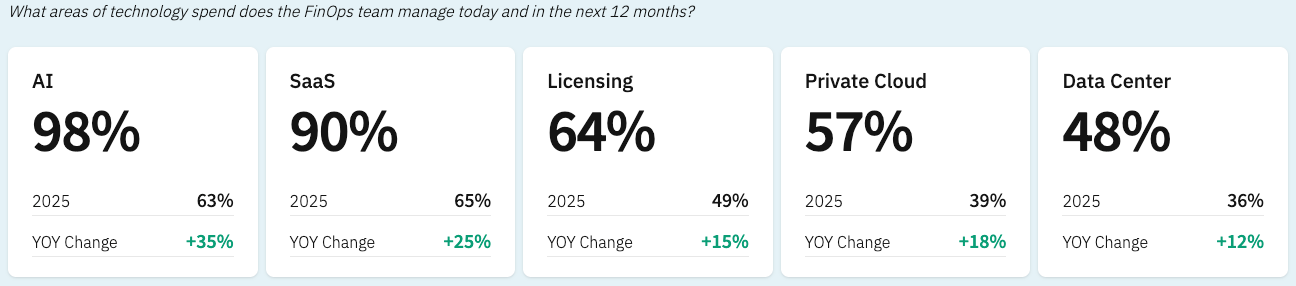
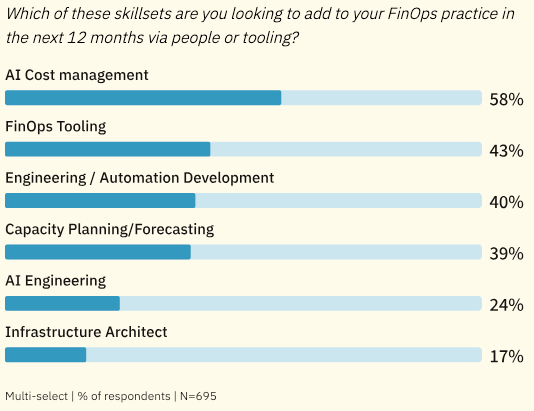
The report also names AI cost management as the single most desired skillset practitioners want to add in the next 12 months. But that coincides with several challenges. For one, AI pricing models based on tokens, inference requests, and GPU utilization don't map cleanly onto billing frameworks built for traditional infrastructure.
"AI is forcing FinOps to answer a harder question," Laungani says. "It's not ‘what did we spend?’, it's ‘what did we actually get out of that spend?’ The hardest part of AI isn't building it, it's proving it was worth it. Without attribution, AI spend is just a growing line item. Insight is what turns it into an investment."
Thompson points to a more immediate operational problem. "It's very easy for application teams to run up very large bills very quickly," he says. "Even some of the basic best practices of FinOps, like shutting down unused capacity, are amplified in the AI world. You're talking about individual resources that can cost a hundred dollars an hour or more each. It doesn’t take long for that to eat up a budget."
“We see customers where AI spend has exceeded their entire legacy data platform budget,” Laungani echoes. “Leadership can't break down a cost by model, team, or use case," he says. "The easiest way to start governing it is the simplest: what models are being used, and why are we using a more intricate model for simple tasks? Build a foundational map of AI use cases before you try to optimize anything."
“The basic best practices of FinOps are amplified in the AI world. You're talking about individual resources that can cost a hundred dollars an hour or more each. It doesn’t take long for that to eat up a budget.”
—Jon Thompson, CTO, Virtasant
The report also notes that many organizations are now being asked to use efficiency gains from cloud cost reduction to create budget room for AI spend. Laungani sees this playing out differently depending on organizational maturity. "Some technology executives we work with are fully on board with AI; as long as they have a viable business case, they're setting a budget aside for it. But for scaling enterprises and middle-market organizations, every dollar in their budget is an advantage. Those teams are weaponizing their cloud spend, fully charging it back to business units and using anything from cost optimization as a budget for innovation."
A secondary benefit of this dynamic, Thompson says, is incentivization. "One of the challenges with FinOps has always been getting action taken," he says. "You may have great optimization ideas, but the dev team has features to ship and a production system to keep stable. Suddenly, you've got another incentive."
#2: FinOps Scope Expanded Whether Teams Were Ready or Not
One practitioner in the report captures the experience on the ground: "First, they asked us to fix cloud. Then fix the software mess. Now it's fix the contract and license mess, now fix the data center."
According to Laungani, FinOps became the default owner of this complexity because it was the only function already built to handle it. "Every new spend category starts the same way: zero visibility, fragmented ownership, and increasing executive pressure. FinOps maturity isn't just scaling. It's constantly restarting the maturity cycle across new domains."
There’s sometimes an assumption that what worked in public cloud will transfer cleanly when scope expands. But that’s something Thompson flags. "People sometimes underestimate the differences," he says. "There are great ideas from FinOps, and some elements are directly translatable. But in other environments, the data is not as clean, not as readily available, not as standardized. A lot of it is specific to individual organizations. It might all be spreadsheet-based. People think, ‘Oh, you're doing it for cloud, it'll be easy for you to take on this extra thing,’ and don't realize quite what's involved."
“FinOps maturity isn't just scaling. It's constantly revamping the maturity cycle across new domains.”
—Rajeev Laungani, Head of Product, Virtasant
Thompson’s recommendation to leaders overseeing FinOps teams that are absorbing new scope: slow down before setting expectations. "Do an initial fact-finding before you set any concrete timelines. Let the team go and understand the space first," he stresses.
#3: FinOps Is Moving into the C-Suite
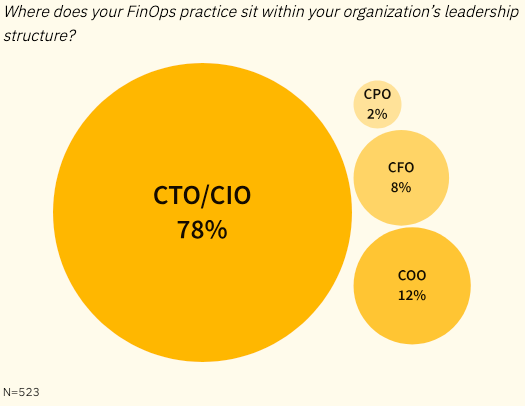
78% of FinOps practices now report to the CTO or CIO, up 18% from 2023. The discipline has moved from a finance-adjacent function to a technology leadership function, and that’s a positive for FinOps practices.
Practitioners with VP, SVP, or C-suite engagement are two to four times more likely to influence technology selection decisions than those with only director-level sponsorship. The gaps in how practitioners are able to influence decisions are significant: 53% versus 12% in cloud service selection, as one example.
The report also notes that FinOps leaders are increasingly being pulled into strategic provider negotiations, multi-year investment decisions, and technology due diligence in mergers and acquisitions. "FinOps has the insights into commitment strategy, and the structure of those commitments, at a technical level," Laungani says. "Because the data and insights are best served from the FinOps arm, executives are beginning to trust FinOps teams more and more in vendor management."
That trust, he argues, now requires a new kind of practitioner. "You can no longer get away with being an engineer who understands the cost components of cloud. You need to understand deal structuring, how aggressive or conservative you can be in negotiations, what similar enterprises with similar run rates are getting, and how to make that case to the provider. Those soft skills aren't advertised in FinOps job descriptions, even at the director level. But they're the hidden differentiator for those who are successful in the vendor management arena."
#4: AI Value Attribution Is an Unsolved Problem
Visibility into AI costs is the top challenge practitioners cite when applying FinOps to AI spend, followed by allocating those costs to business units and determining AI ROI. The top tooling request in the entire survey is granular monitoring of AI spend: tokens, LLM requests, and GPU utilization. Practitioners are saying, explicitly, that commercial tooling has not yet delivered this at scale.
Finding a solution, Thompson explains, is harder than it sounds. "Even getting clarity on relatively basic metrics, like the number of tokens being used, works differently in different areas. It's very fragmented across providers and even across services within a single provider."
He also surfaces an underlying tension between optimization and data privacy. "Really, the only way to understand whether you're using an AI service efficiently is to look at the prompts and the responses. But that’s potentially sensitive data. As a FinOps team, are you going to be able to see the chat logs between a patient and a doctor, for example? That's an organizational challenge people will face more; you need to look inside the black box."
Laungani connects the attribution problem back to where FinOps has always started: visibility first. "You have to build foundational mapping before you can optimize. What are the AI use cases, which models are being used for which purposes, and what does the simplest level of visibility look like, whether that's tokens or GPU usage? You can't optimize what you can't see."
#5: Optimization Is Table Stakes
Waste reduction and workload optimization remain the top current priority for FinOps teams across SMB, enterprise, and large enterprise organizations. Yet mature practitioners describe diminishing returns on traditional approaches. “We have hit the ‘big rocks’ of waste,” said one practitioner in the report, “and now face a high volume of smaller opportunities that require more effort to capture.”
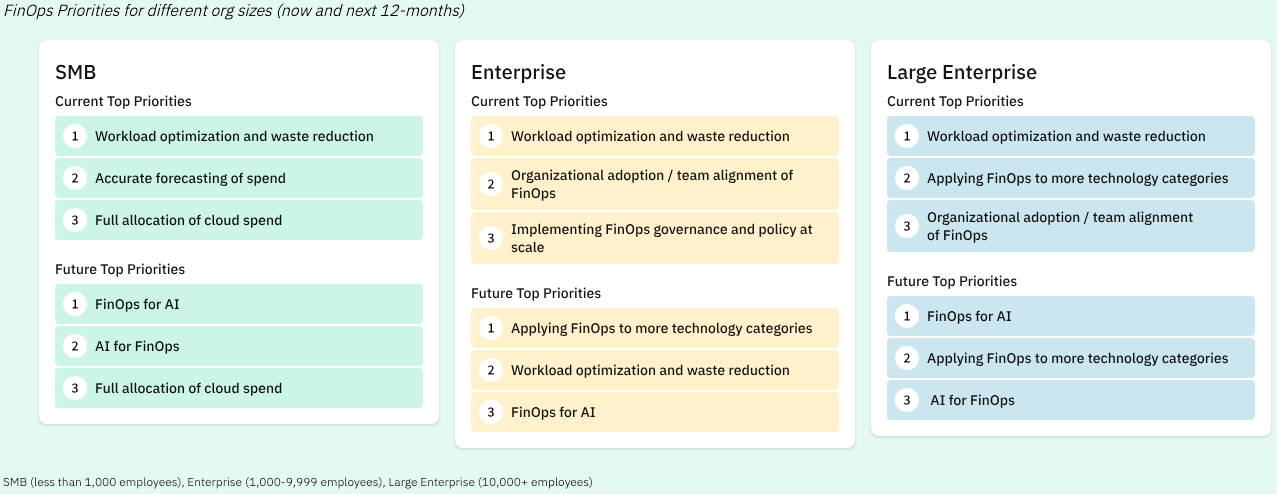
"Waste reduction is still a priority, but it's no longer differentiating," Laungani explains. "The next phase is a lot broader and a lot more strategic. We're moving from optimization to pre-deployment economics. How do we get FinOps upstream into architecture and product decisions, cost modeling before anything is built, design trade-offs between performance and cost, and scalability? The history of FinOps has taught us that the biggest cost decisions are made before resources are provisioned.”
“There are always new services and new ways of using them. Just because you know how to keep on top of what was there yesterday doesn't mean you know how to manage what's there today.”
—Jon Thompson, CTO, Virtasant
Laungani describes a three-part optimization evolution he's seeing with Virtasant's clients:
- Embedding financial modeling before infrastructure decisions are made.
- FinOps is increasingly the function that points to where to spend, not just where to cut.
- Expanding FinOps to total technology spend governance: longer-term architectural decisions with a five-to-seven-year investment horizon.
Thompson adds a caution that mature organizations often overlook. "Don't get complacent. We've seen organizations that have had great success because of senior sponsorship, and they lose focus. Some of the old waste creeps back in. There are always new services and new ways of using them. Just because you know how to keep on top of what was there yesterday doesn't mean you know how to manage what's there today."
FinOps Looks to the Future
The FinOps Foundation’s report reflects an expansive future, and FinOps practitioners are rising to the occasion, benefiting organizations in new and nuanced ways. AI spend governance has gone from niche to universal in two years. Scope has expanded across SaaS, licensing, private cloud, and data center. FinOps decisions are now anchored in technology leadership. Overall, this puts FinOps in an optimistic position, poised to best its most difficult challenges.
"The maturation of FinOps will only continue,” Laungani says. It could expand even outside of technology, into raw materials, into anything."
"The FinOps world is going to continue to grow,” Thompson explains. “There are elements that a year ago we didn't know would exist and certainly didn't think FinOps would cover. I'm sure that will continue."
What is the FinOps Foundation's new mission statement, and why did it change?
The FinOps Foundation updated its mission from "Advancing the People who manage the Value of Cloud" to "Advancing the People who manage the Value of Technology" in 2026. The change reflects practitioners expanding beyond public cloud into AI, SaaS, licensing, private cloud, and data center, driven by executive demand for accountability across all technology spend.
How fast has AI spend management grown within FinOps practices?
Two years ago, 31% of FinOps teams managed AI spend. Today, 98% do. The State of FinOps 2026 report, based on 1,192 respondents representing more than $83 billion in annual cloud spend, identifies AI cost management as the single most desired skillset practitioners want to add in the next 12 months.
Why does executive alignment matter so much for FinOps teams?
78% of FinOps practices now report to the CTO or CIO, up 18% from 2023. Practitioners with VP or C-suite engagement show dramatically more influence over technology selection decisions—including cloud service selection, provider selection, and cloud versus data center placement—than those with only director-level sponsorship.
What is the biggest unsolved problem in FinOps right now?
AI value attribution. Visibility into AI costs is the top challenge practitioners report, followed by allocating those costs to business units and determining ROI. The top tooling request in the entire 2026 survey is granular monitoring of AI spend (tokens, LLM requests, and GPU utilization), which commercial tooling has not yet delivered at scale.
Has traditional cloud cost optimization run its course for mature FinOps practices?
Its role is narrowing. Mature practitioners report diminishing returns on traditional waste reduction. The discipline is shifting toward governing how technology investments are planned and valued before commitments are made, not just how costs are reduced afterward. Still, experts caution practitioners to avoid complacency.


.svg)