Learn how private cloud FinOps extends proven cost management practices beyond public cloud, delivering 20-30% savings through visibility, accountability, and optimization.
Organizations adopting FinOps principles can lower cloud costs by 20-30%. These strategies are also applicable to private cloud environments. Keep reading to explore how FinOps can optimize your private cloud infrastructure effectively.
Key Points:
- Hybrid environments can create fragmented visibility into IT spending, while unifying public and private FinOps creates cohesion.
- FinOps principles successful in public cloud apply to private cloud, with some translating directly and others requiring adaptation for fixed infrastructure.
- The FinOps Framework provides standardized processes and community best practices for private cloud management.
"I think this FinOps framework gives you a roadmap, your guardrails, and it tells you the way you can navigate within this system. The Foundation has brought us a common language to talk about these things, even if they always existed in private cloud. We've now got terminology to use, and through the community and best practice sharing, it can help us improve private cloud as well." —Dr. Maneesha Asundi, Principal IT Product Manager of Mr. Cooper
Consider this scenario. A Fortune 500 CFO receives two IT cost reports each month. The first is an automated dashboard showing public cloud spending. It includes granular, service-level visibility and near real-time data in a consistent, standardized format. The second is a manual spreadsheet for private cloud infrastructure with high-level aggregated costs, limited detail, and a custom structure that changes based on who compiled it, making apples-to-apples comparison nearly impossible.
When the CFO asks her CIO for a unified view of total IT spending, he explains the challenge. They use completely different management frameworks for each environment. The public cloud team operates with FinOps principles, while the private cloud team relies on legacy procurement processes and manual reporting.
This split creates a critical blind spot for leadership trying to understand where money goes and where to invest next.
Before public cloud, organizations managed IT costs through traditional procurement and budgeting processes in their private data centers. The emergence of public cloud transformed this landscape, bringing unprecedented flexibility and complexity to cost management. As public cloud adoption grew, FinOps emerged as a discipline to tackle these new financial challenges. Today, public cloud teams operate with FinOps practices while private cloud teams often use legacy frameworks. Without active management across both environments, businesses miss significant optimization opportunities.
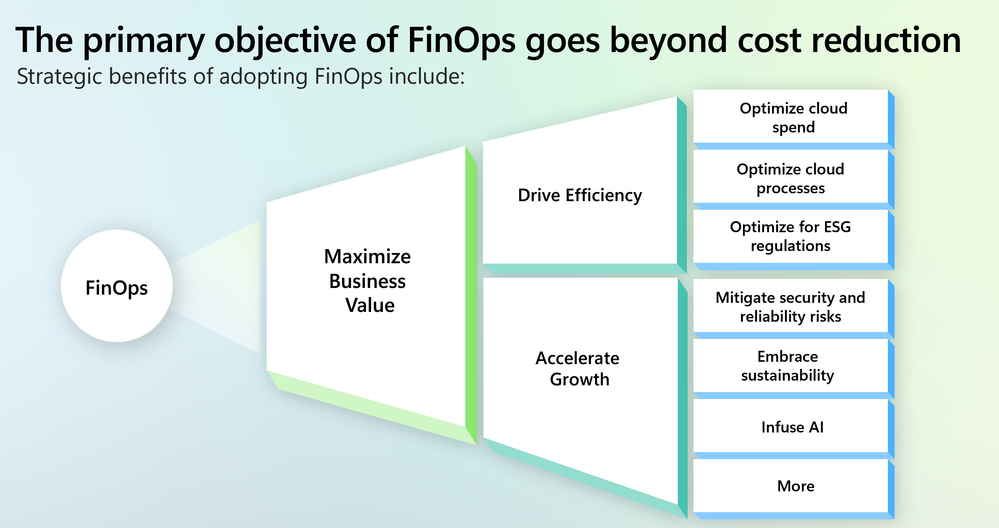
To create a unified approach, IT leaders need shared frameworks, processes, tools, and resources that bridge these traditionally separate domains. The good news is that the principles that made FinOps successful in public cloud environments—visibility, accountability, and optimization—can be effectively applied to private cloud systems. Organizations can achieve 20-30% cost reduction by extending these proven practices beyond the public cloud.
The Challenge: Translating Public to Private
Executives want to capitalize on the opportunity that private FinOps offers. J.R. Storment, Founder and Executive Director of the FinOps Foundation, captures this trend: "Once folks get good at public cloud, the business often says, 'Hey, we really like what you're delivering in terms of real-time visibility, anomaly detection, quick access to data, and the ability to allocate and optimize better. Can we have those same capabilities in other areas?"
Business leaders who experience detailed public cloud cost breakdowns naturally start demanding the same level of insight for private cloud environments.
The challenge lies in understanding how FinOps principles translate. Private cloud operates in fundamentally differently ways than public cloud. Public cloud uses on-demand scaling with pay-as-you-go pricing. But private cloud relies on fixed, upfront investments in servers and hardware. This distinction changes how FinOps principles apply. In public cloud, you reduce resource size and immediately pay less. In private, hardware costs are already sunk, so using less of a resource doesn't reduce your cost. The savings come when you can use that freed-up capacity for something else, rather than needing to buy new hardware.
This challenge isn't new to those of us working in the FinOps space. When I spoke at FinOps X 2024 about FinOps practices across public and private cloud environments, I emphasized how essential it is for organizations to enable FinOps practices to be shared and applied across various settings. For private cloud, organizations have often been left to manage on their own; occasionally, cross-fertilization of ideas would happen when someone moved from one firm to another. But generally, companies had to create their own solutions. This created a lack of standardized frameworks and no community sharing best practices.
FinOps Solves the Cost Model Puzzle
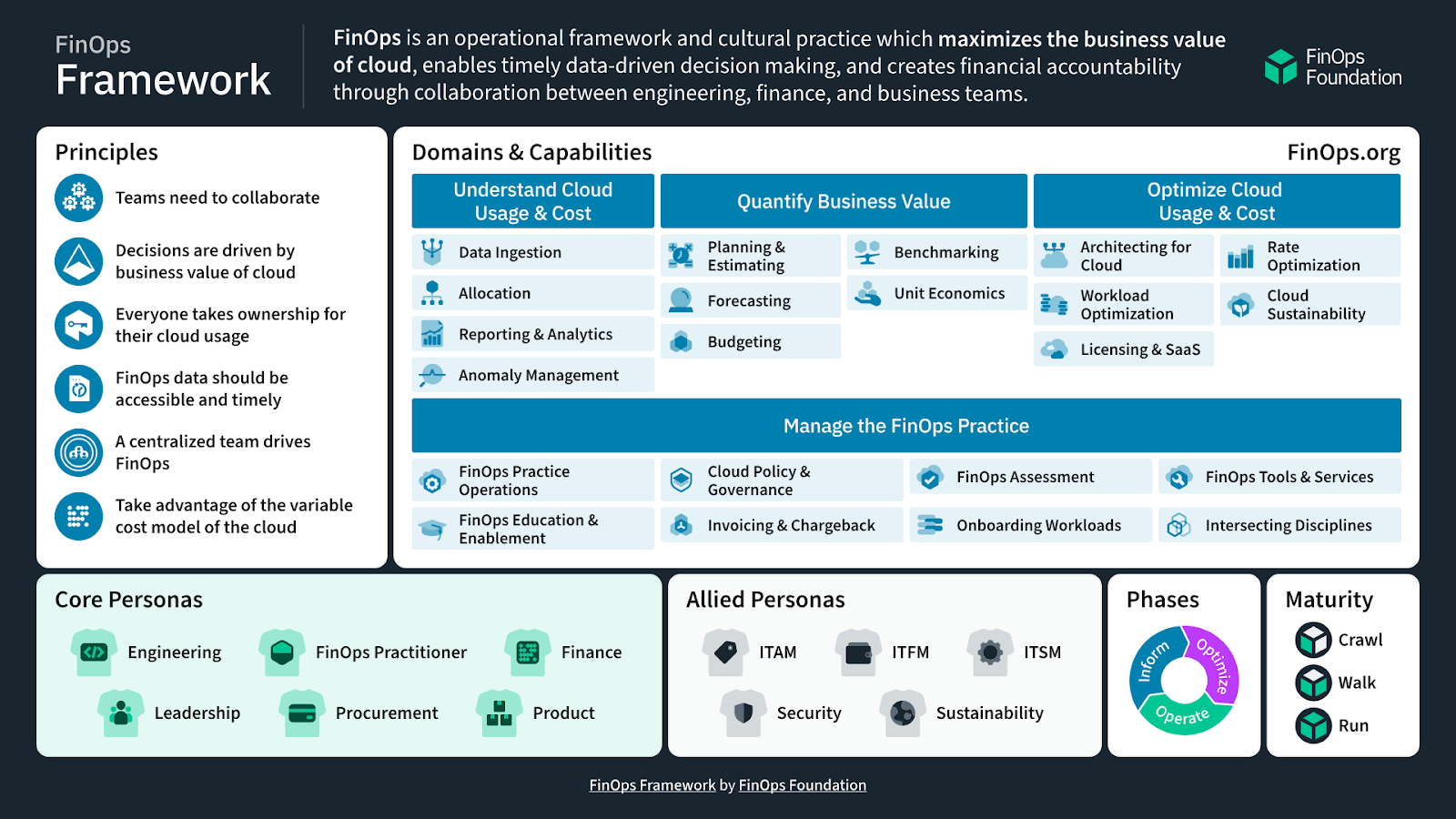
Organizations need a unified view of all IT expenses—whether cloud services, private cloud infrastructure, or SaaS. Without this clarity, opportunities to optimize and reduce costs get missed. This is where frameworks become critical. The FinOps Framework provides a structured approach that helps translate cloud-based insights to private cloud settings.
"If you take a step back of what [are the essential elements of FinOps principles], it's about connecting business and finance folks together, it's about accountability, and it's about really driving maximum business value. I think those three different areas are something that you can take to any offering, whether it be a cloud offering, or whether it be another SaaS offering." —Alee Whitman, Sr. Staff Product Engineer (Cloud), Walt Disney Company
FinOps principles applied to private cloud are about more than just technology. They empower teams to take ownership of IT spending and drive continuous improvement. Over 72% of FinOps practitioners use increased visibility to establish a cost-conscious culture. Bryan Valko, executive vice president at Xosphere, explains that the heart of FinOps principles is the "inform" pillar, which supports informed decision-making and helps businesses optimize budgeting, forecasting, and resource allocation. Breaking down silos between finance, IT, and business units fosters a cost-conscious culture. With real-time insights through analytics and reporting tools, organizations can make smarter decisions, mitigate risks, and seize opportunities.
How Organizations Make FinOps Work
The question is how to adapt FinOps principles effectively. We've seen three strategies emerge from organizations successfully implementing these practices for private cloud.
1. Building Unified Visibility
The first challenge organizations tackle is fragmented data. Each environment generates different billing formats at different times, making unified reporting nearly impossible with traditional approaches.
The solution starts with the FinOps Framework. Dr. Maneesha Asundi, Principal IT Product Manager at Mr. Cooper (a major American mortgage lender and servicer), describes it as "an operating framework and a cultural practice" with four distinct elements—it maximizes business value, provides timely data, fosters collaboration, and enables financial accountability. These principles prove equally valuable for private cloud. Organizations gain a common language across environments. Managing costs beyond public cloud has risen significantly in priority for FinOps practitioners according to the 2025 State of FinOps report, moving up five places in importance. Many FinOps tools can integrate data from various IT systems, creating the "single pane of glass" unified view business leaders demand.
2. Adapting Optimization and Oversubscription Strategy
The second strategy involves rethinking how optimization works in private cloud. This requires understanding a fundamental difference in how resources get allocated. Consider how virtualization handles resources in private cloud environments. A physical server with 32 CPU cores might support virtual machines requesting 64 virtual CPUs total. This is called oversubscription—allocating more virtual resources than physical resources exist.
Here's how it works in practice. The virtualization platform continuously monitors actual usage patterns across all VMs. Most VMs use only a fraction of their allocated resources at any given time. When a VM is allocated 32 virtual CPUs but actively uses just 16, the virtualization platform reserves only what's being used. That spare capacity becomes available for other VMs that might need to expand temporarily. The platform manages this through sophisticated scheduling, ensuring all VMs get the resources they need when they need them.
Think of it like an airline overbooking flights—the airline knows from experience that some passengers won't show up, so they can sell more tickets than seats. The system works because everyone rarely needs everything simultaneously.
Most organizations use oversubscription this way, though some configure full reservation, where each virtual CPU claims a physical core exclusively. But if you’re using an oversubscription strategy, you need to think about optimization differently in private cloud. When someone suggests rightsizing a VM from 32 to 16 virtual CPUs in a private cloud environment, the immediate cost savings aren't as clear as they would be in public cloud. The central virtualization team might already be accounting for actual usage through oversubscription ratios. They've configured the system so it only reserves the 16 cores actually being used, even though 32 are allocated to the VM.
Understanding these implications is critical. Private cloud optimization is about understanding actual utilization patterns and ensuring the virtualization platform is configured to make the most efficient use of physical resources.
The same FinOps principles that help with rightsizing in public cloud—like tracking resource usage and optimizing workloads—apply to private cloud environments, but with this adaptation. Organizations identify underutilized hardware, improve resource allocation, and use this optimization to delay costly hardware upgrades. Organizations like Meta have successfully applied FinOps principles to private cloud, enabling cost optimization and enhanced operational efficiency.
Practical Implementation Steps
Organizations apply a practical approach across several key areas:
- Establish centralized repositories for collecting cost and utilization data from private cloud systems.
- Automation pulls data from monitoring tools, CMDBs, and asset management systems to maintain visibility for data-driven cost decisions.
- Develop clear cost allocation models to assign expenses to business units, projects, or applications, ensuring consistent reporting formats across cloud and private cloud environments. This provides the unified view needed for financial accountability.
- For workload optimization, rightsize physical servers and VMs based on actual utilization.
- Consolidate underused resources and explore virtualization or containerization to increase efficiency. Understanding resource allocation patterns and actual usage becomes critical for optimizing private cloud differently than public cloud.
The reality of implementation includes challenges that organizations must acknowledge. Public cloud provides rich data in standard formats automatically. Private cloud often lacks readily available data. Information may sit in manually maintained spreadsheets or organization-specific databases. Organizations must invest in data infrastructure, implement consistent tagging strategies, and establish centralized monitoring. But the payoff justifies the investment.
What Success Actually Looks Like
It's important to be realistic about the translation of FinOps principles to private cloud. Some capabilities transfer directly. Others require adaptation for fixed hardware environments. Yet the fundamental principles remain constant: visibility, accountability, and optimization drive better business outcomes across all infrastructure types.
Return for a moment to our hypothetical CFO receiving fragmented reports. By applying FinOps principles to private cloud, she now gets unified visibility into total IT infrastructure costs.The split between how public and private cloud are managed disappears, replaced by consistent practices across all environments.
Leadership support proves critical for this transformation. Executives must provide the resources (skills, tools, and processes) that enable teams to work effectively across all infrastructure. The FinOps Foundation plays a key role here, offering resources, best practices, and a community of experts.
Are your public and private cloud environments managed with different frameworks? Are separate teams using separate tools generating separate reports? If so, the path forward exists. The same visibility, accountability, and optimization that transformed public cloud management can do the same for private cloud. What's needed now is the commitment to bridge the gap.
What are private clouds in cloud computing?
A private cloud is a cloud computing environment dedicated to a single organization. It offers enhanced control, security, and customization. Unlike public clouds, it provides exclusive access to resources on-premises or hosted by a third party.
What is private cloud perpetual?
Private cloud perpetual refers to a private cloud infrastructure with perpetual ownership of resources. It typically involves one-time capital expenses for hardware and software, as opposed to ongoing operational expenditures like subscription fees.
What are the three pillars of FinOps?
The three key pillars of FinOps are Visibility (ensuring precise cloud cost data), Optimization (focusing on cost savings), and Collaboration (promoting cooperation between finance, IT, and business teams to manage cloud spending).
What is the full form of FinOps?
FinOps stands for Financial Operations, a discipline that applies financial accountability to cloud spending. It ensures organizations can manage cloud costs while maximizing value through optimized cloud usage and effective financial oversight.
Who uses FinOps?
FinOps is used by organizations with cloud infrastructure, particularly by IT, finance, and business teams. It enables them to manage cloud expenses effectively and ensure cost efficiency, making it popular in industries heavily reliant on cloud computing.


.svg)