Five FinOps trends from FinOps X 2026 that reveal a discipline handed a much larger mandate than it was originally built for.
The most important thing I saw at FinOps X 2026 was not a product launch or a foundation announcement. It was a slide from SAP with two lines on it.
One line showed their cost per token since 2023, falling steadily. The other showed their total AI spend over the same period, doubling. Both were true, and it gave me pause because the first line is the number every one of us in that room had been putting in our decks. It is the number we celebrate at the end of a quarter. But SAP had just shown something uncomfortable. A team can drive its cost per token down every quarter, report that as a win each time, and still end up in front of the board explaining why total AI spend doubled anyway.
That is the whole problem in one chart. When your core metric can improve while the outcome it is supposed to predict gets worse, you don’t have a reporting problem. You have a mandate problem.
For years, FinOps had to fight for a seat at the executive table. We wrote chargeback reports. We built showback dashboards. We explained why cloud spend deserved the same rigor as any other line on the budget. It was slow, unglamorous work. Then AI spend arrived and did in months what all those years of cloud reports never managed. When token budgets blow past expectations by four to ten times inside a single quarter, that gets a CFO's attention fast.
So here’s my somewhat spicy position on all this: AI spend did not earn FinOps a board seat by being mature. It got handed one by being undisciplined enough to scare people. Now, the real test for the discipline is whether practitioners can turn that attention into governed, predictable spend before the boardroom's patience runs out.
The five trends below are what I took away from the conference; together they form a foundational architecture for doing exactly that.
#1 AI Spend Became a Board-Level Conversation
The single most consequential shift from this year is that FinOps and AI spend are now boardroom discussions. The State of FinOps 2026 data makes the scale of it hard to argue with. Ninety-eight percent of organizations now report managing AI spend, up from just thirty-one percent two years ago, and FinOps for AI is now a top priority for organizations regardless of size.
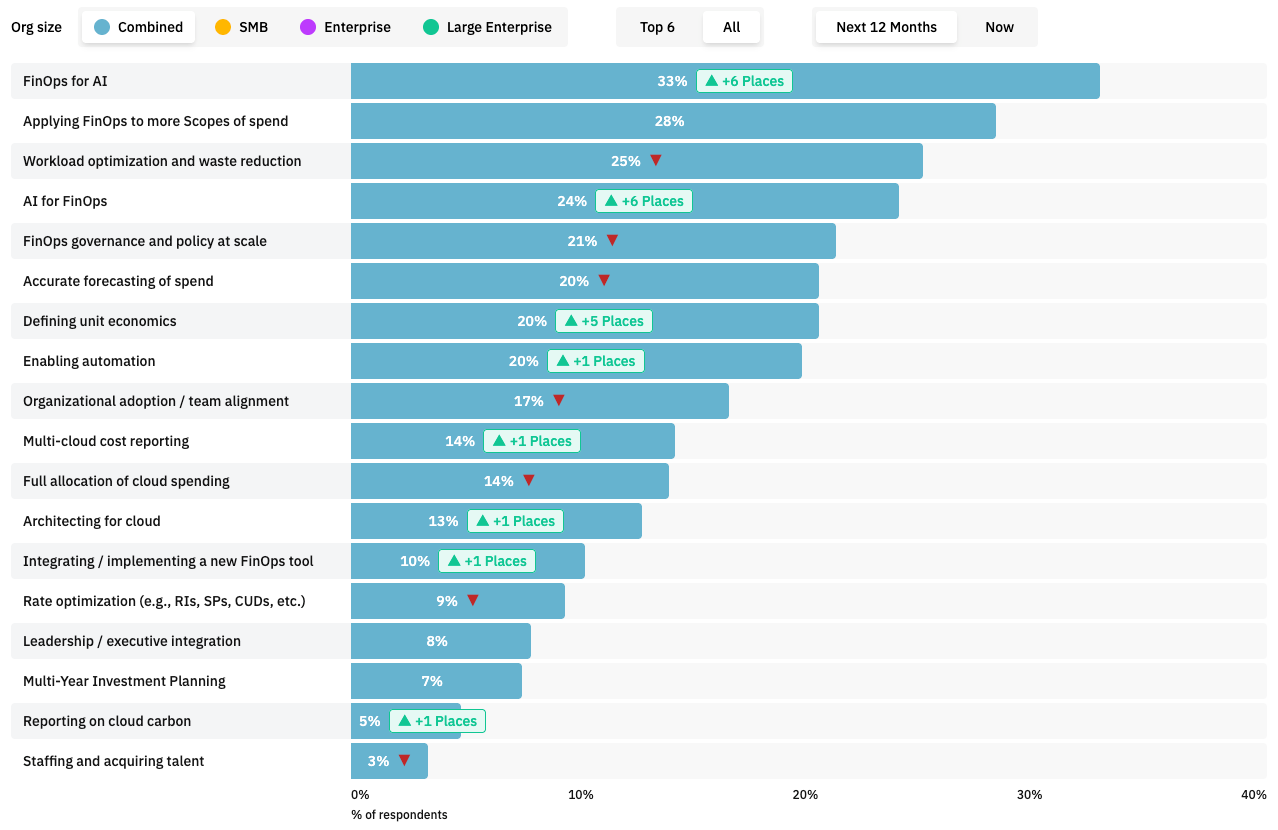
I want to push back a little on the way this shift usually gets framed. People describe it as FinOps finally “earning” its seat at the table, as though the industry passed some maturity test. I feel strongly that this is inaccurate. AI spend is currently undisciplined enough to force a board-level conversation.
The work now is turning that panic into governance. And a lot of that work starts with visibility that simply does not exist yet in most organizations. Chevron’s Colby Rozell, whom I spoke with on theCUBE at the conference, put his finger on the exact problem (you can watch the full video below):
"From the AI space we can see the expenditure, we see the cost, but I really don't have that visibility down to the individual. I can see the model, but I can't see down to the user. I need the traceability; I need that observability data to really understand what was prompted, what was the reasoning, what was the output."
—Colby Rozell, Technical Product Manager, IT Optimization, Chevron
The distance between seeing the model and seeing the user is where the next two years of AI cost management will be won or lost. Attention is not the same as control. The teams that convert one into the other before executive patience runs thin are the ones that will still have a seat when the novelty wears off.
It is worth being precise about what that lost patience actually looks like, because it rarely arrives as a budget cut. What I see with enterprise clients is the AI budget getting moved. It starts on a central innovation line where it is protected, and nobody asks hard questions. Then one quarter, finance pushes it down into the individual business unit P&Ls. That sounds like an accounting change, but it’s not. In a business unit P&L, a token bill competes directly against a headcount request, and no unit leader will defend an unattributed AI line item over hiring an engineer they can point to.
The earliest warning comes before that, though, and it is easy to miss. For months, the CFO asks how much you are spending on AI. Then one day the question becomes “how much … per what?” Once it turns from a total into a ratio, you have about two quarters before someone else picks the denominator for you.
#2: Tokenomics Is Splitting Off as Its Own Discipline
The biggest structural news from the conference was the announcement of the Tokenomics Foundation, a new body under the Linux Foundation. Its sole focus is the standards, benchmarks, and best practices for AI spend. Paralleling that announcement, FinOps X itself will be reborn as Tokenomicon starting in 2027.
Both announcements point in the same direction: the community has decided that AI cost management has different physics than cloud cost management. It needs its own standards body rather than a working group bolted onto the side of FinOps.
I think that instinct is correct. Token pricing, context windows, agent retries, caching behavior: none of these map cleanly onto the cloud cost playbook we spent a decade building. In the opening keynote of FinOps X, the framing was that the token is the atomic unit of AI, and every cost and value question resolves down to it. I would tweak that idea slightly: the same token means different things to the four parties looking at it:
- The data center sees compute.
- The model sees cognition.
- The lab sees price.
- The enterprise sees value.
The money leaks in the space between those four views, and closing that space is crucial work.
Here is where my optimism has a limit. A new foundation is a low-cost signal. Renaming a conference is a low-cost signal. Whether any of this matters comes down to whether Tokenomics builds mechanisms with teeth, benchmarks tied to real savings, or standards that vendors actually have to meet, rather than just new branding and another logo. I want it to succeed. But I am withholding judgment on whether it will.
#3: Standards Are Racing to Catch Up With Reality
The least glamorous announcement of the week was also, to me, the most important. FOCUS, the open specification that standardizes how vendors report cost and usage data, shipped its biggest update yet in version 1.4, adding invoice reconciliation, commitment data, and data integrity improvements. Version 1.5 is already slated for December 2026, and it is set to add native token tracking.
For years, FinOps has had a credibility problem hiding in plain sight. We report savings, and too often those numbers cannot survive a hard look from finance because the underlying billing data was never normalized in the first place. FOCUS is the fix for that. Native token tracking in 1.5 is the difference between AI billing that can be compared across providers and AI billing that fragments into a dozen incompatible formats nobody can reconcile.
The two new certifications Linux Foundation is rolling out alongside the spec, AI Value and Technology Value, are part of the same push forward. But here’s my take: Certifications are the easiest thing to ship and the hardest thing to make matter. A credential proves someone sat through the material. It does not prove their organization captured a single dollar of verified savings. I would rather the Foundation publish outcome benchmarks tied to the certification (like the average effective savings rate that certified practitioners actually deliver) than add another exam to the ladder.
Standards are only as good as what they force people to prove.
Right now, "we do not have the data" is a legitimate answer, because the billing formats genuinely do not support per-unit attribution yet. Once FOCUS 1.5 lands native token tracking in December 2026 and providers implement it, that answer expires. The conversation moves from whether you can attribute AI spend to why you have not. Most teams have until the middle of 2027 before that shift is complete.
#4: Agentic FinOps Is Here, but Context Is the Missing Ingredient
Every major vendor on the floor shipped an AI agent for cost management this cycle. If you walked the expo hall, you could not avoid them.
But the most honest moment of the conference was a cautionary one, a story about an agent that correctly flagged an idle virtual machine that turned out to be a Kubernetes node waiting for load. The agent had the data, but lacked the institutional context. It was confidently wrong.
This story matches where I have landed on this after working with enterprise clients.
When Colby and I talked through it on theCUBE, I laid out the line I think practitioners need to hold. AI is genuinely useful in the places where you are accelerating work you already understand: reporting, anomaly detection, and surfacing recommendations. Those are areas where a wrong answer is cheap and easy to catch. But you have to be very careful when you get into production-level changes and very large billing-construct purchases, because they still present real risk to the enterprise. That is where you need a human in the loop, making the business-level decision, because the AI lacks the proper, context-specific training.
The real next step is figuring out how to feed agents the tribal knowledge that used to live only in meetings, the context that tells an agent that this idle node is not waste; it is a warm spare. Until we solve the context problem, more autonomy just means more confident mistakes at a larger scale. The guardrails have to move with the capability, not trail behind it.
#5: Value Realization Is Replacing Cost Savings as the North Star
The last shift is the one I think will define the next phase of this work.
Across session after session, from practitioners at some of the largest enterprises in the world, the same idea kept surfacing: optimizing the bill is not the point if you cannot prove the AI investment is actually paying off. The questions are getting harder. It is moving from "did we save money?" to something far more demanding: can you prove to a CFO, in the CFO's own terms, that the AI spend generated business value?
Remember that SAP slide from the top of this piece? It is a textbook case of the Jevons paradox: when a resource gets cheaper, people use so much more of it that total spend rises regardless of the falling unit price. Cheaper tokens do not save you money. They invite more consumption.
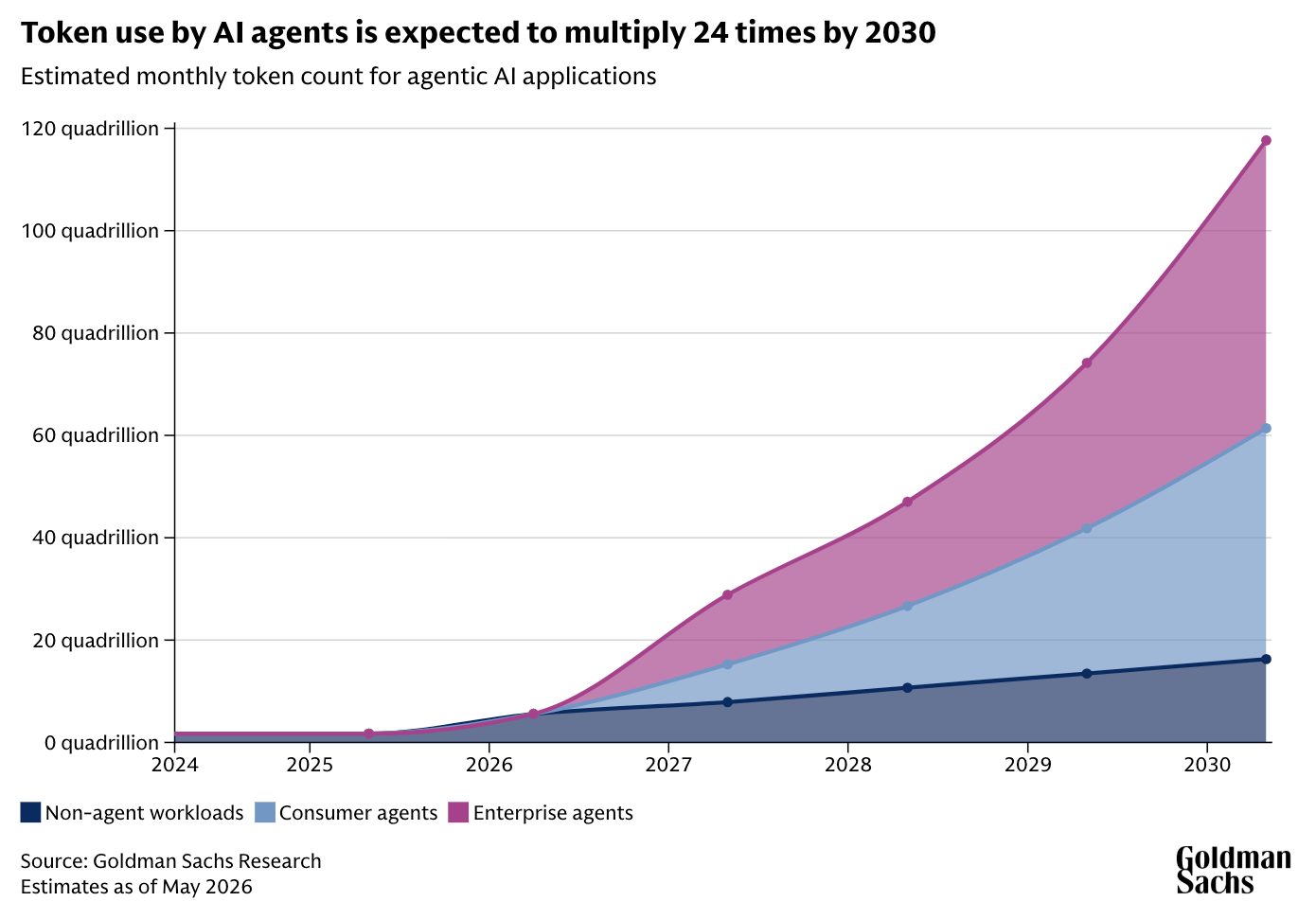
I want practitioners to sit with what that means. If you are optimizing cost per token and reporting that number up the chain as a win, you are optimizing a number that does not matter. The unit cost can fall every quarter while your total bill doubles, and a CFO who understands the Jevons dynamic will not be impressed by your improving unit economics. An outcome-based approach cannot stop at "cost per token went down." It has to track total spend against total value delivered.
This is where I get skeptical of the frameworks I saw presented. Value is where most of them fall apart, because organizations still cannot cleanly attribute a token to a dollar of revenue. But that is the wrong first target anyway. The workable first version does not attribute a token to revenue at all; it attributes it to a business transaction.
Every AI use case has a countable unit of work underneath it: a resolved support ticket, a summarized claim, a reconciled invoice, a completed code review, a qualified lead. Cost per business transaction is something you can compute with the tagging you already have. Cost per dollar of revenue usually is not. So start where the math actually works, and build from there.
The Work Starts Now, Not at Tokenomicon 2027
The above trends are not really five separate stories, but one story told from five angles.
The attention FinOps is garnering due to AI spend is both a gift and a warning. A discipline that started with a narrow mandate (control cloud waste) has been handed a much larger one: govern the value of all enterprise technology, on a compressed timeline and under executive scrutiny it has never faced before. The board is watching, the standards are being written, and the agents are shipping now. But the hardest problem, proving value, is sitting unsolved in the middle of all of it.
The practitioners who succeed will turn boardroom attention into governed, predictable, value-attributed spend. If I had to compress that into one move, it’s this: stop reporting unit cost as an outcome. Cost per token is a diagnostic, not a result. It is useful for choosing between two models for one task and worthless as a measure of whether your program is under control.
Start governing volume instead, because it is the only variable you actually own. You do not set the price of a token; the labs do, and they are cutting it whether you optimize or not. What you control is how many you buy. So forecast volume per use case, budget it in units of work rather than dollars, and require a business case for growth in consumption the same way you would for growth in headcount.
What is FinOps?
FinOps is the practice of managing and optimizing technology spend by bringing finance, engineering, and business teams together around shared cost accountability. It began with cloud costs and is now expanding to cover AI and token spend, giving organizations a way to govern spending that scales quickly and unpredictably.
What was the biggest theme at FinOps X 2026?
The dominant theme was that FinOps has outgrown cloud cost management and must now govern AI spend. Token budgets are climbing far faster than the discipline matured, which pulled AI cost management into board-level conversations and prompted the announcement of a separate Tokenomics Foundation to build standards for AI billing.
What is tokenomics in FinOps?
Tokenomics is the emerging discipline of managing AI token spend, treated as separate from cloud cost management because it follows different rules. Token pricing, context windows, agent retries, and caching behavior do not map onto the cloud playbook, so the community launched a dedicated Tokenomics Foundation to build standards and benchmarks for it.
Why is value realization replacing cost savings in FinOps?
Cheaper tokens invite more consumption, so total spend can rise even as unit cost falls. SAP showed its cost per token dropped since 2023 while total AI spend doubled. Optimizing cost per token becomes meaningless, so practitioners must prove business value, not just lower bills.
Where should human judgment stay in agentic FinOps?
AI works well for reporting, anomaly detection, and surfacing recommendations, where a wrong answer is cheap to catch. Production-level changes and large billing-construct purchases still need a human in the loop, because those decisions carry real risk to the enterprise and require business context AI does not yet reliably hold.


.svg)