
More Licenses Won't Fix It: The Context Architecture Behind Morgan Stanley's AI Advantage
Leading enterprises don't win with better AI models — they win with context architecture: the knowledge, workflows, and governance that connect AI to how their business actually works. Before your next license purchase, build the underlying layer.
Roughly 95% of enterprise AI pilots show no profit, yet future-built firms see five times the revenue gains.
The model is not the differentiator. Winners build context architecture: knowledge, patterns, and governance wrapped around AI.
Build that foundation before buying licenses. Morgan Stanley, McKinsey, and JPMorgan did, then scaled to measurable value.
In March 2023, only days after GPT-4 entered the world, Morgan Stanley made a move that caught the attention of the financial industry. The firm quietly rolled out one of the first large-scale enterprise deployments of the technology, placing an AI assistant in the hands of 300 financial advisors as part of their enterprise AI strategy.
On the surface, it seemed like a straightforward experiment with a new model that any competitor could have licensed at the same time. But that wasn’t the case.
Long before advisors typed their first question into the system, Morgan Stanley was doing work that never made the headlines. Teams spent months curating more than 100,000 internal documents, organizing decades of institutional knowledge into a structured resource the model could reliably retrieve from. Subject-matter experts then tested the system's responses, refining and validating outputs before any advisor ever saw them.
"We have a knowledge base of over 100,000 documents, and the idea is to bring that intellectual capital on top of the models of GPT-4."
– Jeff McMillan, then Head of Analytics, Data and Innovation at Morgan Stanley Wealth Management.
The payoff came quickly. By mid-2024, nearly 98% of Morgan Stanley's advisor teams had adopted the AI Assistant, changing what began as an experiment into an everyday tool. While many organizations were still running generative AI pilots, Morgan Stanley had already embedded AI into its operations.
That result raises a question most organizations haven't answered yet: what is an enterprise AI strategy, really? Many leaders treat it as a procurement decision: the right model, the right licenses, the right training program. Morgan Stanley's experience points in an entirely different direction.
The real advantage wasn't GPT-4. It was the knowledge, patterns, and governance the firm built before a single advisor touched the system, which practitioners and analysts now call context architecture.
The market data makes the stakes clear. Roughly 95% of generative AI pilots have produced no measurable profit-and-loss impact. The failure isn't the model. It's the absence of a context architecture under it.
A successful enterprise AI strategy isn't a plan for which model to buy. It's a plan for the context those models run on: the knowledge they can retrieve, the patterns they can follow, and the governance that keeps their outputs reliable and compliant. Morgan Stanley's edge was never just GPT-4. It was everything the firm had built before GPT-4 touched a single advisor.
In this article, we’ll look at how leading enterprises built those foundations across three layers: knowledge, patterns, and governance, and the measurable business results those investments produced.
The Context Architecture Gap in Enterprise AI
Before an AI model can do useful work inside your business, it needs context, or a working understanding of your organization that no foundation model arrives with out of the box. Without it, the model is fluent but uninformed, capable of generating polished output that misses everything specific to your business. And that is what most enterprise AI strategies never build.
Access to AI isn’t a competitive advantage anymore. It’s a baseline. Most organizations have already purchased licenses, deployed chatbots, and encouraged employees to experiment with generative AI tools. In fact, 62% of organizations are already exploring or using AI agents in some capacity.
Yet adoption and value aren’t the same thing. Only 5% of companies qualify as future-built, meaning they have put in place the capabilities needed to make AI work at scale, including the context most companies never build. Those companies are achieving five times the revenue increases and three times the cost reductions of their peers. The other 60% report minimal gains in revenue or costs despite substantial investment in the same tools and models.
The reason isn’t the model. It is what the model can access once deployed. The same foundation models are available to nearly every organization through the same vendors. What separates leaders from the rest is whether they have connected those models to the right context.
"What they don't have access to is your enterprise data. That piece of the puzzle is missing."
– Shobhit Varshney, VP and Senior Partner and Americas AI Leader at IBM Consulting.
For instance, in marketing and sales teams, the consequences show up fast. AI-generated content sounds polished but misses brand guidelines, customer context, or compliance requirements. The output gets rewritten. The pilot stalls. The ROI case collapses.
The irony is that these are exactly the functions where AI should deliver the most. Studies estimate that 70% of AI's potential value is concentrated in core business functions such as marketing, R&D, and digital operations. But most organizations are investing in the wrong layer to unlock it.
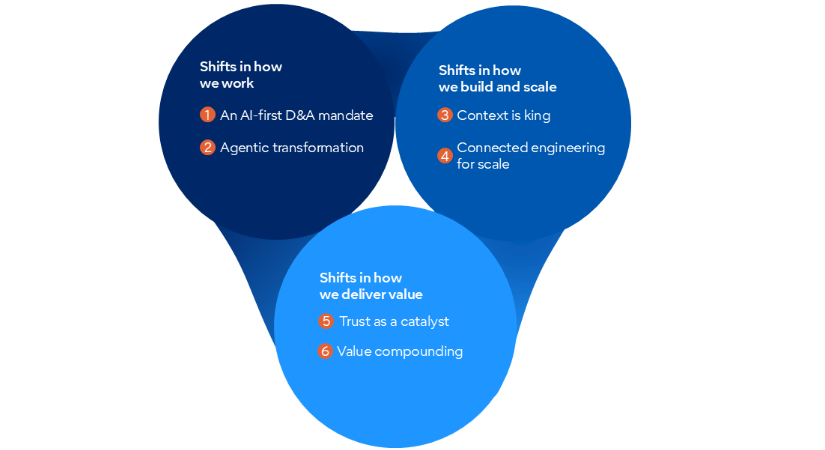
That missing layer is known as context architecture: the curated knowledge, repeatable patterns, and governed data that determine what any model can actually do inside your business. It is what a working enterprise AI strategy is built on, and it is what most rollouts skip entirely. Gartner puts it plainly in their six-shift framework for AI success, labeling shift three simply: "Context is king."
What Are the Three Layers of Context Architecture?
Many AI rollouts focus on the visible pieces of AI adoption. This includes model licenses, chatbot deployments, and employee training. What ends up getting buried under these pieces is the foundational context for AI solutions.
The investment patterns paint a vivid picture. Organizations with successful AI initiatives invest up to four times more in their data and analytics foundations than their peers. In other words, they are investing in the context on which their models run.
That context architecture consists of three layers: curated knowledge, repeatable patterns, and governed data that determine what any model can actually do inside your organization. Here’s a closer look at what each one covers:
- Knowledge: The knowledge architecture determines what the model can retrieve. It consists of curated, vetted, and tagged organizational information. When this AI knowledge management layer is missing, employees end up repeatedly recreating context. As a matter of fact, employees spend nearly 19% of their workday searching for information, not including time spent recreating knowledge they couldn't find. For instance, marketing teams rewrite brand guidelines into every brief, while sales reps continually explain customer history, positioning, and ideal buyer profiles.
- Patterns: Patterns determine how successful work gets repeated. This layer captures workflows, decision rules, proven outputs, and best practices. Without it, the same AI task produces different results depending on who runs it, and that inconsistency only gets worse at scale. Consider the sales team: one rep sends a sharp, well-positioned outbound email while another starts from scratch. By 2027, Gartner projects that 95% of seller research workflows will begin with AI, which means the inconsistency between how reps work will compound, not shrink, without standardized patterns underneath.
- Governance: An AI contextual governance framework defines what AI systems can access, what actions they are authorized to take, and how those actions are monitored and audited. This is often where promising pilots break down. An agent may perform well in a demo environment but fail in production because permissions, controls, and oversight processes were never established. Only 29% of organizations have a comprehensive AI governance plan in place.
Together, these three layers form the foundation of a working enterprise AI strategy. Next, we'll walk through how leading enterprises built each one and the business results that followed.
How Wells Fargo Gave AI Access to the Right Organizational Knowledge
One of the most common reasons enterprise AI initiatives underperform is surprisingly simple: employees spend too much time recreating context that already exists. When AI is added without addressing this problem, it complicates business workflows instead of streamlining them.
Employees end up rebuilding the same context from prompts rather than retrieving it. The result is the same wasted time, now dressed up as an AI workflow.
Wells Fargo, an American multinational financial services company, ran into exactly this problem. With a workforce of around 215,000 people, policies, procedures, and operational guidance were scattered across multiple systems. Employees searched through records, switched between applications, or asked colleagues just to answer routine questions. The information existed, but no one could find it quickly.
Rather than relying on a foundation model's general training, Wells Fargo built a retrieval-augmented generation (RAG) system connected to a curated library of approved policies and procedures. When an employee asks a question, the system retrieves relevant information from trusted internal sources before generating a response. The result was a roughly 20% reduction in query resolution effort across the teams that adopted it.
"By leveraging advanced agentic AI capabilities, we can get answers and insights faster, work more efficiently, and free up time to focus on what matters most: helping people reach their financial goals."
– Tracy Kerrins, Consumer CIO and Head of Enterprise Generative AI at Wells Fargo.
The same AI knowledge management challenge appears across nearly every business function. Marketing teams repeatedly explain brand voice, positioning, and campaign history before meaningful work can begin. Sales teams constantly reconstruct account history, product positioning, and territory rules. In both cases, employees spend time rebuilding context that already exists somewhere in the organization.
A reliable knowledge architecture layer changes that. Instead of starting from a blank prompt, AI retrieves approved information automatically and generates outputs grounded in institutional knowledge. The place to start is identifying where your teams repeatedly explain the same things. Those recurring explanations mark exactly where a knowledge architecture can help.
McKinsey Made High Quality Work Repeatable Across 45,000 Employees
If the knowledge architecture layer answers "What should the AI know?", the patterns layer answers "How should the AI work?"
The same AI tool and the same prompt can produce entirely different outputs depending on who's using it. This is because the workflows, decision-making processes, and prompting patterns wrapped around the AI model aren’t the same. That inconsistency doesn't shrink as AI adoption grows. It compounds.
Most organizations respond to that inconsistency by investing in training. McKinsey reports that 84% of employees receive significant organizational support to develop AI skills, but training people is only part of the equation. Consistent output requires repeatable patterns, not just capable people.
McKinsey & Company faced this directly. With roughly 45,000 employees and nearly a century of proprietary knowledge, access wasn't the problem. Consistently turning that knowledge into high-quality outputs was. To address it, the firm launched Lilli, an internal AI platform that brought together more than 40 knowledge sources and over 100,000 documents, not to centralize information, but to make the firm's best thinking repeatable at scale.
McKinsey recognized that its best consultants didn't just have knowledge. They followed proven approaches for researching problems, synthesizing insights, and communicating recommendations, and Lilli was built to capture those patterns and put them in the hands of everyone. The interface below shows how consultants interact with the platform, accessing structured workflows that reflect how McKinsey's best work actually gets done, not just a search bar pointed at a document library.

Alt text: Laptop displaying McKinsey's Lilli internal AI platform on a desk in an office setting, illustrating an enterprise AI assistant used to help employees access knowledge, conduct research, and generate business content.
The impact was substantial. Over 70% of McKinsey employees now use Lilli regularly, generating more than 500,000 prompts per month and reclaiming roughly 30% of time previously spent on research and synthesis. McKinsey didn't just teach AI what to know. It taught AI what good work looks like.
Knowledge alone isn't enough to get there. Once information is accessible, organizations must also codify the workflows, formats, and standards that ensure consistent outcomes; without that layer, every employee reinvents the process from scratch.
For marketing and sales teams, the same challenge runs through every function where output quality depends on who writes the prompt. Think about outbound sales emails, campaign briefs, or proposal decks. The place to start is by identifying the task where output varies most across your team, because that is your first patterns-layer investment. Capture how your best performer approaches it, codify the structure, and build it into the workflow before scaling access further.
JPMorgan Chase Scaled 450 AI Use Cases by Fixing Governance First
We have seen how knowledge determines what AI retrieves and how patterns make quality work repeatable across teams. The remaining piece is governance, where most promising AI initiatives quietly fall apart.
Pilots perform well in controlled environments, but momentum slows the moment organizations try to connect AI to customer records, internal databases, or operational systems. At that point, the challenge isn’t technical. It is trust.
Questions about security, compliance, permissions, and accountability quickly move to the forefront and often have no clear owner. According to EY, 62% of organizations cite data privacy and governance risks as a major barrier to adopting generative AI. That barrier doesn't disappear with a better model. It disappears when governance is built into the platform from the start.
JPMorgan Chase faced this problem. As it rolled out its LLM Suite to roughly 250,000 employees, the central question wasn't which model to use. It was how to give AI access to enterprise data without compromising security or compliance at the scale of the world's largest bank.
Rather than treating governance as a final approval step, JPMorgan Chase built it directly into the platform, combining model access, security controls, observability, and governance into a single centralized environment. New AI applications can reuse pre-approved components, letting teams move faster without repeating compliance reviews for every use case.
"We would not permit a solution to go live until this risk was appropriately managed."
– Derek Waldron, Chief Analytics Officer at JPMorgan Chase.
That decision is what made scale possible. JPMorgan Chase now supports more than 450 AI use cases in production across the organization, with roughly half of its 250,000 eligible employees using the platform daily. Governance didn't slow that down. It was the infrastructure that made it deployable.
Take marketing and sales teams, for example; the same dynamic plays out at a smaller scale. The moment AI needs to touch customer data, pull CRM records, or act on pricing information, ungoverned access either stalls the project or creates risk. Yet only 21% of organizations have policies governing employee use of generative AI, which means most are building on a foundation never designed to bear the weight of autonomous action.
A practical first step is to define what AI can read, what it can modify, and what it must escalate to humans for approval before any deployment begins. That clarity is the governance layer, and it costs far less to build before deployment than to retrofit after something goes wrong.
By 2027, Context Architecture Will Separate AI Leaders From Everyone Else
The model Morgan Stanley deployed in March 2023 was available to every competitor that same week. The foundation beneath it wasn't.
That distinction is what a working enterprise AI strategy is actually built on. Each firm covered in this article improved productivity, increased consistency, and scaled across hundreds of use cases, not because they had a better model, but because they invested in the layer beneath it. Knowledge, patterns, and governance were built before deployment, not after.
As foundation models become more powerful and widely available, choosing a model will become the easiest part of any enterprise AI strategy, and the easiest part for competitors to copy. What they can't easily replicate is the underlying context architecture. By 2027, organizations that prioritize contextual foundations for AI-ready data are predicted to improve agentic AI accuracy by up to 80% while reducing costs by up to 60%.
The most important AI investment isn't the next model license. It is the knowledge architecture, patterns, and AI governance framework that transform a general-purpose model into a system that understands your business, scales across teams, and delivers measurable value.
.avif)


.svg)


_0000_Layer-2.png)

