
Inside How Shell and Chevron Use AI in Industrial Automation
The industry written off as an AI laggard tells a different story. Explore how Equinor, Chevron, Shell, and Repsol made AI in industrial automation deliver real value.
For AI in industrial automation, the bottleneck is connection, not model capability.
Adoption is near-universal, but returns aren't. 71% of energy firms use AI, yet only 27% say it meets expectations.
Equinor, Chevron, Shell, and Repsol each solved a different link in that chain, which is why their AI reached production while most pilots stall.
At the Johan Sverdrup field in the North Sea, some of the most experienced engineers at Equinor, the Norwegian state-backed energy major that operates the country's largest oil fields, had spent months on a question that decides how much oil a field will ever give up.
Where should the next wells go, and how should they route through the rock? They had mapped the field layouts and well paths by hand, weighed the trade-offs, and worked toward a plan. Then their industrial AI solution ran into the same problem and found a path none of them had considered.
They pursued it. That single AI recommendation saved an estimated $12 million. This example of AI in industrial automation didn't outthink the engineers. It out-searched them, working through more layouts than any team could weigh by hand, and only because it could reach the planning systems and field data they already relied on.
That reach took years to build. Not long ago, sensor readings from deep underground were saved onto hard drives at Equinor's offshore rigs, then flown to shore by helicopter for analysis. Engineers waited two to three weeks for the results while the field kept operating without them.
Equinor fixed this by laying fiber-optic cable along its wells and streaming the data to shore in real time, turning a two-week wait into seconds. Only once the data arrived in real time could AI read conditions while decisions were still being made.
The same foundation now runs industrial AI systems far beyond well planning. Machine learning interprets seismic data 10 times faster, covering more than 2 million square kilometers in 2025. Predictive maintenance across 700 rotating machines and 24,000 sensors has generated more than $120 million in value since 2020.
Those gains are from a much broader AI in industrial automation program.
"Since 2020, we have realized values of over $330 million with artificial intelligence in industrial processes, of which $130 million came in 2025. We primarily use 'traditional' machine learning on our operational data."
—Hege Skryseth, Executive Vice President for Technology, Digital, and Innovation, Equinor
AI in oil and gas is often cast as a laggard, too old and too physical for software to change much. Equinor tells a different story.
So how is AI used in industrial automation when it actually works? It runs inside the systems, equipment, and workflows a business already has, reading operational data and acting close enough to shape decisions while they are still being made. Equinor built those connections before it scaled, which is exactly where most efforts stall.
In this article, we’ll look at why most AI in industrial automation pilots stay stuck and how a handful of energy companies solved the real bottleneck, which was never model capability but connection to the systems, data, and workflows the business already ran on.
Why the Industrial AI Bottleneck Is Connection, Not Capability
Equinor's results are easy to attribute to its engineering expertise, its scale, or the resources of a major energy company. The evidence points somewhere simpler. The companies creating measurable value from AI in energy are solving the AI integration problem before deployment begins.
It’s also clear that investment has never been the constraint. Across the oil, gas, and chemicals sector, 49% of companies report making a great deal of planned investments in digital technologies in 2024, up 20 percentage points since 2020, while another 42% are making a moderate level of investment.
Meanwhile, the energy industry is seeing results reach the field. BP, the British energy major, now evaluates seismic data in the Gulf of Mexico in 8 to 12 weeks instead of 6 to 12 months, and Devon Energy has extended the productive life of its wells by 25%. Similarly, across the sector, AI in oil and gas is already speeding up drilling and reopening prospects once written off as too costly.
But those wins are the exception, not the rule. An EY survey found that 71% of companies are already using AI in energy, including generative AI and machine learning, but only 27% say it is living up to expectations.
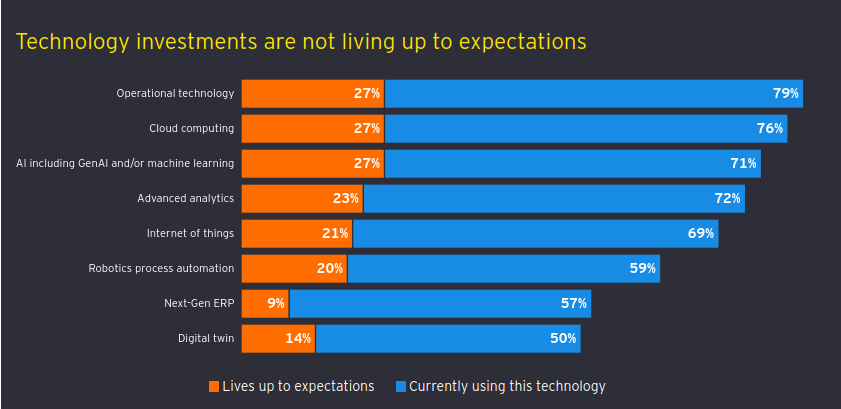
So what explains the gap? Not the models. 96% of oil and gas executives say connecting data across organizational silos remains a challenge for AI in energy.
And that fragmentation is often deliberate. Field and process control networks are walled off from corporate systems to protect safety, reliability, and uptime. The architecture is doing exactly what it was built to do, but it also keeps operational data locked away from the AI models that could use it.
That is why companies moving beyond pilots fix the connection before adding intelligence. AI in industrial automation creates value only when it can reach operational data, work alongside the systems already running the business, and support decisions inside the workflows people use every day.
The Three Points Where AI in Energy Loses Momentum Before Production
AI in industrial automation rarely stalls because an AI model isn't capable enough. More often, it fails because AI can't reach the data, systems, or workflows where work actually happens.
The challenge is structural, as only about 10% of enterprise data is structured. The remaining 90% is unstructured. It includes well logs, seismic interpretations, maintenance records, and technical documents where much of the industry's operational knowledge lives. AI in industrial automation can't improve operations if it can't access that knowledge.
Here's an overview of the three integration gaps that keep industrial AI from reaching production:
- Data the AI Can't Reach: Answers exist in the business, but scattered across unstructured documents and disconnected systems, so AI sees only part of the picture. Fewer than 10% of AI use cases deployed in business functions get past the pilot stage. A geologist may know a survey exists, but finding it means digging through decades of reports. The fix isn't a smarter model. It's access.
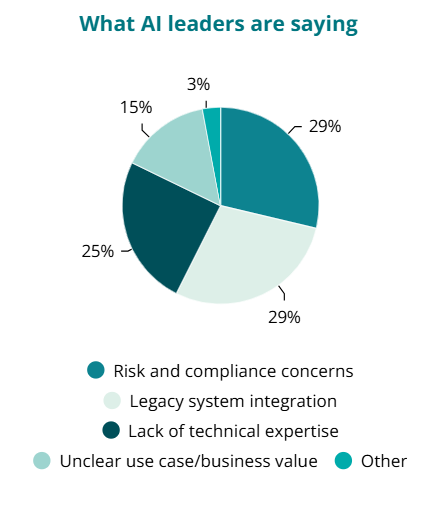
- Legacy Systems AI Can't Connect To: Many energy companies run on systems built decades before AI, with few interfaces for models to connect through. The recommendation is right; the path into the plant doesn't exist. A Deloitte survey found legacy system integration is the joint top barrier to agentic AI, cited by 29% of AI leaders. Replacing that infrastructure isn't realistic, so connect to it.
- AI That Can Recommend but Can't Execute: AI identifies the right action, but a person still reviews it, approves it, and enters it into the operational system. That's partly by design: a study of deployed AI agents found 68% run fewer than 10 steps before handing off, and 47% hand off within 5. The value comes from connecting industrial AI to the workflow that executes the decision, not just the one that generates it.
Chevron Made Decades of Buried Exploration Data Searchable in Seconds
Deepwater exploration is a race. When a lease block becomes available, the company that understands it first has an advantage. For Chevron, that meant finding a way to reach decades of exploration knowledge much faster.
That is the shift AI in industrial automation delivered. Work that once required days of manual research now happens in moments, giving teams more time to evaluate prospects and make better-informed decisions before bidding windows close.
The value isn't measured in barrels produced. It's measured in faster, better-informed decisions, with every drilling or lease opportunity time-sensitive.
"What used to require days of research now happens in moments. We are radically improving the speed and quality of decision-making."
—Ryder Booth, Chief Technology and Engineering Officer, Chevron
Reaching that point meant solving a data access problem, not a model problem. Chevron has spent more than 85 years exploring the Gulf of America, where it targets 300,000 net barrels of oil equivalent per day in 2026, and has built an archive of surveys, well logs, seismic interpretations, maps, technical reports, and subsurface analyses spanning more than 1 million files.
The information existed, but finding the right data often took days of manual research, leaving less time to evaluate prospects before bidding windows closed.
To solve that, Chevron built ApEX, an in-house generative AI platform launched in August 2024. Rather than introducing a new exploration model, ApEX made the company's existing knowledge searchable. Teams ask questions in natural language, while specialized agents retrieve maps, geospatial data, exploration studies, and technical records from across the archive in seconds.
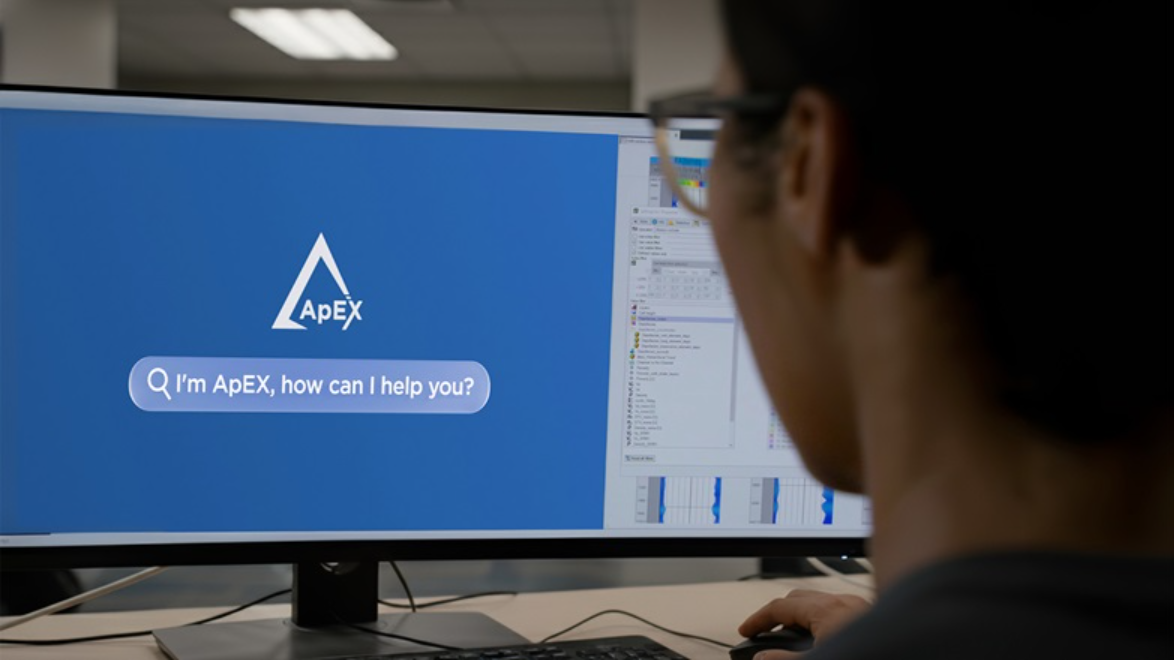
Today, ApEX gives exploration teams access to more than 4 TB of exploration data, including seismic interpretations, annotated well logs, and historical technical records that might otherwise remain buried in decades of archives.
This was never a standalone experiment. ApEX is one of roughly 15 enterprise AI workflows within Chevron's broader AI strategy. Rather than relying on a more capable model, Chevron focused on making decades of exploration knowledge accessible, allowing AI in oil and gas to surface the right information when decisions mattered most.
Inside Shell's Decision to Connect AI Instead of Rebuilding
At a Shell refinery in the Netherlands, an AI system analyzing sensor data identified 65 control valves that needed repair. Scheduled inspections had missed them. The issue was fixed before it could trigger a hydrocarbon breakthrough downstream, the kind of failure that can force a shutdown and create environmental risk.
What made that possible wasn't a better model. It was that AI could reach the live operational data already flowing through the plant. That has long been the hard part in industrial AI. Shell's compressors, pumps, and control valves generate enormous volumes of sensor data, but much of it sits inside operational systems never built for AI in energy.
The warning signs were already there. The challenge was reaching them before the equipment failed. Shell considered building its own AI platform and decided against it.
Maintaining one would have been a major long-term commitment. Instead, it took a different approach to industrial AI by integrating its in-house predictive maintenance models into its sensor network and digital twin technology.
By 2022, the platform was processing 20 billion rows of data weekly from more than 3 million sensors, running nearly 11,000 machine learning models and generating over 15 million predictions a day across more than 10,000 pieces of critical equipment. It has since expanded past 13,000 assets.
"Equipment and maintenance represent a significant percentage of Shell's operating costs, and AI-based predictive maintenance enables us to lower those costs by using resources much more efficiently, reducing production interruptions, avoiding unplanned downtime, and extending asset life."
—Dan Jeavons, VP Computational Science and Digital Innovation, Shell
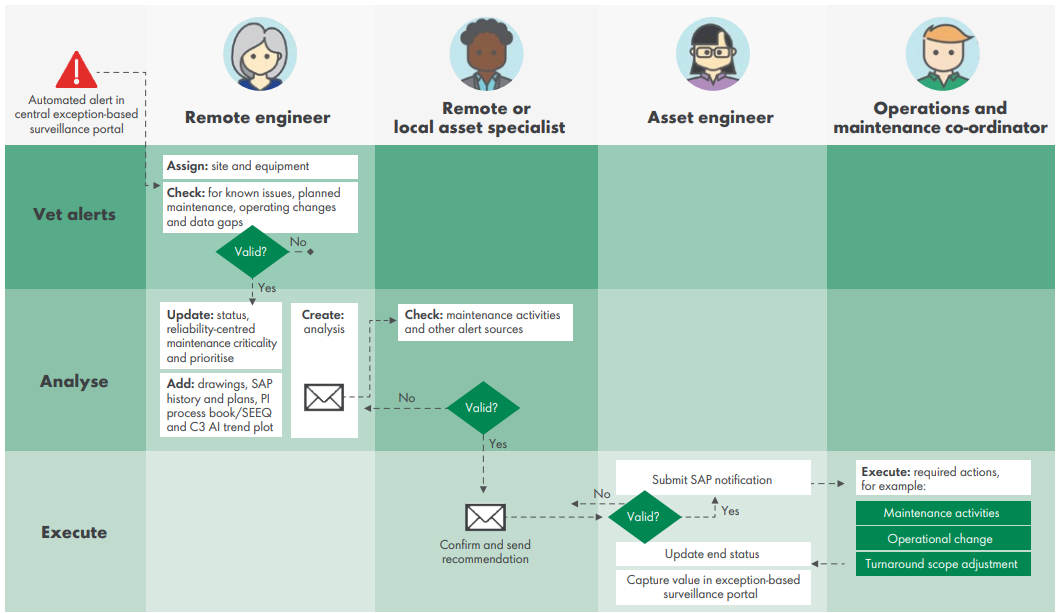
The integration didn't stop at prediction. Alerts flowed directly into Shell's existing maintenance process. A remote engineer reviewed each alert, a specialist validated it, and asset teams scheduled repairs as shown below before failures occurred. AI in industrial automation started running the plant rather than serving as just another monitoring tool.
The results extended beyond the Netherlands. For example, the system caught a control valve at a Singapore refinery beginning to oscillate months before it could have caused a shutdown, and on a deepwater platform in the Gulf of Mexico, it flagged valve movements too fast and too infrequent for conventional monitoring to catch.
Repsol Turned AI Recommendations Into Field Action
Repsol, the Spanish energy company, had built a multi-year vision for digital production and ran into a wall that had nothing to do with model quality. Its engineers worked across fragmented systems, making it hard to evaluate field conditions, assign actions, and track whether those actions delivered the expected results. The insight existed. Following it through still depended on people, manually, one well at a time.
This is a different integration gap than the first two examples we discussed. The data can be connected, and the AI can identify the right action, but the work still stalls because someone has to carry it out, monitor what happens, and decide the next move. Until then, the workflow stays manual.
Repsol closed that gap by deploying Leucipa, an automated field production platform from energy technology firm Baker Hughes, across its operations. The platform pulls data from multiple operational systems, builds digital twins of production assets, and monitors field performance continuously across what the vendor describes as tens of thousands of wells.
The shift came after the recommendation. Once an engineer records an action in natural language along with the expected outcome, a monitoring agent takes over, tracking performance, checking whether the intervention worked, and flagging the next step.
Rather than having engineers watch dashboards, the system monitors thousands of wells at once and surfaces only the ones that need a human. Traditional industrial AI follows predefined rules; the agentic approach reasons toward an outcome and acts to reach it.
"It doesn't just show you problems, it refactors the solutions for you. One AI agent can watch thousands of wells across thousands of tasks."
—Sebastiano Barbarino, Digital Production Solutions Leader, Baker Hughes
The deployment delivered a 3% increase in production, a 75% increase in efficiency, and lower lifting costs across Repsol's operations. Simply put, the value didn’t come from a better recommendation. It came from connecting the recommendation to the work that implemented it.
Why AI in Oil and Gas Pays Off Only When It's Connected
At Johan Sverdrup, the AI system found a well configuration no one had considered, not because it outthought Equinor's engineers, but because it could finally reach the planning systems and field data they already worked with.
That reach was the whole difference. The model had been capable all along. What changed was that it could act on the information the business already had.
The companies pulling ahead aren't the ones that bought smarter models. They're the ones who connected the models they had to the data, systems, and workflows where the work actually happens, close enough to shape decisions before it was too late to act.
Organizations with fully integrated AI are nearly four times more likely to report AI-driven revenue growth than those still running pilots. The difference isn't the technology. It's whether the technology can reach the business.
So the question for any leadership team with stalled AI in industrial automation pilots isn't which model to deploy next. It is where AI is still cut off from the systems, data, and workflows the operation already runs on. That is where the value has been waiting the whole time.
.avif)
Frequent Asked Questions
What is industrial AI?
Industrial AI is built for physical operations, reservoirs, turbines, pipelines, and refineries, where it reads operational data, predicts what will happen, and increasingly carries out the response inside existing systems. Its payoff comes from treating AI as infrastructure rather than a bolt-on. Equinor is a case in point, crediting AI with roughly $130 million in value in 2025, and more than $330 million since 2020, by embedding it across seismic analysis, well planning, and predictive maintenance.
How is AI used in the energy sector?
AI is wired into the operational core, the sensors and control systems already running the plants, so it can predict and act instead of sitting in a separate tool. The connection is the difficult part: 96% of oil and gas executives call connecting data across silos a challenge, and legacy system integration is the joint top barrier to agentic AI, cited by 29% of leaders.
How is AI used in oil and gas?
Across exploration, maintenance, and production, AI reaches data that was previously trapped, connects into the aging systems that run the field, and acts on what it finds. The sector is asset-heavy and data-rich, which makes it a natural fit, and investment reflects that: 49% of oil, gas, and chemicals companies report a great deal of planned digital investment, up 20 points since 2020. Chevron's ApEX platform is one example, searching more than a million exploration files and returning in moments what once took days.
What is the role of AI in industrial automation?
Its role is to act inside the physical operation, not just report on it: controlling equipment, predicting failures, and turning a recommendation into action rather than another dashboard. The hard part is connection, not capability.


.svg)


_0000_Layer-2.png)

