
Enterprise AI Agents Are Changing How Organizations Scale AI
AI assistants boost individual productivity but leave the P&L unchanged. IBM, Orica, and AstraZeneca show how enterprise AI agents close the gap, and what the shift requires.
AI assistants hit a hard ceiling: output can't scale faster than human attention allows.
In creating enterprise AI agents, IBM's AskHR resolved 94% of 11.5M interactions without escalation, saving $3.5B in 2024.
Structure is critical: Gartner projects 40% of agentic AI projects will be canceled by 2027 due to governance gaps.
In early 2023, IBM CEO Arvind Krishna gave his company an unusual mandate. Rather than announcing a new product or entering a new market, he told 270,000 employees that IBM would become its own most demanding client. The initiative was called "IBM as Client Zero," designed to deploy IBM's own AI and automation tools across every major internal function, measuring the results with the same rigor IBM applied to client work.
The HR department was an early test case. IBM had already built AskHR, a virtual assistant that handled routine employee inquiries. But the model had a ceiling that became visible as ambitions grew. AskHR could answer questions, but it couldn't complete transactions, orchestrate across multiple enterprise systems, or execute multi-step processes without a human re-entering the workflow at each handoff. Answering a question about a payroll discrepancy was one thing. Resolving it was still a human job.
So IBM rebuilt it. AskHR moved from a virtual assistant to a fully agentic system running on watsonx Orchestrate. The agents now handle more than 80 HR processes end-to-end, without human initiation at each step. In 2024, AskHR handled 11.5 million employee interactions and resolved 94% of them without escalation. Managers complete HR transactions 75% faster. The HR team's operating costs dropped 40% over four years. And across all IBM's internal AI deployments, the company achieved $3.5 billion in productivity savings in 2024 alone against a $2 billion target, resulting in $12.7 billion in free cash flow that year.
The difference between AskHR version one and AskHR version two isn't model quality. It's organizational architecture. According to PwC's 29th Global CEO Survey of 4,454 executives, 56% of CEOs report neither higher revenues nor lower costs from AI despite significant investment. Most of them are still running version one.
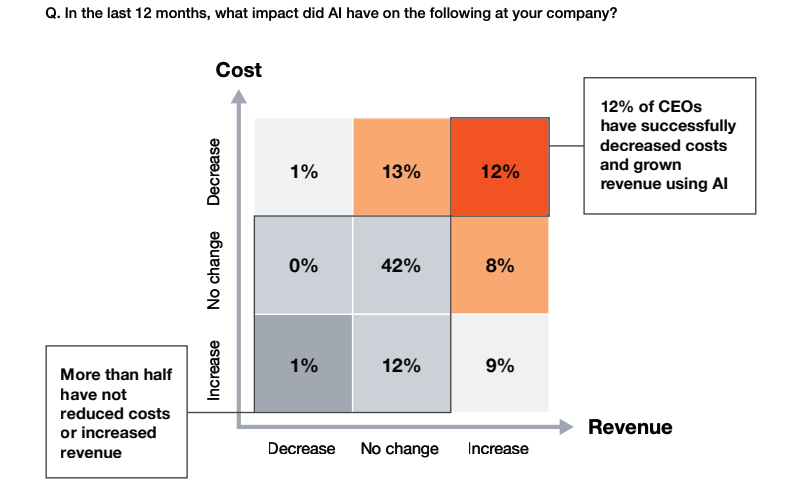
AI assistants are working exactly as designed, and that's precisely why they can't deliver what most enterprises hoped. They accelerate individual tasks, but every action still requires a human to initiate, review, and approve it. You cannot scale AI assistant output faster than you can scale human attention. Enterprise AI agents break that dependency by executing multi-step workflows autonomously, within defined boundaries. The organizations making that shift are now seeing the outcomes that AI assistants could never produce.
The Ceiling AI Assistants Were Always Going to Hit
Most enterprises are running into three problems in shifting from AI assistants to agentic AI.
First, AI assistants are best defined as the prompt-and-response tools that help employees draft faster, summarize better, and research more efficiently. They work exactly as designed, and that's the problem. The first issue is that workflows still route every action through a human. Every AI assistant requires a human to initiate an interaction, evaluate the output, and decide what to do next. The tool accelerates individual tasks. But the workflow it sits inside stays intact.
Gartner's 2025 Microsoft 365 and Copilot Survey captured this dynamic precisely. Of the organizations that had completed pilots, only 5% moved to broader deployment, and 57% reported that user engagement declined quickly after implementation.
Second, the highest-impact, function-specific AI deployments, the ones that would free skilled workers from low-value work, aren't getting out of pilots. According to McKinsey, roughly 90% of these use cases remain stuck in the pilot phase.
Finally, organizations are deploying AI tools without changing the structures around them. There’s no policy shift, and no forcing function that makes agents a planning assumption rather than an experiment.
Enterprise AI agents address all three directly. Where assistants stall at the point of human initiation, agents execute multi-step workflows autonomously within boundaries the organization defines. Where high-impact deployments sit idle in pilots, agents are purpose-built for the function-specific work that moves the needle: IT service desks, onboarding, operations. And where organizations lack a structural commitment to AI, agents force the question. The human role shifts from operator to supervisor. Instead of initiating every action, leaders define the outcome, set the guardrails, and intervene when the agent hits an edge case it can't resolve. That shift is where the P&L impact of AI is clarified.
Shopify Makes a Workflow Tool Organizational Policy
Most enterprises announce AI initiatives. Few change the organizational logic around them.
In April 2025, Shopify CEO Tobi Lütke shared an internal memo publicly. The subject line read: "Reflexive AI usage is now a baseline expectation at Shopify."
"Before asking for more headcount and resources, teams must demonstrate why they cannot get what they want done using AI," Lütke wrote. He pushed further: "What would this area look like if autonomous AI agents were already part of the team? This question can lead to really fun discussions and projects."
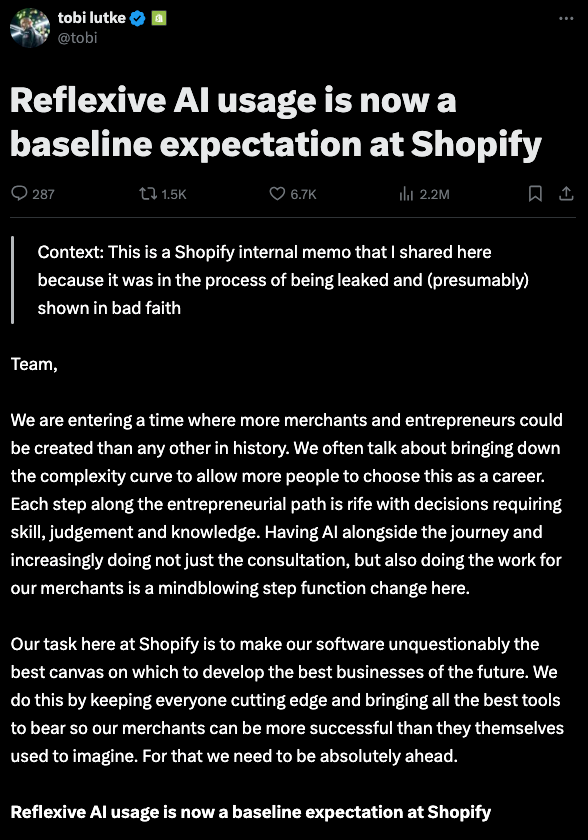
Lütke’s bullish new organizational logic positions AI agents as a planning assumption. Headcount decisions would now be made downstream of that assumption, not upstream of it.
This is a meaningful distinction. Most enterprises have announced AI initiatives. Shopify restructured the question employees have to answer before any team grows. That's a different kind of commitment, and it reflects what leading organizations are beginning to understand: enterprise AI agents don't slot into existing organizational structures. They require those structures to change.
The technology is moving faster than most organizations can orient around it, but that is the nature of this moment in AI’s story. The enterprises pulling ahead are consistently the ones redesigning how work gets done.
Orica Solves Its Transactional Layer
Orica is a global explosives and mining services company. They also happen to use autonomous AI agents on the ServiceNow platform to handle IT service desk requests.
Before the deployment, their IT service desk was running at 18% deflection; 82% of incoming requests required a human agent to handle them end-to-end. The volume and cost resulted in more tickets, which meant more headcount.
After two months of running autonomous, enterprise AI agents, the deflection rate jumped. Success rates doubled. Monthly usage nearly doubled.
"If you look at virtual agents alone, the deflection rate has gone from 18 to 94 percent, which is just a massive increase."
—Bradley Hunt, DevOps and Regional Apps Manager, Orica
Two years of foundational work made this possible. Orica had spent 12 months re-platforming its ServiceNow instance: standardizing data, cleaning configurations, and returning it to an out-of-the-box state. The agents needed clean, structured information to operate reliably. Without that foundation, agentic AI workflow automation produces inconsistent outputs that push work back to humans rather than removing it.
The governance lesson here is simple but often skipped: AI agents for workflow automation are only as reliable as the data and process architecture underneath them. Orica's deflection rate spiked because the organization had done the unglamorous work of making its environment agent-ready.
AstraZeneca Restructures High-Volume Knowledge Work
AstraZeneca, a major Swedish-British multinational pharmaceutical company, hires more than 20,000 new employees every year. Before they built autonomous agents into the onboarding process, managers were spending more than 50 hours per hire on transactional tasks like document routing and portal setup. Multiply that across 20,000 annual hires, and the opportunity for time savings becomes huge.
The company built what it calls Onboarding 2.0, a system of autonomous enterprise AI agents that handle the transactional layer of onboarding without requiring a manager to initiate each step. Personalized portals, document processing, and provisioning tasks now run through agents that execute end-to-end.
"If processes that previously took 20 or 30 minutes now take seconds, and we do that over 60,000 times a year, you can imagine the scale of the time that you can free up."
—Dinesh Krishnan, Global Head of Enterprise Platforms, AstraZeneca
The projected savings: more than 90,000 hours annually by automating just 10% of manager onboarding time.
AstraZeneca's agentic AI governance approach is worth examining closely. The company ran approximately one year of proof-of-concept work before moving to production. In a regulated pharmaceutical environment, every agent's output must be verifiable. "You still need skilled engineers to understand every line and every nuance of why the system behaves the way it does," said one engineering leader. The agents removed humans from the transactional layer, but not from accountability. That distinction is what separates a successful deployment from an expensive rollback.
What Agentic AI Governance Requires
Enterprises that see real results from enterprise AI agents treat agent deployment as an organizational decision.
Agentic AI governance determines what an agent can do autonomously, what it has to escalate, and what evidence it produces when it acts. Without that architecture, agents generate outputs that humans can't trust, reintroducing the human bottleneck the agent was supposed to remove.
Gartner projects that more than 40% of agentic AI projects will be canceled by 2027 due to governance gaps. The organizations avoiding that outcome have built three things before deploying at scale:
- Clean, standardized data that agents can consume reliably.
- Defined autonomy boundaries that specify when a human has to intervene.
- Audit trails that make agent actions reviewable and reversible.
Orica's two-year re-platforming effort and AstraZeneca's year of proof-of-concept were governance work at its core. What might be seen initially as delays are actually foundational investments that determine whether an agent deployment creates ROI or collapses.
The Future of Enterprise AI Agents
AI assistants accelerate individuals. Enterprise AI agents transform workflows.
The gap between those two outcomes is organizational, and closing it requires structural decisions that most enterprises haven't made yet.
Deploying enterprise AI agents without governance infrastructure is like hiring employees without giving them a job description, system access, or a way to flag problems. The successful agent deployments in this article share a common prerequisite: the organization defined the agents' parameters before workflows went live.
Enterprise AI agents are on target to become standard operating infrastructure. Gartner predicts that 40% of enterprise applications will include task-specific AI agents by the end of 2026, up from less than 5% in 2025.
Which workflows in your organization are already well-defined enough, high-volume enough, and governed well enough to hand to an agent? And what will it take to get the rest there?
.avif)
Frequent Asked Questions
Which enterprise workflows are the strongest candidates for AI agent deployment?
The best candidates are workflows that are high-volume, well-defined, and repeatable, where steps are consistent enough that human judgment isn't required at each stage, only for exceptions. Orica's IT service desk and AstraZeneca's employee onboarding both meet this profile. AstraZeneca's agents handle more than 60,000 onboarding transactions annually, with tasks that previously took 20 to 30 minutes now completing in seconds. Orica's agents took IT deflection from 18% to 94% in two months.
How are leading enterprises structuring their organizations around AI agents?
The pattern emerging in leading organizations treats agents as planning assumptions, not experiments. Shopify CEO Tobi Lütke formalized this in a 2025 memo requiring teams to demonstrate why AI agents cannot perform work before requesting additional headcount, and added AI usage to performance reviews as a structural accountability mechanism. IBM structured its transformation around CEO-led sponsorship, two-week delivery sprints, and measurable business outcomes at every stage.
What does it take to deploy enterprise AI agents successfully?
Three prerequisites appear consistently across successful deployments. First, clean and standardized data. Orica spent two years re-platforming its ServiceNow environment before agents could operate reliably. Second, define autonomy boundaries that specify exactly when a human must intervene. Third, audit infrastructure that makes every agent action traceable and reversible. Gartner projects that more than 40% of agentic AI projects will be canceled by 2027 due to governance gaps.
Why do AI assistants fail to deliver P&L impact even when adoption is high?
AI assistants accelerate individuals, but the workflow they sit inside (approval chains, handoffs, review cycles) stays intact. You cannot scale AI assistant output faster than you can scale human attention. PwC's 2026 Global CEO Survey of 4,454 executives found that 56% report neither higher revenues nor lower costs from AI. High adoption metrics and unchanged income statements can coexist because the tool is working; the organizational model it operates inside is not.
What is the difference between an AI assistant and an enterprise AI agent?
An AI assistant responds to human prompts. Every action requires a person to initiate, review, and approve each step. An enterprise AI agent pursues a defined goal across a multi-step workflow autonomously, acting within preset boundaries without waiting for human initiation at each stage. IBM's AskHR illustrates the distinction: as a virtual assistant it answered questions; rebuilt as an agent, it executes transactions end-to-end across Workday, SAP, and Concur.


.svg)


_0000_Layer-2.png)

