
How Mastercard, Unilever, P&G Made the CHRO the Center of AI Strategy
Enterprises are routing AI workforce decisions to the wrong function at the wrong stage. Mastercard, Unilever, and P&G show what happens when the CHRO is in the room before the architecture is set.
83% of CEOs say AI success depends more on people than technology, yet most still structure it the opposite way.
Only 13% of enterprises have a CHRO leading AI workforce strategy; those that do report training effectiveness that is double that of CIO- or CTO-led models.
Organizations that conduct workforce and workflow redesign in parallel see 2.3x higher shareholder returns.
The invitation arrives too late in the process.
An enterprise organization has spent six months standing up its AI transformation program. The CIO owns the steering committee, the CFO controls the budget, vendors have been selected, and workflows have been redesigned. Now, with the rollout approaching, someone thinks to loop in HR.
The CHRO opens their calendar one morning and sees a new event scheduled for that day: "Change Management Kickoff."
Her role in the process is not to shape the program, but to land it. And that’s precisely the problem.
Dave Barnett spent years as a CHRO before becoming Chief Administrative Officer at DeVry University, and has watched this scene repeat itself. He has a name for what happens next: a "silent standoff."
Employers deploy AI tools and assume workers will experiment, adapt, and find productive uses on their own. Workers wait for guidance, guardrails, and workflows that never come. Each side assumes the other is handling it.
"While AI and transformation have been largely driven out of the CIO's office, what we're seeing now is it moving into the CHRO's office — because this is a people matter. This isn't purely about technology or tools. This is about people working differently."
—Dave Barnett, Chief Administrative Officer, DeVry University
Most enterprises have organized AI transformation as a technology initiative: owned by the CIO, funded by the CFO, and handed off to HR only when downstream change management support is needed. The CHRO arrives after vendor decisions are locked and deployment timelines are fixed.
But that approach is resulting in a loss of returns. IBM's 2026 survey of 2,000 CEOs found that 83% say AI success depends more on people's adoption than on the technology itself. Bain research shows that enterprises applying AI in a human-centric way generate total shareholder returns that are 2.3 times higher than those of enterprises that treat workforce readiness as an afterthought. Yet only 13% of enterprises currently have a CHRO leading AI workforce strategy, while organizations that do report AI training effectiveness more than double that of CIO- or CTO-led models.
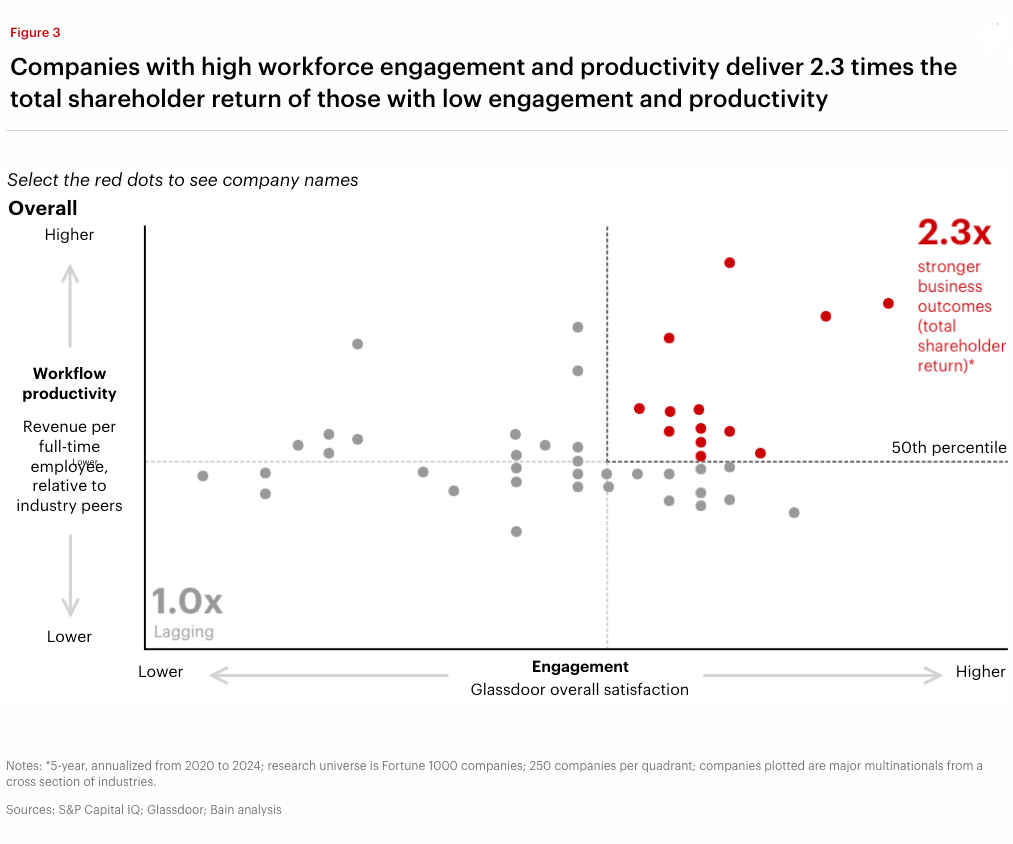
Successful AI adoption hinges on how accountability is assigned. Enterprises losing AI ROI are utilizing a governance structure that assigns the wrong executive to the wrong stage of the process. The companies generating 2x+ shareholder returns from AI have moved the CHRO from change management support to strategy co-owner, a decision that translates directly to adoption rates, workforce liquidity, and bottom-line returns.
Here, we explore how Mastercard, Unilever, and Procter & Gamble each confronted a version of the structural problem Barnett describes, solving it by advancing the CHRO function within their AI strategies.
Why AI ROI Stalls Before It Starts
Three people-related organizational patterns keep appearing in enterprises where AI investment fails to produce returns: governance problems around who owns what, and when.
1. HR Arrives After the Board Is Set
This is simply a sequencing problem. Only 21% of CHROs are closely involved in AI strategy decisions. The vast majority are peripheral players, consulted after the technology architecture is designed, the vendors are selected, and the workforce implications are already baked in.
When workflow redesign happens without the function responsible for workforce capability, AI tools sit unused or underused while organizations wait for training programs to catch up. According to research from Bain, fewer than 40% of employees in AI-led reorganizations understood the scope and rationale of the changes, well below rates for other types of transformation. This is a design problem that originates at the strategy stage.
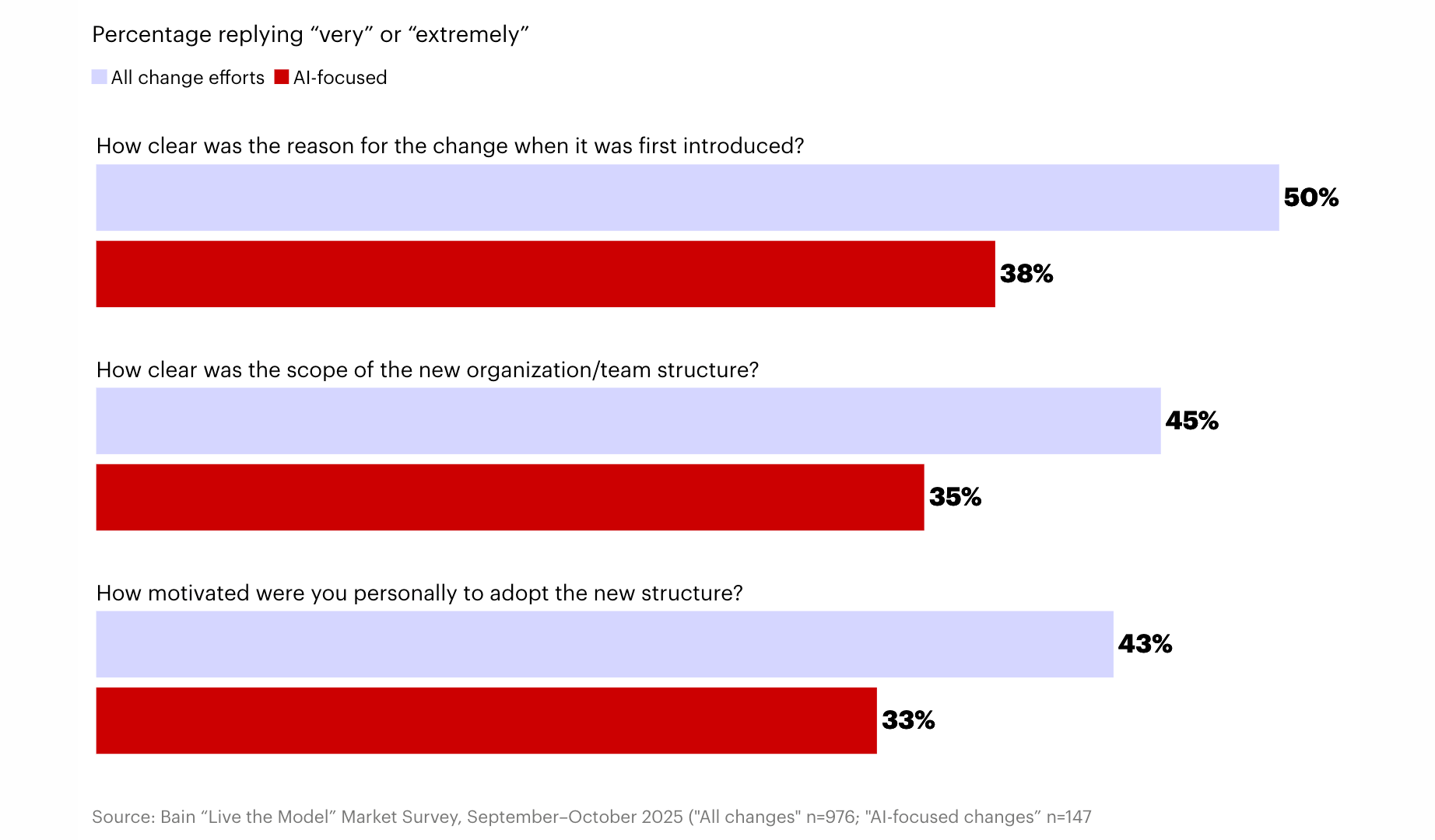
2. Workforce Readiness Is Treated as a Downstream Problem
When the CHRO is not involved in AI strategy design, workforce readiness becomes an afterthought. By the time HR develops an upskilling curriculum, the workflows have already been designed around assumptions about employee AI fluency that were never validated.
85% of employees say the AI training they receive does not help them apply AI in their actual role, and one in five received no AI training at all, according to Docebo's 2026 AI Readiness Gap report. BCG's 2026 analysis is direct about where the value goes: 70% of AI value comes from workforce and behavioral changes, not technology.
3. AI Strategy and People Strategy Are Siloed
When IT owns AI deployment, and HR owns workforce capability, the connection between deploying a tool and redesigning how people use it is severed. These two functions report through different chains, operate on different planning cycles, and measure success with different metrics. The business result is fragmented accountability and stalled governance. AI strategy ownership remains fragmented in 40% of organizations, with no clear owner at all in 17%.
AI governance questions like who decides which decisions remain human, which are AI-supported, and where accountability sits, cannot be answered from inside a single function. It requires the CIO and CHRO to operate as co-architects of the same process.
Mastercard Made the CHRO an AI Infrastructure Decision
Mastercard's "Unlocked" talent marketplace illustrates what happens when the CHRO owns AI-enabled workforce infrastructure from the start.
Launched globally to Mastercard's 35,000-person workforce, Unlocked matches employees to internal roles, projects, mentoring relationships, and learning pathways based on current skills and aspirational career goals. The platform was designed as an enterprise infrastructure, not an HR program.
That infrastructure decision paid dividends when Mastercard's fraud detection team urgently needed AI talent. Unlocked enabled rapid internal redeployment of employees with adjacent data skills with no external hiring or delays. Today, more than 90% of Mastercard's workforce is registered on the platform, employees have collectively logged one million project hours, and a third of those who engaged made an internal career move or promotion within a year, half of those moves crossing job functions.
"Learning isn't an HR metric anymore; it's a business performance driver."
—Lucrecia Borgonovo, Chief Talent and Organizational Effectiveness Officer at Mastercard
The business case is workforce liquidity: the ability to move capability to where the organization needs it, at the speed AI-driven change demands. That requires the CHRO to design the infrastructure before the demand arrives, not after.
Unilever Ran Workforce Redesign in Parallel with Supply Chain AI
Treating workforce readiness as something HR handles after deployment can have costly downstream consequences. Unilever decided to take a different approach.
When Unilever's Customer Operations team undertook a major supply chain AI deployment, its DigiOps people upskilling program was designed and initiated in parallel. Digital and AI capabilities were created inside the supply chain team alongside implementation so that the workforce was ready the moment the tools were.
Because of that program, Unilever's Customer Operations team delivered over €1.7 billion in value through enhanced service, reduced inventory, and improved operational efficiency. That outcome required both the technology and a workforce capable of operating it on day one.
The CHRO function's contribution here was to co-design the capabilities that made the technology investment well-founded in the first place. That is the distinction most enterprises miss when they route workforce readiness to HR after the architecture is set.
How Procter & Gamble Made AI Everyone's Job
Procter & Gamble's approach started with a question: What happens to AI adoption when you remove barriers between the tool and the person using it?
P&G's Chief Digital and AI Officer Alfredo Colas found out. When P&G removed approval layers, licensing friction, and the departmental gatekeeping that typically separates AI capability from business users, consumption skyrocketed. Aside from higher usage, the work was measurably better. In a study conducted with more than 700 P&G employees across four business units, researchers from Harvard and Wharton found that individuals working with AI outperformed traditional two-person specialist teams working without it. AI-supported teams were three times more likely to produce solutions rated in the top 10% for quality.
This outcome was possible because P&G made an organizational design decision that forced the workforce question into the open. Rather than housing data scientists and AI engineers in a centralized analytics function, P&G embedded them directly within business units and operational teams across supply chain, marketing, and commercial functions. In partnership with Harvard Business School and BCG, P&G built an intensive eight-week AI upskillng program for executives focused on the strategic impact of AI, with in-house programs running in parallel to build daily AI fluency across the broader workforce. More than 4,000 executives have completed it.
"The decisive differentiator will not be access to technology, but the ability to orchestrate human transformation around it."
—David Henderson, Group Director of HR, Al-Futtaim Group
When AI capability moves out of centralized functions and into the business itself, adoption stops being a mandate handed down from leadership and becomes something that emerges from the people closest to the work. David Henderson, Group Director of HR at Al-Futtaim Group, cites "adoption catalyst" as one role of CHROS in the AI era. This charge, he says, ensures AI value is not confined to central teams, but scaled from the bottom up, by employees empowered to apply it where their insight is deepest. As AI embeds itself further into business operations, that role becomes increasingly foundational.
The Question Your Next Steering Committee Should Answer
59% of CEOs expect the CHRO's influence to increase over the coming years as AI transformation matures. The structural default (CIO owns AI, CHRO manages the people side) produces the very adoption lag many enterprises are experiencing.
At your next AI steering committee, ask two questions: When was the CHRO brought into the conversation? What decisions were already locked in by then?
The companies generating excellent results in AI deployments are making an important decision before the architecture is in place: that the person responsible for workforce capability should help design the system that those workers will be asked to operate.
.avif)
Frequent Asked Questions
What can executives do immediately to fix the CHRO-AI alignment problem?
At the next AI steering committee, ask two questions: when was HR invited into the room, and what decisions were already locked in by then? If the CHRO joined after vendor selection and workflow design were complete, serious problems may already be built into the program structure.
What does AI governance look like when the CHRO co-owns strategy?
Effective AI governance requires the CIO and CHRO to jointly define which decisions remain human, which are AI-supported, and where accountability sits. A 2026 report found that only 40% of organizations still split AI strategy ownership across multiple executives, with 17% reporting no clear owner at all.
How does CHRO involvement in AI strategy affect shareholder returns?
An analysis of Fortune 1000 companies found that organizations modernizing both workflow and workforce capability in parallel generate total shareholder returns 2.3 times higher, compared to those treating workforce readiness as secondary to technology deployment.
Why do most enterprise AI programs stall before generating ROI?
The most common cause is a sequencing failure: workforce readiness is treated as a downstream training problem rather than a parallel design workstream. A 2026 survey found that 85% of employees say the AI training they receive does not help them apply AI in their actual role.
What is the CHRO's role in AI transformation?
The CHRO's role in AI transformation is to co-own strategy from the design stage. Enterprises where the CHRO helps design workflows and workforce capability before rollout report AI training effectiveness more than double that of CIO or CTO-led models.


.svg)


_0000_Layer-2.png)

