
What Meta's Token Bill Reveals About AI Change Management
AI usage targets are easy to hit and don't prove much. Meta learned that over ten months of token leaderboards. What turns AI spend into value sits in the operating model, not the rollout plan.
84% of CFOs struggle to measure AI ROI, so spend keeps rising without proven return.
AI change management is what turns usage into measurable return.
To translate usage into ROI, organizations customize AI use cases at the team level and share successful approaches across functions.
In November 2025, Meta's Chief People Officer Janelle Gale sent an internal memo telling employees that "AI-driven impact" would become a core expectation as of 2026. AI use was now a term in the performance review, and the company would reward those who delivered that impact in their own work or their team's.
The memo wasn’t Meta's first attempt to get people using AI. It had already opened its coding interviews to AI and run an internal game called Level Up to encourage AI adoption.
The tools were in place, and people were using them, so access wasn’t holding the company back. What the review change added was a score, and with it a question that sits at the center of AI change management: what should a company actually measure?
Every performance measure has to rest on something the company can already see. What Meta could see was tokens, the units of text an AI model processes with every request. Token counts are instrumented by default and comparable across teams. They are also silent on whether the work improved.
The ranking did what rankings do. Engineers competed to consume the most tokens and posted their scores on an internal leaderboard, and Meta later found people running AI on extra tasks purely to move up the board. In other words, tokenmaxxing.
"Nobody should be using AI tools just for the sake of using them. Token usage alone is not a measure of impact of any kind."
—Andrew Bosworth, Chief Technology Officer, Meta
Ten months on, a second memo reversed the policy. Meta would no longer use adoption dashboards or token counts to evaluate impact, and managers were told to look at output quality, velocity, problem complexity, and the scope someone took on.
The push for AI itself was sound. People need room to experiment before the returns are visible. What fell short was letting learning stand in for performance.
Meta could carry the cost of ten months of tokenmaxxing and walk the policy back. But for most companies, AI change management doesn't come with that much room, because the same question arrives with a budget attached.
What is AI change management when the tools are in use, the usage targets are met, but the spend still has to show its value? A rollout plan can't answer that, because it ends at the launch date. So what decides whether the investment was valuable?
In this article, we'll look at what AI change management requires after launch, and how three leading enterprises turned AI use into value the business could measure.
What AI Adoption Metrics Miss About AI Value
Meta's token counts measured how much AI its engineers used. They didn’t reflect what that use produced. That isn’t a Meta problem; it shows up wherever AI spend has scaled faster than the ability to account for it, because AI culture follows whatever the organization decides to count.
Spending on AI isn’t slowing. Worldwide end-user spending on AI models and platforms is projected to reach $64 billion in 2026, up 63% from $39 billion in 2025, while 84% of CFOs struggle to measure AI ROI. Gartner calls the fix valuemaxxing, meaning spend needs to be judged by what it returns rather than by how much of it happens.
"AI value erosion is often not due to technology failure, but rather cost creep due to human factors."
—Lydia Clougherty Jones, Vice President Analyst, Gartner
That distance shows up clearly in the numbers. In McKinsey's 2026 survey of 1,719 business leaders, 80% said AI had improved their own productivity, while only 37% could attribute any EBIT impact to it, essentially unchanged from a year earlier.
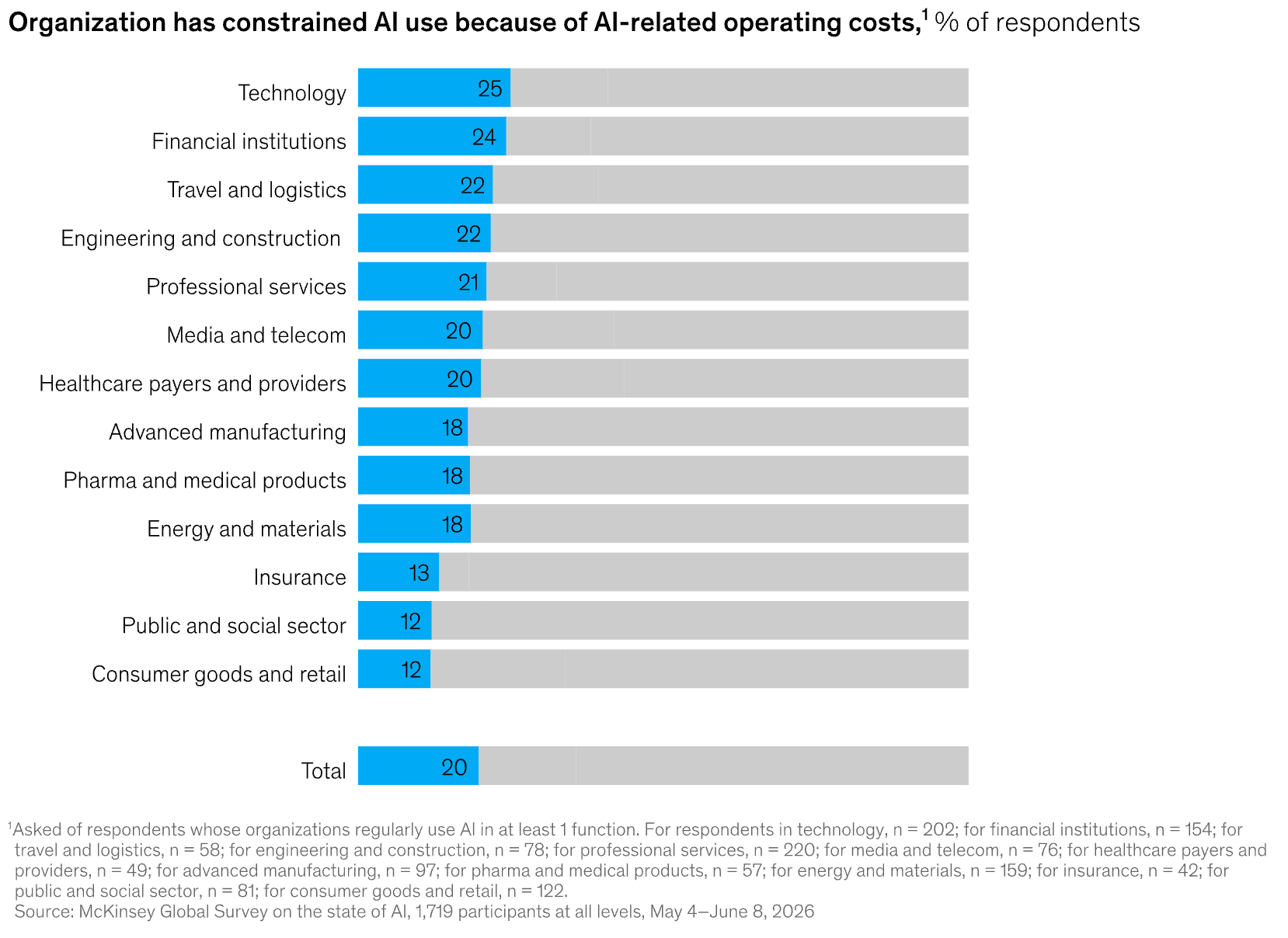
Some organizations have already hit the ceiling. The industry breakdown below shows one in five organizations constraining AI use because of operating costs, with technology at 25% and financial institutions at 24%. The sectors furthest along in deploying AI are hitting the ceiling first.
Successful organizations behave differently. Nearly three-quarters of AI high performers redesign workflows rather than layer AI onto existing ones, compared with one-quarter of everyone else. Gartner's warning for the rest is that mistaking access and adoption metrics for AI transformation, what it calls the enablement illusion, is draining ROI.
AI change management starts where the rollout plan stops. A rollout delivers licenses, training, and a date. It doesn't reach the barriers to AI adoption that appear afterward, whether the functions agree on what counts as value, whether each shapes AI to its own work, or whether what works in one reaches the next.
The Three Barriers to AI Adoption a Rollout Never Reaches
Faced with an AI deployment that isn't paying off, most organizations reach for the same three explanations: people need more training, the tool needs better onboarding, or the usage targets weren't ambitious enough. Each of those is fixable, which is part of the appeal. But none of them explains why a deployment running well still fails to show up in the numbers.
The real barriers to AI adoption are structural. 68% of executives view their current organizational structures as impediments to realizing AI's full value. Those obstacles sit in the operating model rather than in the tool, which is why a rollout plan can't reach them.
Here's a closer look at the three AI adoption challenges, each sitting at a different level: one across the enterprise, one inside each function, and one between them.
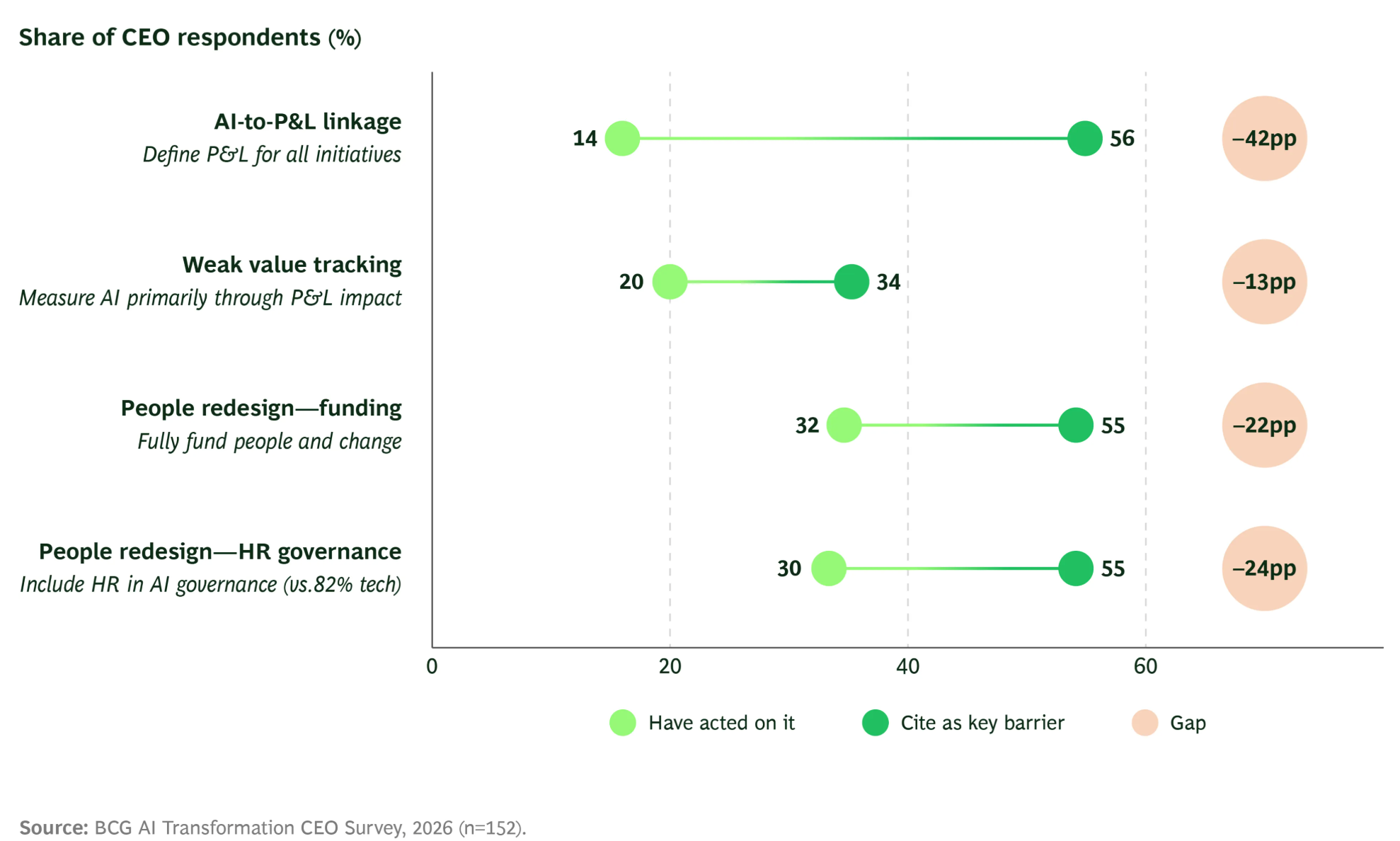
- AI Value Isn't Defined, So It Can't Be Measured: Before a return can be measured, the business has to agree what counts as one. 56% of CEOs cite the missing link between AI initiatives and the P&L as a key barrier, while only 14% have defined that link for their initiatives. The chart below measures the distance between naming that problem and fixing it. Naming a chief AI officer or a center of excellence feels like closing the gap, but that does not define what value means for finance, operations, and the business at once. And the further a fix sits from the technology function, the less likely it is to have really been made.
- Every Function Gets the Same Tools and Training: A single rollout gives every function the same tools and training regardless of what its work requires, so the fitting has to happen inside the function. Most organizations leave that to chance. Only 15% of leaders say decisions made with AI sit with the business unit or function leader actually using it, and only around one-third say it's very clear when humans should override or correct an AI output. A model that states something false with complete confidence is only a problem if nobody in the function knows when to overrule it.
- The Work Crosses Functions, but the AI Stays Put: Most business outcomes require several functions and several tools working together, but AI usually gets deployed inside one function at a time. 83% of operations leaders expect AI to break down functional silos, yet only 27% have fully embedded an AI strategy across business units, and only 41% operate with horizontal structures today. Until AI is wired into the operating model rather than bolted onto individual functions, its impact will be limited.
Next, we'll look at what AI change management looked like at three enterprises that ad.
DBS Bank Made Every Business Unit Prove Its AI Value
In its 2022 annual report, DBS, a Singapore-headquartered bank, said it aspired to reach SGD 1 billion in economic value from AI within five years. By the end of FY2023, the figure stood at SGD 370 million. Aspirations like that are easy to announce and hard to defend, because most organizations have never agreed on what counts as a return in the first place.
The scale makes that harder still. DBS runs more than 430 AI use cases, four times its 2021 level, on over 2,000 models spanning software development through client service across consumer and institutional banking. Spread that thin, a return is easy to claim and hard to prove.
So DBS defined it first. Returns would be traced to the three components that combine into banking profit: additional revenue, cost savings, and risk avoided. And use cases would be built for each line of business against the income that line actually earns.
The definition holds because no single function owns it. At DBS, the CFO of each business unit vets the AI value figures before they roll up to the enterprise, working alongside the technology executives who built the systems. Neither side signs off alone. The result is then tested against control groups, so it reflects measured AI benefit rather than projection.
"We will continue to reinvest efficiency gains into new builds and enhancements to sustain this momentum. Economic impact from data analytics and AI/ML was approximately SGD 1 billion in 2025."
—Chng Sok Hui, Chief Financial Officer, DBS Group Holdings
DBS reached the billion mark in 2025, two years into the five-year window, up from SGD 750 million in 2024. The cost-income ratio held at 40% while headcount declined, and DBS Joy, the customer-facing generative AI assistant, improved customer satisfaction by 23% across more than 235,000 interactions.
Running 430 use cases still brings every barrier to AI adoption you would expect. What DBS removed was the guesswork about what those use cases returned. It defined what counted as return before it measured anything, applying the definition across functions.
AI Change Management at Yorkshire Building Society Started with Frustration
Rebecca Fitzgerald, Director of Data and AI at Yorkshire Building Society (YBS), gives every area of the business the same instruction. Start with what frustrates you most, because that is usually the best use case available.
It is a small rule with a structural consequence. No two functions get the same rollout. The people doing the work decide what AI is for, rather than receiving a tool chosen elsewhere and being asked to find a use for it.
In the complaints team, the frustration was obvious. YBS is a 160-year-old UK mutual serving more than three million members. Heavy regulation meant colleagues spent a lot of time switching between multiple systems, searching for policies, summarizing long histories, and drafting detailed responses.
Three AI agents now split that workload. “Sam” summarizes long or detailed complaints, “Alf“ searches policies, procedures, and past cases, and “Penelope” drafts the final response. Human review stays central throughout.
The override rules were built the same way, inside the function rather than around it. YBS runs what Fitzgerald calls human-in-the-lead rather than human-in-the-loop, meaning the people using the AI decide when to overrule it. The AI literacy that makes that possible goes into the risk, compliance, and audit teams from the outset.
Her warning is that adding more checkpoints doesn’t scale, and that control teams left out of the design will stop the work in its tracks.
"We're starting to develop the QA and the controls alongside building the actual operational workflow."
—Rebecca Fitzgerald, Director of Data and AI, Yorkshire Building Society
It didn’t happen without sponsorship. YBS ran AI sessions for board members, executives, and senior leaders, and every chief officer now sponsors use cases, pushing AI adoption beyond the technology function and changing the AI culture around it.
The complaint agents save almost 30 minutes per complaint, with Sam returning an estimated seven minutes per use and Penelope up to 26 minutes on more complex responses. A separate pilot applying agents to risk and control testing is showing early efficiency savings of around 40%. Around 100 use cases are now running at various stages.
YBS never handed every function the same tools and expected them to fit. AI change management happened inside each function, where the rules for overruling the AI were also set. In a regulated complaints process, people who know what the right answer looks like can also catch a confidently wrong answer.
Cognizant Made AI Work Across Departments, Not Just Within One
At Cognizant, AI wasn't missing from any function. It was stuck inside each one. Across 350,000 employees, departments had built their own AI tools and agents on their own stacks for years, and every new capability made the experience more fragmented, not less.
Booking leave meant one system. Checking an IT request meant another. Employees had to work out which system owned a task before they could start it.
More AI made it worse. New agents landed in the same silos as everything else, so the tools got smarter while the experience stayed the same. That’s how AI culture hardens around workarounds.
Rather than add more capability to a broken foundation, Cognizant rebuilt its intranet from the ground up. The mandate for the new platform, OneCognizant (1C), was to centralize control without slowing anyone down.
The CIO function now stewards the agentic ecosystem for consistency, security, and lifecycle management, while business teams keep the flexibility to build. Departments develop their own agents or provision third-party ones, put them through structured verification and sandboxing, then wire them into the wider platform, where authorized users can discover them and use them alongside everything else. The agents sit in the operating model rather than in the department that built them.
"1C is not just a digital workplace upgrade; it's a fundamental shift in how we run the enterprise."
—Neal Ramasamy, Chief Information Officer, Cognizant
In practice, that looks like a request that crosses three departments and resolves in one conversation. An employee books leave, reserves a desk, and requests hardware without switching systems, because each agent was built by a different function and made available to all of them.
The platform launched with three agents and now spans more than 200 capabilities, routed hierarchically so new ones can be added without reconfiguring the network.
The ticket data shows what that removed. Incident tickets peaked at 186,799 in July 2025. OneCognizant went live in August, and by January 2026 the monthly figure had fallen by more than half. The team had projected improvement but not on that scale, and concluded in hindsight that a large share of those tickets came from employees who couldn’t find something or didn’t know which system owned a process.
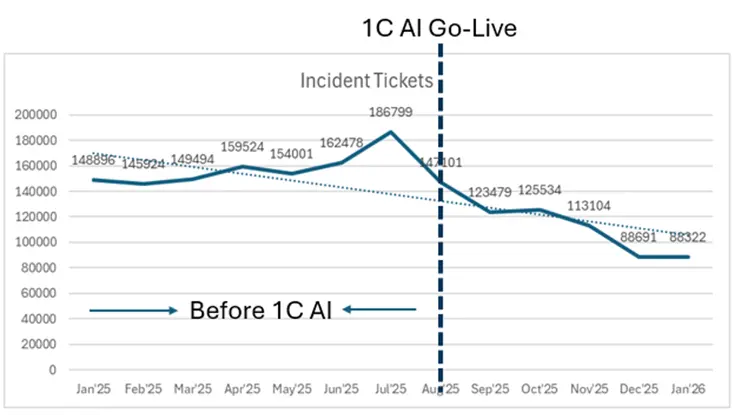
Rather than stopping departments from building their own agents or going through AI transformations, AI change management at Cognizant meant wiring AI into how work actually moves, across departments rather than inside them.
AI Change Management Doesn't End at Launch
Meta didn’t step back from AI. It stopped scoring how much people used it and went back to judging the work they produced. For ten months, its measurement strategy rewarded consumption, and consumption told the company nothing about what it was getting back.
An organization’s AI culture follows what gets measured. Usage can be mandated, tracked, and rewarded, and still say nothing about return. AI change management defines that ROI at the operating model level: whether functions agree on what counts as value, whether each function shapes AI to its own work, and whether what works in one function can work in others.
So before approving the next round of AI spend, don’t ask how many people are using the tool. Ask whether the functions that answer for the P&L have agreed on what using the tool produced.
.avif)
Frequent Asked Questions
How can CFOs tell whether AI spend is creating value?
CFOs can tell by measuring what AI use produces rather than how much it gets used. At DBS Bank, each business unit's CFO vets the AI value figures before they roll up. The bank reported about SGD 1 billion in economic value from data analytics and AI in 2025.
What are the biggest barriers to AI adoption?
The biggest barriers are structural rather than technical. In one operations survey, 83% of leaders expected AI to break down functional silos, yet only 41% operate horizontally today. A rollout plan can’t reach problems that live in the operating model.
How does AI culture affect whether AI spend creates value?
A company’s AI culture follows what gets measured. When usage is the target, AI culture bends toward usage. Meta's engineers competed on a token leaderboard and took on extra tasks to raise their scores, which pulled them away from their actual work.
What are the challenges of adopting AI in the workplace?
The main AI adoption challenges come from the disconnect between individual gains and business results. In one global survey, 80% said AI improved their own productivity while only 37% attributed any EBIT impact to it. Usage measures activity rather than what that activity produces.
What is AI change management?
AI change management is the work of turning AI use into business return after launch. A rollout delivers licenses, training, and a timeline. AI change management decides who owns the value and how each function shapes the tool to its work.


.svg)


_0000_Layer-2.png)

