
How BMW and Renault Scaled Agentic AI in Manufacturing
BMW, Renault, and Schneider Electric broke the pilot trap by moving from standalone AI deployments to integrating AI into operational infrastructure, where results compound across every plant.
Only 2% of manufacturers have fully embedded AI into their workflows, though 74% have already invested.
Isolated systems, not weak models, keep agentic AI in manufacturing stuck in pilots.
BMW, Renault, and Schneider Electric all scaled AI by stopping standalone pilots and deploying connected operational infrastructure instead.
A machine stops on the floor at Bosch's Bamberg facility with no warning. The line goes quiet, and every minute of that quiet costs money.
In the past, a stop like this meant a search across disconnected systems. Maintenance logs on one platform, sensor history on another, repair records buried in files that walked out the door when experienced engineers retired. The answer almost always existed somewhere. The line just stayed dark while someone went looking for it.
The plant already had AI running, but each system worked in isolation, blind to the machine beside it and to every other plant in the network. More data wasn't creating more value. It was locked in silos.
Then Bosch made one structural decision. It stopped deploying agentic AI in manufacturing as isolated use cases and built a shared platform where every failure feeds a common intelligence layer that every plant can inherit.
Today, when a machine stops at Bamberg, the Shopfloor Agent diagnoses the cause in seconds, guides the operator through the fix, and triggers the next maintenance task itself. Reduced downtime alone saves roughly €850,000 per plant a year.
"Our Shopfloor AI Agent is slashing production downtime by helping our teams resolve disruptions three to five times faster."
—Norbert Jung, CEO, Bosch Connected Industry
This wasn't a startup building from nothing. It was a €90.3 billion manufacturer stuck in the same isolated AI pilots as everyone else, until that one decision let its results compound. Bosch now sells the platform to other manufacturers, so every COO who is still rebuilding those AI capabilities from scratch is already a step behind.
It also reframes a question most manufacturers haven't answered. What is the role of AI in industrial automation when the technology already works on a single line, but the wins never travel beyond it?
For years, the answer was a better AI tool. One plant would deploy generative AI in manufacturing for quality checks; another would pilot AI agents for manufacturing on a single line; and each win stayed where it landed.
The plants pulling ahead now treat agentic AI in manufacturing as connected infrastructure: multi-agent systems that operate within production workflows, diagnosing failures and acting in real time rather than producing reports for later review. The question isn't whether AI works on one production line anymore. It’s what it costs to keep every other line waiting for an answer that already exists somewhere in the network.
In this article, we'll look at how three leading manufacturers each solved the structural barriers that keep agentic AI in manufacturing stuck in pilots.
The Real Reason Most Manufacturing AI Never Leaves the Pilot Stage
What Bosch achieved at its Bamberg plant is easy to attribute to its size, resources, or decades of manufacturing experience. But the evidence suggests something much simpler. The companies pulling ahead are making different architectural decisions about how they deploy AI.
Agentic AI in manufacturing is moving rapidly from experimentation to real-world deployment. The challenge is no longer adoption. By 2025, 88% of organizations were already using AI in at least one business function.
The real challenge is scaling those deployments across operations. A survey of 101 manufacturing COOs found that two-thirds of organizations remain stuck in the exploration or targeted implementation stage, while only 2% have fully embedded AI across their operations.
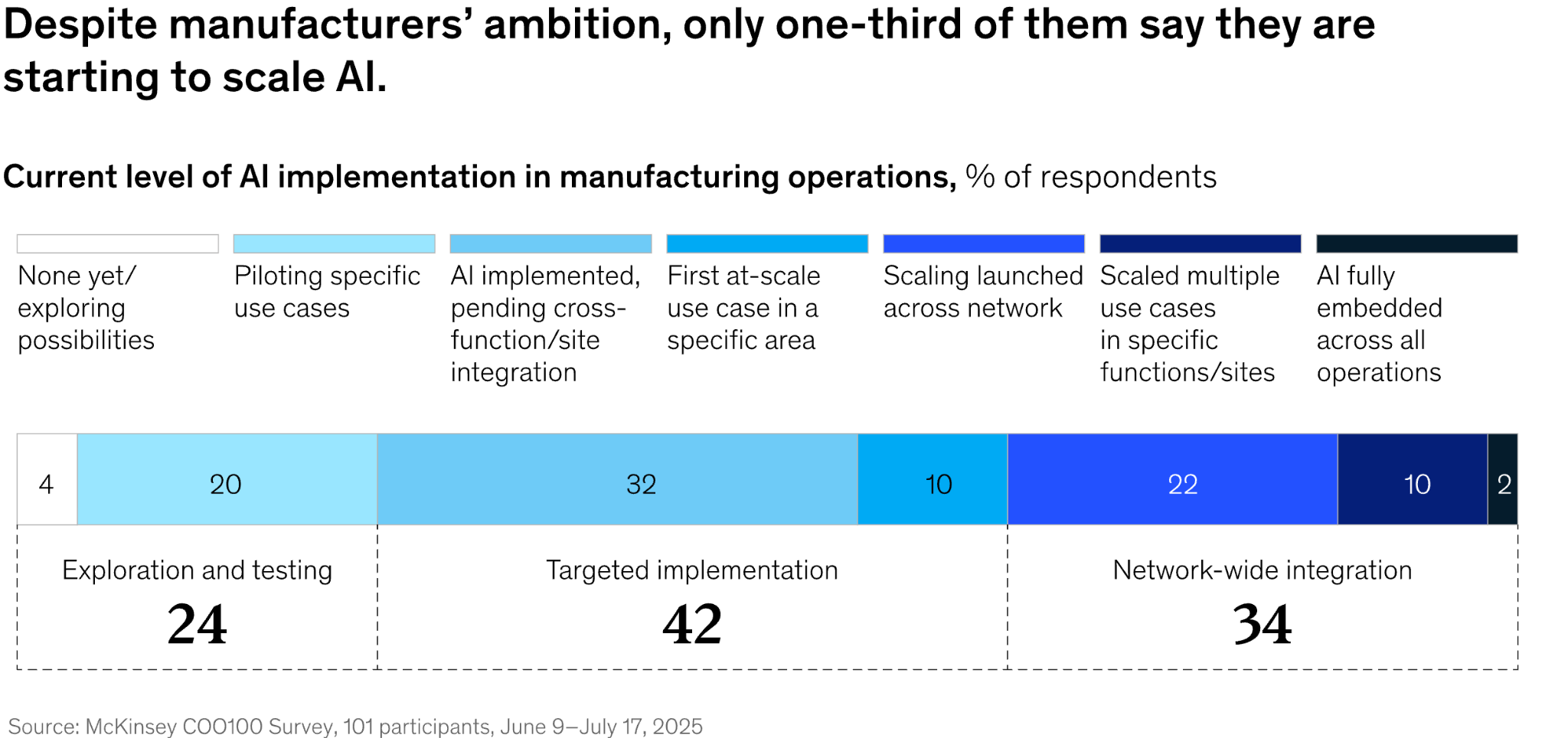
The returns reflect it. 74% of companies have invested in AI and seen limited value from it. These aren’t underfunded pilots at small companies. They are enterprises with data, models, and budgets to scale. The technology itself isn’t the constraint.
Research on AI adoption across tens of thousands of U.S. manufacturing firms points to the core issue. Companies that introduce AI frequently see a measurable drop in productivity before any gains arrive, a trajectory researchers call a J-curve. The losses are sharpest at older, more established firms, not because their models are weaker, but because AI introduced into environments built around legacy processes, disconnected platforms, and siloed data doesn’t compound. It creates friction instead.
"AI isn't plug-and-play. It requires systemic change, and that process introduces friction, particularly for established firms."
—Kristina McElheran, Professor, University of Toronto
Manufacturers that break that pattern share one trait. They align AI directly with core operational processes rather than treating it as a collection of standalone experiments.
Instead of deploying separate AI solutions for scheduling, quality inspection, or predictive maintenance, they build a connected operational infrastructure where those capabilities share data, workflows, and intelligence across the factory network. The AI models themselves are increasingly similar across the industry.
The structural decision to make AI connected and reusable, rather than isolated and use-case specific, is what separates the leaders. That is the decision Bosch made at Bamberg, and it is the one separating the 2% from everyone else.
The Three Structural Gaps Keeping Manufacturing AI Stuck in Pilots
Most manufacturers can point to successful pilots centered on machine learning and generative AI use cases. Far fewer can point to AI that scales across operations.
In fact, 46% of COOs at billion-dollar manufacturers cite IT and OT system limitations as the biggest barrier to scaling AI, while one in four can’t reuse proven applications across sites. The challenge isn’t ambition or technology. It is architecture.
Here’s an overview of the three barriers that prevent agentic AI in manufacturing from scaling beyond the pilot stage:
- Every AI Deployment Starts From Scratch: Many agentic AI deployments in manufacturing are built on separate pipelines, models, and infrastructure, leaving little to reuse across production lines or sites. As a result, the tenth deployment often costs nearly as much as the first. Much of the problem originates in the factory's operational technology stack. Systems such as SCADA platforms, PLCs, and MES environments were designed for reliability and isolation rather than data sharing. Without a common data foundation, AI remains difficult to scale across operations.
- AI Lives Outside the Workflow: When AI outputs surface in dashboards rather than inside the MES or ERP systems where production decisions are made, insights rarely translate into action. Operators can’t act while decisions are still pending, leaving AI disconnected from day-to-day operations. The challenge is widespread: 64% of senior executives cite integration complexity as their top barrier to scaling AI. Without embedding AI into existing workflows, even advanced systems tend to underdeliver or create new bottlenecks rather than remove existing ones.
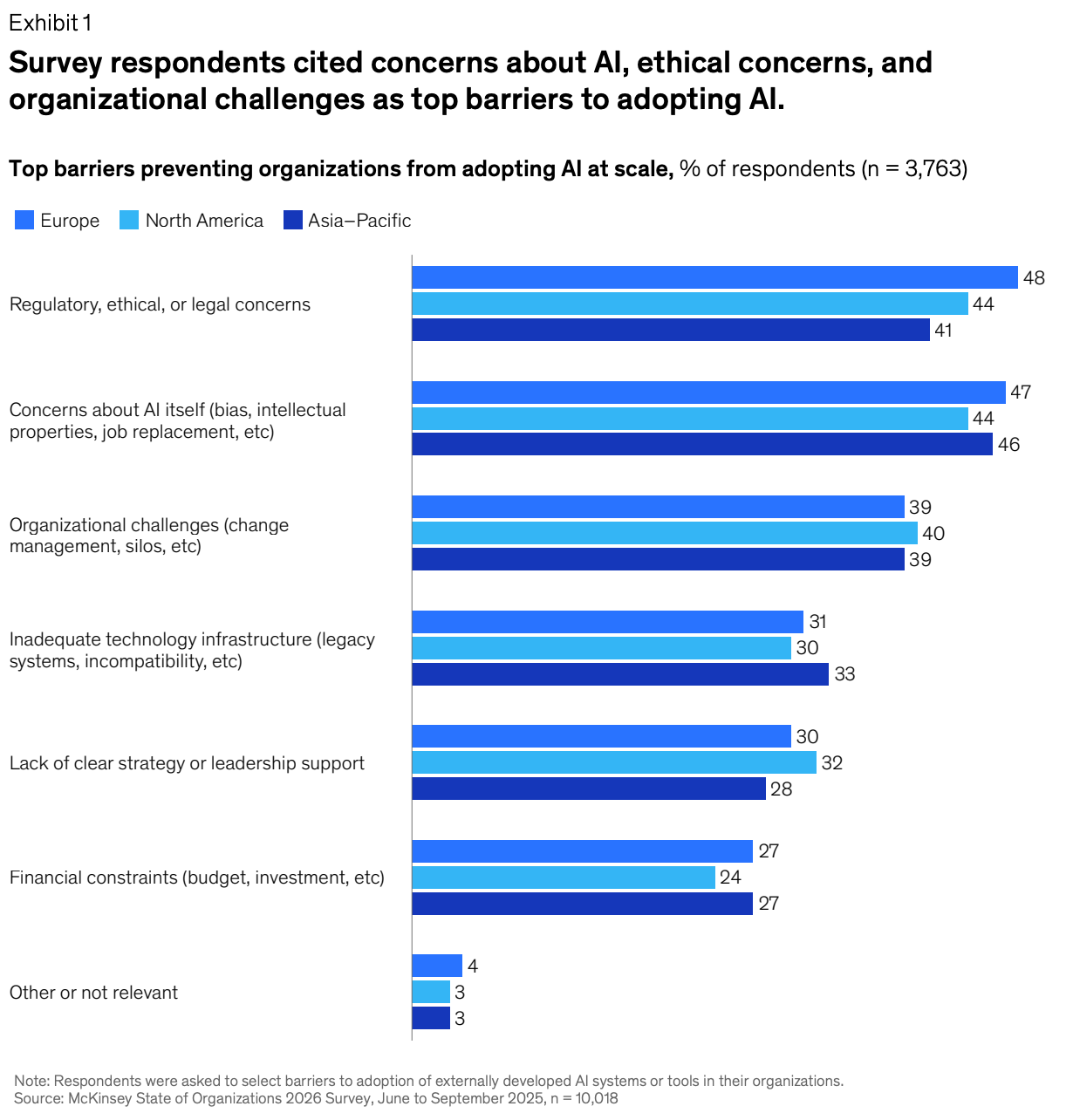
- No Governance, No KPI Accountability, No Scale: Most manufacturers lack a formal structure for deciding which AI in industrial automation initiatives get funded, who owns the outcome, and which metrics define success. McKinsey's State of Organizations 2026 survey makes the pattern clear. As Exhibit 1 below shows, when 3,763 respondents were asked to name the top barriers to adopting AI at scale, the leading answers weren't technical. Regulatory and ethical concerns topped the list at 41 to 48% across regions. Beyond those headline concerns, high-performing organizations are three times more likely to assign senior operational leaders accountability for AI outcomes, and where AI-specific KPIs exist, nearly two-thirds of manufacturers meet or exceed their performance goals. Governance isn't a compliance function. It is what turns AI from a pilot into an operational capability.
Next, we'll look at how leading manufacturers overcame these barriers and the specific changes that helped them scale AI beyond the pilot stage.
BMW Turned One AI Platform Into 1,000 Use Cases Across Every Plant
When isolated deployment architectures can't compound, the cost is initially invisible. Each new AI use case looks like progress. It is only when the tenth deployment costs as much as the first that the structural problem becomes impossible to ignore.
BMW Group ran into exactly that wall. The automaker operates more than 30 production sites worldwide across BMW, MINI, and Rolls-Royce brands, and its early AI quality inspection projects delivered measurable results at individual plants. But each deployment relied on plant-specific data formats, separate pipelines, and standalone infrastructure, so what worked at one facility couldn't be easily reused at another.
As more use cases emerged, the limitation became clear. Every new deployment required teams to rebuild much of the same foundation, slowing expansion across the network.
BMW addressed the problem by creating AIQX, a company-wide AI platform that standardized cameras, sensors, cloud analytics, and real-time feedback systems across its plants. Instead of treating each project as a standalone initiative, every new AI deployment in manufacturing could build on the same foundation.
The impact appeared quickly on the factory floor. At Spartanburg, South Carolina, where more than 1,500 vehicles are produced daily, AI now manages roughly 500,000 stud welds. Misplacements are corrected automatically, saving more than $1 million annually. Meanwhile, at Debrecen, BMW's newest plant, AI was integrated before production began, with operations tested virtually through the company's Virtual Factory environment.
The same foundation enabled BMW to move from standalone tools to AI agents for manufacturing and procurement. The company launched AIconic, a multi-agent system for its Purchasing and Supplier Network that searches supplier information, retrieves internal knowledge across business functions, and is now being built to recommend actions and automate tasks on its own.
"We are now entering the next chapter: scaling AI across our organization to unlock new levels of efficiency and to empower smarter, faster, and more forward-looking decision-making."
—Dr. Nicolai Martin, Member of the Board of Management, BMW AG
The results reflect the value of a shared foundation. More than 1,000 AIQX use cases are now live across BMW Group plants worldwide, while AIconic has grown to 1,800 active users running 10,000 searches and is now the standard across the Purchasing division.
BMW's breakthrough wasn't a better AI model. It was a reusable platform. Once that foundation was in place, new deployments could be replicated across the organization rather than rebuilt from scratch, which is the structural shift that lets agentic AI in manufacturing scale rather than stall at one plant.
Why Renault's Operators Now Spend 80% of Their Time Acting, Not Detecting
AI insight that lives outside process workflows rarely changes decisions. There’s a slight chance it may inform them if someone remembers to check. For Renault Group, that challenge was playing out across a manufacturing network generating billions of data points every day.
Renault operates more than 30 industrial sites globally and posted €56.2 billion in revenue in 2024. Its factories were generating 5 billion data points per day from 8,500 connected pieces of equipment. Yet quality decisions, scheduling adjustments, and supply chain responses still depended on people finding the right information and deciding what to do next.
The issue wasn't a lack of data. Rather, AI insights existed outside of the workflows where decisions were being made. The solution came in the form of the Industrial Metaverse, a real-time digital twin connecting plants, equipment, and operations across Renault's manufacturing network.
Instead of treating analytics as a separate destination, Renault connected AI directly to operational workflows. The Supply Chain Control Tower concentrates information flows, identifies risks, and proposes AI-optimized responses within the same systems teams use to execute decisions.
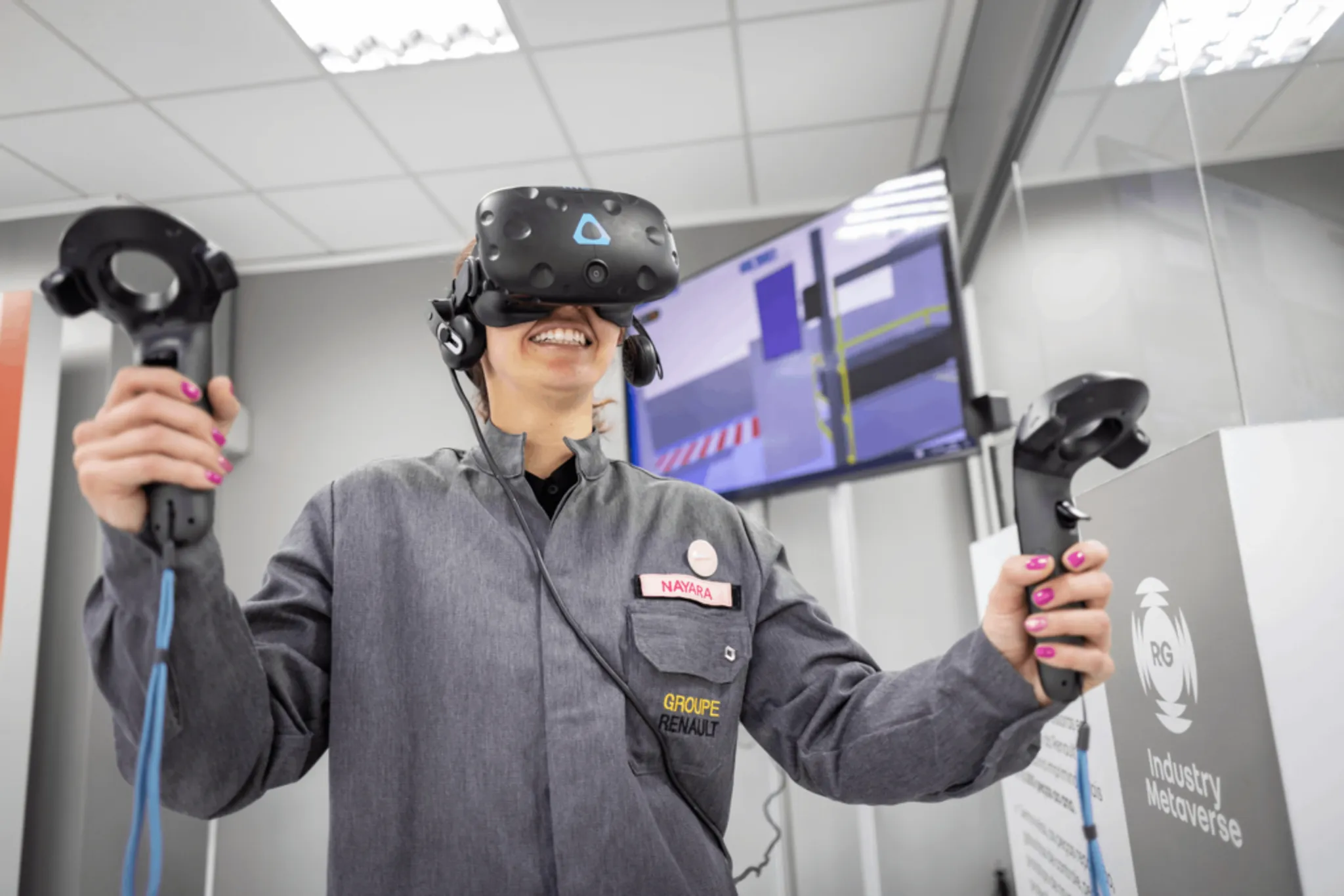
The clearest measure of what changed is how operators spend their time. Before the Industrial Metaverse, teams spent roughly 80% of their effort detecting anomalies and 20% resolving them. With AI embedded into operational workflows, that ratio shifted to 20% detection and 80% action.
"Every day, a billion points of data are collected within the Renault Group's industrial sites. The Metaverse provides real-time supervision that increases the agility and adaptability of industrial operations as well as the quality of production and the Supply Chain."
—Jose Vicente de los Mozos, EVP Industry Group, Renault Group
Since 2019, Renault has avoided 300 production stoppages through real-time AI alerts. Total savings reached €780 million, including €270 million from AI initiatives in 2023 alone. Renault's Re-Industry plan now targets a 50% reduction in EV production costs by 2027, with the Industrial Metaverse as the infrastructure that enables it.
Schneider Electric Gives Every AI Project an Owner and a KPI
So far, we've looked at two structural fixes: BMW built a shared platform that lets deployments compound, and Renault moved AI into the workflow where decisions are made. But even the right platform and the right workflow integration stall without someone accountable for the outcome. That is the gap Schneider Electric closed.
Schneider's problem was never a shortage of AI ambition. Initiatives were emerging across business units, but few made it from experiment to production. What was missing was a clear operating model.
No structure existed for deciding which AI initiatives deserved investment, who owned the outcome, or what metric defined success, so investment flowed toward projects judged on technical performance while factory-level results went unaddressed. At Schneider's scale, that meant pilots multiplied faster than business value.
Today, Schneider Electric holds nine World Economic Forum Global Lighthouse Network designations, more than any other manufacturer. That AI outcome came from three structural decisions made before any use case was approved.
The first was governance. In 2021, Philippe Rambach was appointed Chief AI Officer and established an AI Hub of more than 350 specialists structured to partner directly with business units rather than operate as a centralized IT function. Every initiative moves through a stage-gate process from vision through incubation to production, with the business case reassessed at every step. Use cases that can’t demonstrate a path to production are stopped before resources are committed.
The second was accountability. Every internal AI application tracks two KPIs: one adoption metric and one performance metric. Business stakeholders, not the AI development team, own both.
"Our goal is not to have pilots and experiments: use cases are deployed at scale."
—Philippe Rambach, Chief AI Officer, Schneider Electric
The third was workforce capability. AI training became mandatory across four employee groups, from production-line workers to business leaders and AI specialists. In January 2026, Schneider's Wuhan factory received its ninth Lighthouse designation, including recognition for talent development.
Nearly 100 AI use cases are now running in production. For instance, at the Monterrey 1 factory in Mexico, manufacturing costs fell by 16%, product defects dropped by 20%, and customer lead time was reduced by 49% over three years.
Schneider Electric's AI didn’t scale because the models were better. The manufacturers who are still waiting for certainty before acting are the ones running pilots without a business owner, a KPI, or a path to scale.
The Structural Decision That Separates the 2% From Everyone Else
When a machine stops on the floor at Bamberg today, the Shopfloor Agent diagnoses it in seconds. Not because Bosch found a better model, but because it built a shared platform that every machine, plant, and agent could inherit.
Across more than 10,000 senior executives in 15 countries, fewer than 20% of organizations deploying AI report significant operational impact. The gap isn't investment or ambition. It is the structural conditions that allow each deployment to build on the last, rather than stalling as an isolated pilot.
So the question for every COO still presenting pilots at the next board review isn't how to find a better AI use case. It is about whether the organization has created the conditions that enable agentic AI to scale in manufacturing.
.avif)
Frequent Asked Questions
How do AI agents deliver results differently from traditional automation?
Traditional automation executes fixed rules on known inputs. AI agents operate across multiple variables simultaneously, adapt within defined parameters, and act inside the workflow in real time. At Bosch, a machine stop that once triggered a manual search across disconnected systems is now diagnosed in seconds. At Renault, operators previously spent 80% of their time detecting anomalies and 20% resolving them. With AI embedded into operational workflows, that ratio flipped to 20% detection and 80% action. The result isn’t faster automation of the same task but a structural reallocation of human time from searching for problems to solving them.
What are the highest-impact generative AI use cases in manufacturing today?
Quality inspection, predictive maintenance, and supply chain control are delivering the clearest ROI at scale. BMW's AIQX covers variant detection and completeness checks across global plants. Bosch's Shopfloor Agent resolves disruptions three to five times faster, saving approximately €850,000 per plant annually. Renault's Industrial Metaverse has avoided 300 production stoppages since 2019 and delivered €270 million in AI-specific savings in 2023 alone. In each case, the results compound because the use case is embedded in the workflow rather than sitting in a separate reporting tool.
How are manufacturers using generative AI on the factory floor?
BMW is the clearest example. Its AIQX platform standardized cameras, sensors, and cloud analytics across its plants worldwide, with AI quality inspection now running across more than 1,000 active use cases. At Spartanburg, AI manages roughly 500,000 stud welds per day, with misplacements corrected automatically, saving more than $1 million annually. The reason it scales is that generative AI in manufacturing works here as part of connected production infrastructure, not as a standalone tool.
Why do most industrial AI pilots fail to scale across operations?
The barrier is structural, not technical. Only 2% of manufacturers have fully embedded AI across all operations, and 74% of companies have invested in AI and seen limited return. Three root causes account for most failures: isolated deployment architectures that cannot share data across sites, AI outputs surfaced in dashboards outside the workflows where decisions are made, and no operations leader accountable for factory-level results. While the technology works, the conditions for compounding it across a network don’t yet exist in most plants.
What is agentic AI in manufacturing?
Agentic AI in manufacturing refers to systems that monitor equipment, predict maintenance needs, and optimize scheduling simultaneously, acting inside operational workflows rather than generating reports for humans to review later. The key distinction from earlier AI tools is that agentic systems make decisions within defined parameters in real time. At Bosch's Bamberg plant, when a machine stops, the Shopfloor Agent diagnoses the root cause in seconds, delivers resolution instructions to the operator, updates the shift log, and triggers a follow-up maintenance task, with no human triage required.


.svg)


_0000_Layer-2.png)

