
How 3 Health Systems Turned Hospital Records Into Revenue
AI scribes save doctors time, but the financial return comes when care becomes a bill. Inova, Mercyhealth, and Baylor Scott & White show how revenue cycle management automation captures it.
Once doctors adopt an ambient AI scribe, it’s easy to count it as a finished ROI story. But the scribe only makes the record fuller, and the return depends on how that record becomes a bill.
That’s where revenue leaks. Billing errors and backlogs mean hospitals get paid less, get paid later, or face denials.
Revenue cycle management automation closes those gaps by checking the record as it becomes a bill, with a person approving each decision.
A family doctor’s day generally starts before 8 a.m. Between back-to-back visits, there’s little time to write notes, so they often pile up by the time the clinic closes. Doctors finish them at home after dinner, rebuilding each visit from memory. They call it pajama time.
At McLeod Health, a seven-hospital system in the Carolinas, that time was measurable. Before an AI pilot, the median clinician in one group spent 2.8 minutes on each visit’s note and 5.6 hours every four weeks documenting after hours.
Bryon Frost, McLeod’s chief medical information officer, wanted to give that time back. So he bought an ambient AI scribe, a tool that listens to the visit and drafts the note for the doctor. He said publicly that if it lost money, so be it. Privately, he had one worry.
“In my head, I was thinking that I don’t want to have to justify to the CFO in three months why we chose the solution.”
—Bryon Frost, Chief Medical Information Officer, McLeod Health
The scribe did its job. In a 90-day pilot that McLeod later published in a peer-reviewed journal, clinicians spent 28.3% less time on notes. Then something Frost hadn’t planned for happened. The CFO came around because the notes had changed McLeod’s bills.
Why would a note change a bill? It comes down to how a hospital gets paid. After a patient’s care, the hospital has to turn what happened into a bill. It decides whether the patient was admitted or only kept for observation, translates the care into billing codes, and checks the bill before sending it to the insurance company. That path, from the visit to the payment, is called the revenue cycle.
Each step takes time, and a mistake at any point can cost the hospital money. That’s why hospitals are bringing AI into the process. For a hospital leader weighing that move, the first question is simple. What is revenue cycle management automation, or RCM automation? Put simply, it’s using AI to help with each step in the revenue cycle, such as setting patient status, assigning billing codes, and checking claims before they go out.
The scribe wasn’t built for any of that, but it changed the starting point for every bill: the note. Each visit is billed at a complexity level, a bit like a grade, and higher levels pay more. As ambient clinical documentation captured more of each visit, the share of returning patient visits billed at level 4 rose by 3.8 percentage points.
Using Medicare rates, McLeod estimated an extra $2,629 per provider per month from the pilot, with $379 from higher-level visits and the rest from an 8.5% rise in returning patient volume. After subscription costs, Frost puts the net gain at almost $2,600.
Those gains came partly by accident, and insurers now scrutinize the same records. The stakes rise now that Frost has begun taking the scribe into McLeod’s hospitals, where the record shapes how a stay is paid and whether the insurer accepts the bill. Under his governance rules, no AI at McLeod runs without a human in the loop.
To make gains like these repeatable and defensible, AI revenue cycle management has to check the record at each step of the revenue cycle, with a person approving each decision. In this article, we’ll explore three places revenue leaks after the AI scribe finishes its note, and how leading health systems use AI with human review to close each one.
How Ambient AI Scribes Affect Hospital Revenue
McLeod isn’t an outlier, and the same pattern shows up at a much larger scale. Across more than 1.2 million visits at one academic health system, physicians who adopted ambient AI scribes generated 5.8% more billable work per week than those who didn’t. That was worth about $3,044 a year per physician, and their claims were denied less often.
“These findings provide initial evidence that AI scribes change how physicians code and bill.”
—A Jay Holmgren, Associate Chief for Research, UCSF Division of Clinical Informatics and Digital Transformation
However, the researchers couldn’t tell whether the gains came from more care or from coding changes. If fuller notes change how visits are coded, someone needs to check the record before it becomes a claim.
Yet health systems are adopting AI scribes faster than revenue cycle management automation that works on billing. In Eliciting Insights’ survey of 120 health systems, 68% use or plan to use ambient AI scribes, compared with 36% for AI medical coding.
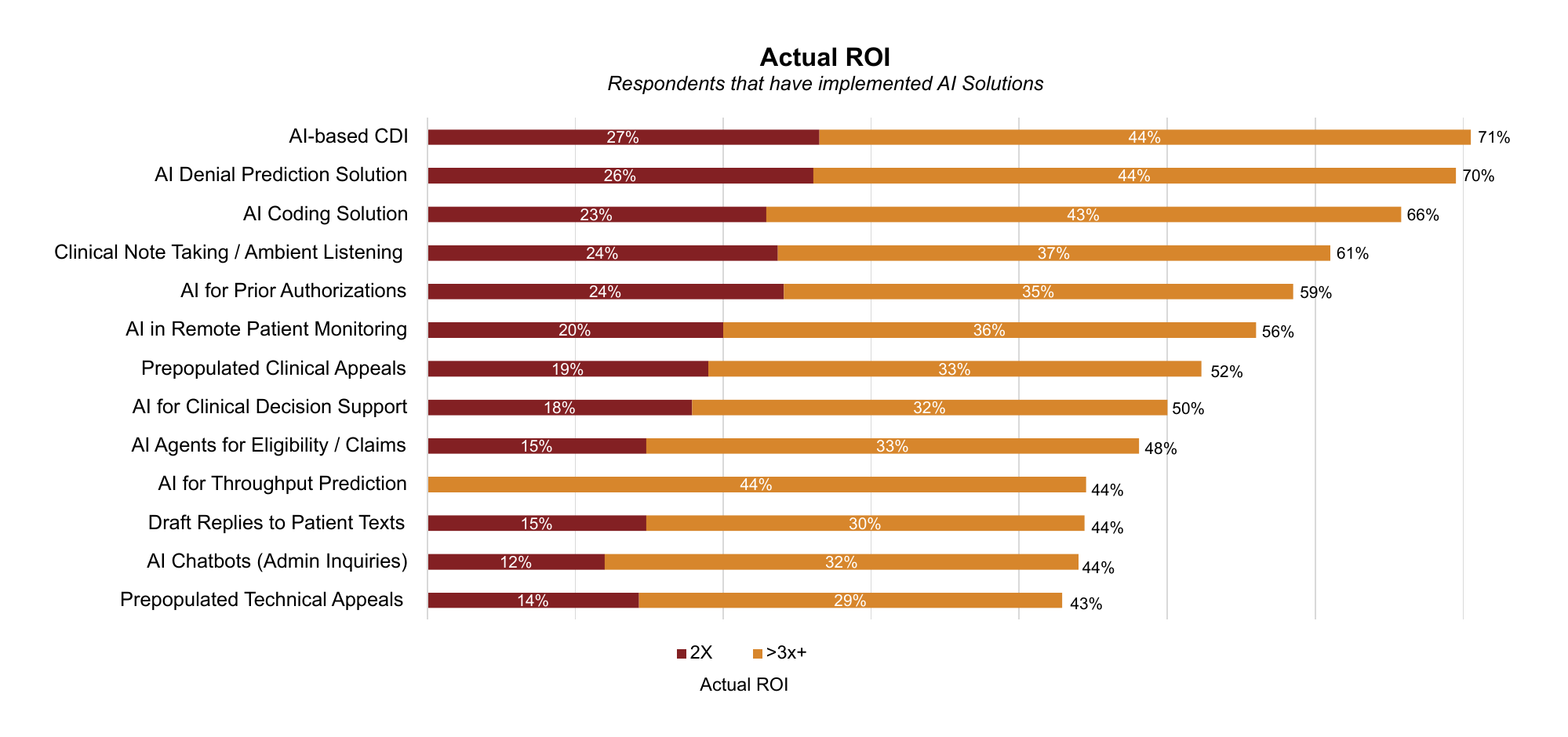
Yet the tools with lower adoption deliver higher returns. Among systems that have implemented each tool, 71% report at least double their money back from AI that flags documentation gaps, and 66% from AI medical coding, compared with 61% from scribes, as the chart below shows.
Payers (the insurers and government programs that pay hospital bills) are watching that disconnect. Insurance plans covering 62 million members found inpatient costs per member rose about 9% from 2023 to 2024, attributing about a fifth of that rise to hospitals coding stays as more complex without a matching rise in care. They link that shift to the spread of AI documentation and coding tools.
Hospitals dispute that link and point to sicker patients, but their national trade group agrees that human validation remains essential to coding integrity.
The same record can affect what a hospital earns and what a payer agrees to pay. Next, let’s look at the three points where the record becomes a bill, and what revenue cycle management automation needs to do at each one.
Three Places Revenue Leaks After the Ambient AI Scribe Is Done
An ambient AI scribe does what it was bought to do. Doctors spend less time on notes. But getting paid depends on what happens after the visit, when the hospital sets the patient’s status, codes the care, and sends the bill. Revenue cycle management automation handles the steps the scribe doesn’t.
Getting paid is already expensive. Hospitals spent $43 billion in 2025 trying to collect payment from insurers for care they had already delivered. To avoid that cost, hospitals need to check the record at each step before the payer does.
Here are the three places revenue leaks after the note is written:
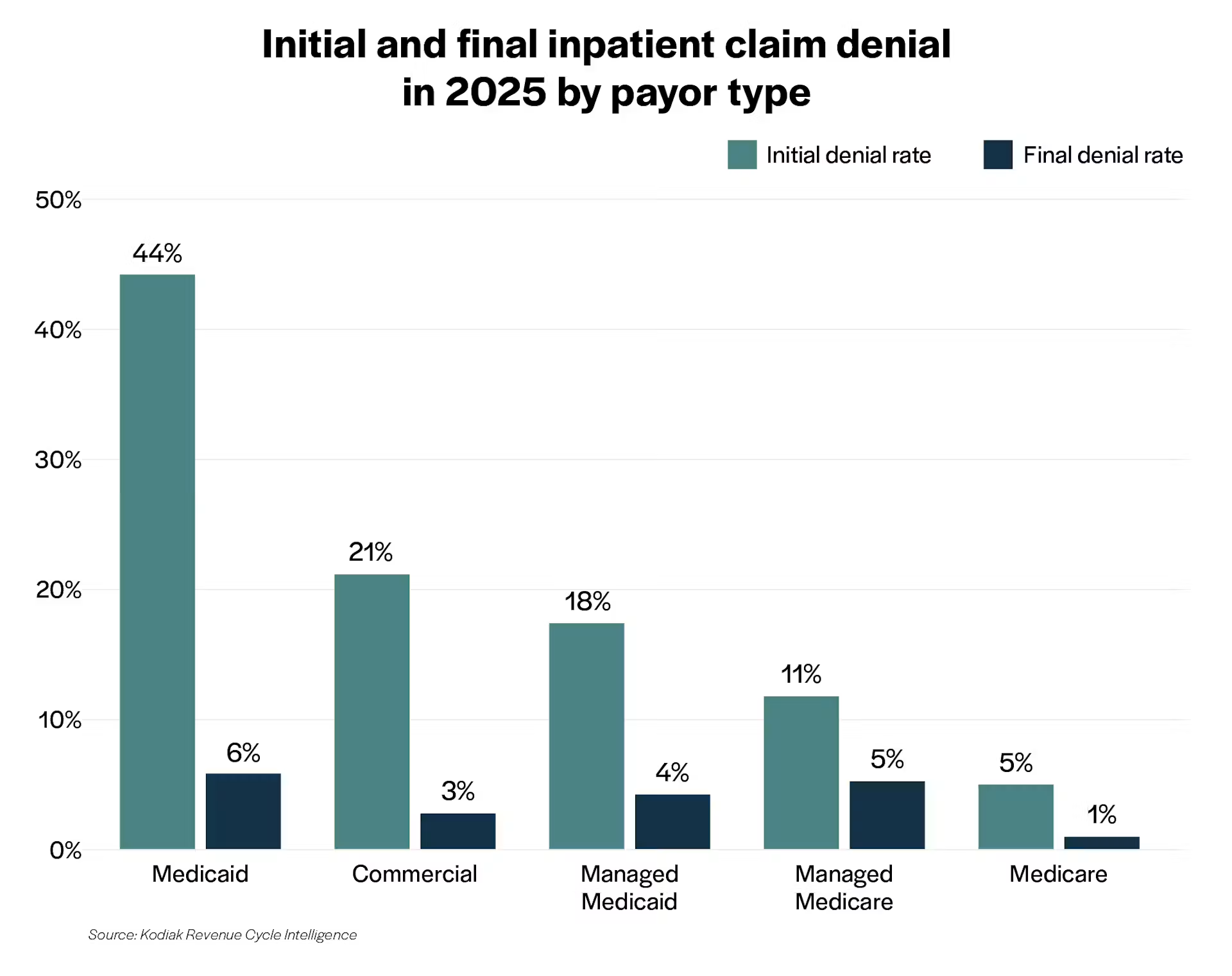
- Getting Paid Less Than the Care Delivered: Hospitals must decide whether to admit a patient or keep them under observation, which Medicare counts as outpatient care. A wrong call means lower payment, or a denial after discharge if the insurer decides the stay wasn’t needed. Clinical denials of inpatient claims, including medical necessity denials, rose more than 12% in 2025 and are among the hardest to overturn. As the chart below shows, Medicaid initially denied 44% of the inpatient claims it received but ultimately refused just 6%. That money comes back only after costly appeals, so healthcare denial management starts with settling patient status during the stay.
- Coding Backlogs That Delay Payment: Before a bill goes out, medical coders turn the patient’s chart into billing codes. But the national coder shortage is as high as 30%, and even UC Davis Health, which offers California salaries and fully remote roles, struggles to fill coding positions. When charts pile up faster than coders can process them, bills go out late and payments are delayed. AI medical coding can handle routine charts, leaving coders to check its work and handle complex cases.
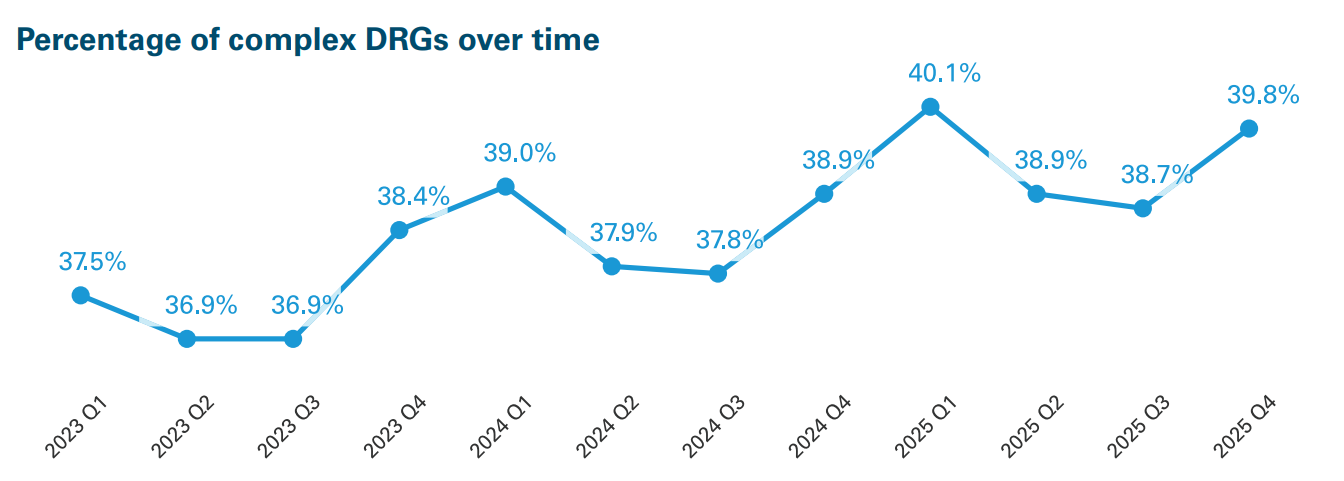
- Bills That Don’t Match the Record: A hospital bill lists the main diagnosis and secondary conditions that affect payment. Missing a supported condition loses revenue, and adding an unsupported one invites payer disputes. An insurer analysis found the share of inpatient stays billed as complex rose from 37.5% in early 2023 to 39.8% by late 2025, peaking at 40.1% in early 2025, as the chart below shows. The climb wasn’t smooth, but it never returned to where it started. The analysis estimated $942 million in added costs over two years, driven mostly by secondary diagnoses added without a matching change in care, a shift it links to the spread of AI-assisted billing tools. Hospitals need to check each bill against the full chart, with a physician confirming the findings.
Each of these leaks happens after the scribe’s work is done, and each one needs a person to confirm what the AI finds. Let’s walk through how three health systems used revenue cycle management automation to close them, starting with patient status.
Getting Paid for the Care Delivered: Inside Inova’s 20-to-1 Return
More than 1,000 providers at Inova Health use an ambient AI scribe. It can draft their notes, but it can’t answer the question that shapes how much Inova gets paid for a hospital stay. Should this patient be admitted, or kept under observation?
That question comes up constantly. Inova, a nonprofit system with five hospitals, more than 26,000 employees, and $7.2 billion in net operating revenue, handles more than 102,000 admissions a year. Keep a patient who needs inpatient care under observation, and the hospital is paid less. Admit one who doesn’t, and the insurer may deny the claim after discharge.
Yet the nurses who reviewed those decisions used to start each day building lists by hand of everyone admitted from the emergency department overnight. The team also had limited visibility into its observation rate, the share of patients kept under observation rather than admitted.
Hiring more reviewers wasn’t the answer. Inova’s leaders knew they couldn’t scale the work by adding staff alone.
In December 2024, Inova began a six-month pilot of an AI revenue cycle management platform that gives each patient a level-of-care score. The score updates as lab results, imaging, and clinical notes come in, helping nurses decide which cases to review first. Clinicians make the final call on each patient’s status, in line with Inova’s commitment to human oversight of AI-enabled decisions.
“We’ve right-sized our observation rate, and we’re now getting paid for the level of care we actually provide.”
—Michelle Tutem-Greame, AVP of Revenue Integrity, Inova Health
Inova now reviews 80% of cases within the first 24 hours. The pilot projected a 10-to-1 return and delivered a 20-to-1 operational return. Inova’s vice president of revenue cycle also says the tool helps the team measure the denials it prevents.
Inova stopped getting paid less than its care was worth by reviewing status early, not after discharge. Revenue cycle management automation flags which cases need attention, and clinicians make the final call.
From 16 Days to 7: Mercyhealth’s Fix for Coding Delays Without New Hires
At Mercyhealth, coders could review only about 30% of the charts coming through. The rest moved forward without a full coding review, and the charts that were reviewed sat in a queue for an average of 16 days. Since a bill can’t go out until its chart is coded, payment waited too.
MercyHealth, a regional health system based in Rockford, Illinois, runs seven hospitals across Illinois and Wisconsin and serves more than 2.4 million patients a year. As visits grew, monthly volume passed 130,000 charts.
Hiring more coders wasn’t a practical fix. MercyHealth struggled to find experienced coders and was competing with its own organizations for the same people.
In 2023, MercyHealth adopted autonomous coding, a form of AI medical coding that assigns billing codes to routine charts without a coder entering each one. After evaluating several vendors, the team chose one it could customize for different payer rules and integrate with its existing electronic health record. The rollout began in family and internal medicine, then expanded to 10 specialties across 37 sites. Complex or uncertain cases can still go to a coder.
You might be wondering whether you can trust AI medical coding with the bill. Kelly Pierson, who leads coding at Mercyhealth, initially worried that the system would apply the wrong charge codes. So coders checked a share of its work before shifting to proactive audits.
The system also records the reasoning behind each code and links it to the clinical notes. Coders can see why the AI chose a code, making it easier to review and defend during payer audits.
“It really changed a lot of us. We go into payer audits feeling confident.”
—Kelly Pierson, Director of Coding and Clinical Documentation Integrity, Mercyhealth
Today, AI medical coding handles more than 50,000 charts a month, with many routine cases moving through without manual intervention. Coding queues have fallen from 16 days to 7, and pre-A/R days, the time between a visit and the bill going out, have dropped by about 50%. Revenue rose 5.1%, which Pierson attributes to bills capturing care more accurately and the team handling more charts without adding staff.
Clearing the coding backlogs that delayed payment came down to revenue cycle management automation that lets AI medical coding handle routine charts, while coders check its work and handle complex cases.
Baylor Scott & White Used AI to Find Missing Diagnoses Before Billing
Baylor Scott & White’s leaders thought their clinical documentation improvement program, which reviews doctors’ notes before coding and billing, was already strong. An AI-assisted review agreed. It still found bills missing diagnoses the medical record supported, and fixing them brought in an extra $20.6 million in six months.
Baylor Scott & White Health is Texas’s largest nonprofit health system, serving more than 3 million customers through 55 hospitals with more than 59,000 team members. For the fiscal year ended June 2026, it reported $18.5 billion in operating revenue.
In February 2025, Baylor Scott & White began a two-month pilot of physician-led, AI-assisted chart reviews at two flagship hospitals. The results were strong enough to expand the program to 26 acute-care locations in May 2025, building on more than a decade of revenue cycle management automation.
After discharge and before submitting a bill, AI reviews the full inpatient chart for documentation gaps and coding opportunities, including conditions that affect payment. The model was trained on millions of physician-reviewed charts that payers had already processed.
Physicians on the vendor’s team then review what the AI flags, and unclear notes can prompt a query to the treating doctor. The vendor says this physician review keeps the bill defensible if a payer disputes it.
How strong was the existing program? Its opportunity rate, the share of charts with something to fix, was almost half the vendor’s client average.
“Even with a strong program, AI and the additional physician resources allows us to identify additional dollars that we may not have captured otherwise.”
—Sarah Knodel, Senior Vice President of Revenue Cycle, Baylor Scott & White Health
Annual gains are projected to reach $45 million. On cases where the review found something to fix, the Case Mix Index, a measure of patient complexity used to help determine hospital payment, rose by an average of 3.5%. Queries also improved documentation in an estimated 8% to 9% of cases, and the added efficiency freed staff to focus on quality capture and other priorities.
All of those gains came from the same step. Fixing bills that don’t match the record meant using revenue cycle management automation to check each bill against the full chart before submission, with a physician confirming the findings.
The AI Scribe Writes the Note. A Person Still Checks the Bill
Bryon Frost bought an ambient AI scribe to ease burnout at McLeod Health, not to change the bill. The CFO came around when fuller notes changed it anyway. Now Frost has begun taking the scribe into McLeod’s hospitals, where patient status, coding, and billing decisions shape how much the system gets paid.
Most health systems haven’t taken AI that far. In a February 2026 survey of 95 healthcare finance leaders, only 27% said their organizations were deploying AI at scale across multiple functions. The most-cited concern, named by about a quarter of respondents, was errors scaling faster than people could catch them.
The three health systems we discussed answered that concern the same way. Each built a person into its revenue cycle management automation at the step where the record becomes a bill. Clinicians make the final call on patient status, coders audit the AI’s work, and physicians confirm findings before bills go out.
For a CIO with an ambient AI scribe in place, revenue cycle management automation is the next step, and the real questions start after the note is written. Who confirms patient status? Who checks the codes? And who compares the bill against the full chart before it reaches the payer?

Frequent Asked Questions
How can AI help the revenue cycle?
AI revenue cycle management can check the record when patient status is set, care is coded, and the bill is reviewed, with a person approving each decision. Inova reviews 80% of cases within 24 hours, and Baylor Scott & White captured an extra $20.6 million in six months.
What is ambient clinical documentation?
Ambient clinical documentation turns a recorded patient visit into a draft clinical note for the health record. Because these notes capture more of each visit, they can change billing. In one study, physicians who adopted AI scribes generated 5.8% more billable work per week.
Can medical coding be done by AI?
Yes, for routine charts. Coders still check the AI’s work and handle complex cases. At Mercyhealth, coding queues fell from 16 days to 7, and the team handled more charts without adding staff.
What does ambient AI scribing mean?
An ambient AI scribe listens to a patient visit and drafts the clinical note. At McLeod Health, clinicians spent 28.3% less time on notes, and as notes captured more of each visit, more returning patient visits were billed at a higher complexity level.
What is revenue cycle management automation?
Revenue cycle management automation uses AI for the work between a patient’s visit and the hospital getting paid, such as setting patient status, assigning billing codes, and checking claims before they go out. At Mercyhealth, AI medical coding now handles more than 50,000 charts a month.


