
Inside AI Portfolio Management at J&J, Coca-Cola, and Guardian
Boards want proof of AI value, and a pilot count no longer works. See how J&J, Coca-Cola, and Guardian use AI portfolio management to fund promising projects, stop weak projects, and scale what works.
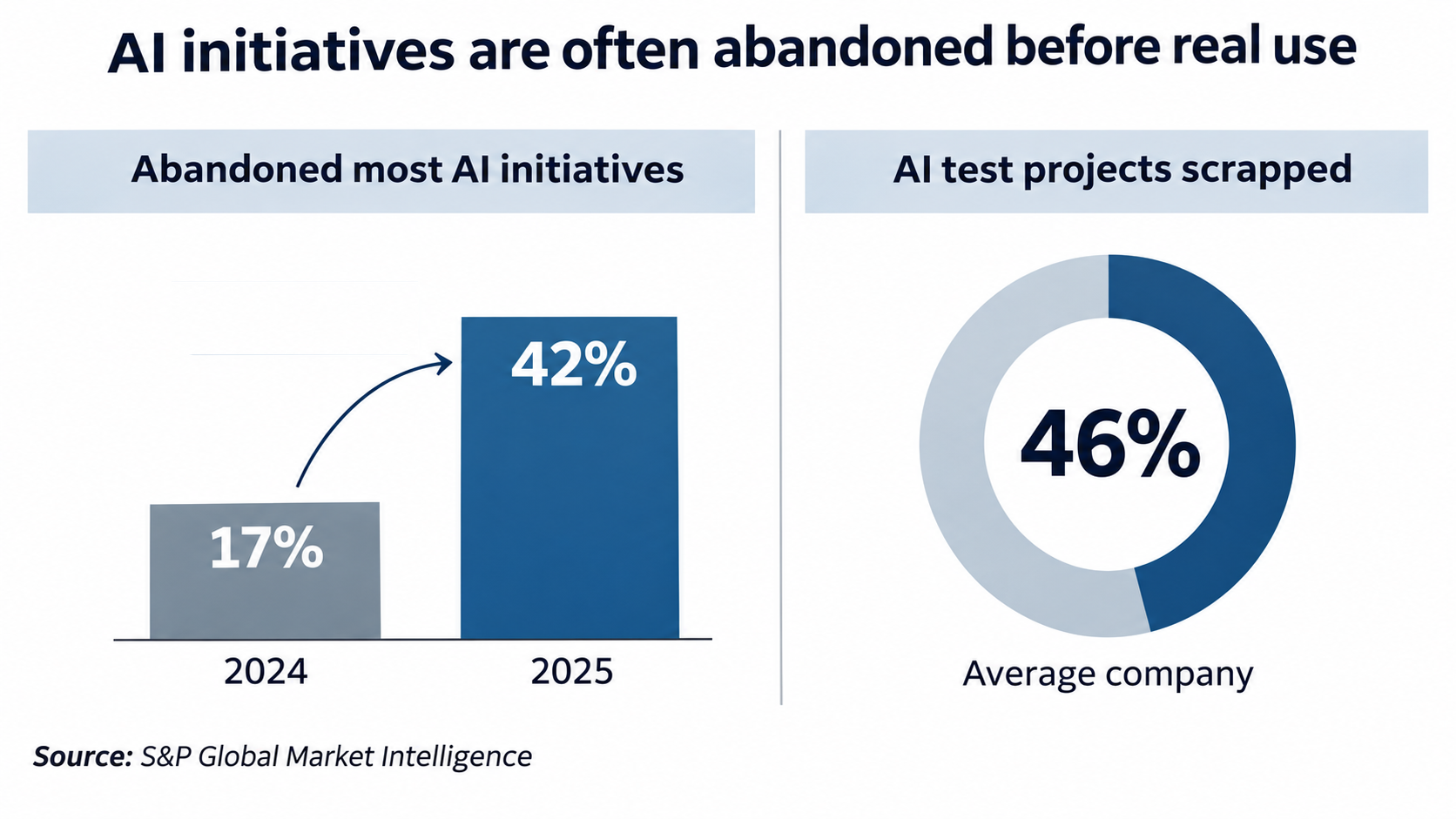
42% of companies abandoned most of their AI initiatives in 2025, up from 17%.
Boards expect concrete proof of AI value: “number of active AI pilot programs” is not a strong enough metric.
A one-page AI portfolio view gives boards a clear view of what they need to know.
In March 2025, Joe Park stood on a stage in New York and made a bold claim.
Park was the chief digital and technology officer of Yum Brands (the company behind Taco Bell). He told the crowd that every aspect of a restaurant can be touched by AI. Taco Bell had already spent more than $1 billion on digital tools, he said, and digital sales had jumped from 19% to over 50%. But nobody in the room was asking the question AI portfolio management is built to answer: where does AI belong, and where doesn’t it?
By then, Taco Bell was rolling out voice AI at hundreds of drive-thrus. A customer pulled up, talked to the speaker, and a machine took the order.
But then a customer ordered 18,000 cups of water (to garner attention on social media). Mirroring a similar AI drive-thru malfunction at McDonald's, the system choked, and a human worker had to step in. The clip, posted as a lesson in how to get around AI, drew tens of millions of views. Soon after, Taco Bell’s tech chief, Dane Mathews, said the company was now thinking about where to use voice AI and where to hold back. He suggested busier stores might do better with a person taking orders.
Taco Bell still calls voice AI a core part of its future, but the sequence of events offers an important lesson for organizations everywhere. The company asked “where does this belong?” after the rollout, after the spending, and after the viral video. Most companies make the same mistake with AI, just with less public evidence.
Why Boards Want More Than a List of AI Pilots
The numbers show how common this is. In 2025, 42% of companies abandoned most of their AI initiatives, up from 17% the year before. The average company scrapped 46% of its AI test projects before they ever reached real use.
Boards have noticed. When a director asks what the company is getting for its AI spending, many finance leaders answer with a count: Forty pilots, twelve tools, three use cases live. Gartner says that answer no longer works. Counts of pilots and tools show movement, Gartner’s finance analysts argue, but they do not prove the value boards now expect. In the same research, 63% of finance teams said AI rollouts ran slower than planned in 2025.
The pressure is growing because budgets are growing. Three-quarters of CFOs are raising tech budgets for 2026, and nearly half by 10% or more. Bigger checks bring sharper questions.
Johnson & Johnson, Coca-Cola, and Guardian Life have found better answers. Each one manages AI as a set of investments, with clear rules for what gets more money and what doesn’t. Each one used AI portfolio management to fix a different problem.
What Is AI Portfolio Management?
Think of every AI project as one stock in an investment account. You would never judge your account by counting how many stocks you own. But you would look at all of them side by side and ask which ones are earning their place.
AI portfolio management does the same thing for AI spending. It puts every project on one page. For each project, the page shows four things:
- Stage: Is it an idea, a pilot, or in full use?
- Owner: Which named leader is on the hook for results?
- Cost to date: How much has it spent so far?
- Proof standard: What test must it pass to get more money?
Then leaders hold regular portfolio reviews and reallocate funds. Projects that miss their test get fixed, paused, or stopped. Projects that pass get more funding. Without AI portfolio management, each pilot is approved individually, and no one sees the full list until the board asks.
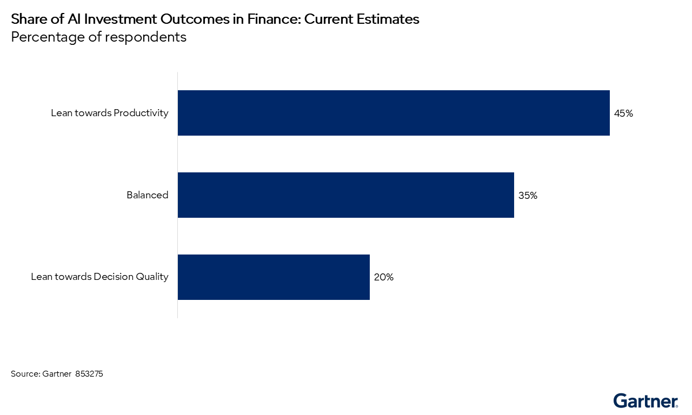
Gartner now tells CFOs to work this way. Its July 2026 survey of 204 finance leaders found that 45% of finance AI spending leans toward productivity, while only 20% leans toward better decisions. Gartner advises a portfolio approach: keep a healthy mix of quick efficiency wins and bigger bets, and rebalance as needs change. Teams that funded bold bets, the ones that create new products or markets, were more than twice as likely to report high value from AI.
Three Ways AI Spending Goes Wrong
When companies skip AI portfolio management, three problems keep showing up.
- Saying yes to everything: Companies approve AI projects too easily. The list grows, and so does the bill.
- Funding before defining a win: Projects get money before anyone defines what success looks like. Months later, the team simply picks whatever numbers look good.
- Good pilots getting stuck: A pilot works, but no one owns the plan to grow it. It sits in test mode while the business keeps paying for it, and it stagnates.
Each of the three companies below solved one of these problems.
J&J’s AI Portfolio Management Stopped Saying Yes to Everything
Johnson & Johnson does business in 150 countries and employs more than 130,000 people. When generative AI arrived, the company encouraged employees to experiment. Ideas poured in. Before long, J&J was tracking nearly 900 GenAI use cases across the company.
That was the “yes to everything” stage. CIO Jim Swanson has said openly that it was a learning phase.
“Much of our Gen AI work was in proofs of concept and pilots.”
—Jim Swanson, Executive Vice President and Chief Information Officer, Johnson & Johnson
So J&J created a group to review the full list. The group flagged ethical, legal, and compliance risks. It also sorted the projects by impact and steered effort toward the ones that could scale. The shift from a pile of experiments to a ranked list is where AI portfolio management begins.
The short list paid off. One tool helps service reps answer customer questions about the company’s hundreds of thousands of products. Reps went from weeks of research to answers in minutes. In clinical trials, AI models now recommend which test sites to use. The better sites those models picked saw up to 2.6 times higher patient enrollment.
J&J applies the same discipline to outside partners. Swanson says the company runs small tests with AI startups, then decides whether the work can scale. If it can’t, both sides walk away.
The governance lesson is simple. Every proposed GenAI use case at J&J goes through a review that includes security and architecture experts. An AI Council and a Data Management Council oversee the rules. That review gives J&J a set place to say no.
Coca-Cola Defines What a Win Is Before the Money Moves
Coca-Cola serves 2.2 billion drinks a day through 200 bottlers and 950 plants. At that size, a weak AI pilot can burn money fast. So the company sets the bar before funding a pilot.
CIO Neeraj Tolmare authorizes only AI pilots that can produce new revenue or major efficiency gains at full scale. The rule comes from the top. CEO James Quincey and his leadership team set the mandate.
“[AI experimentation] has to be tied to a real outcome that moves the needle for us.”
—Neeraj Tolmare, Senior Vice President and Chief Information Officer, The Coca-Cola Company
One of Coca-Cola’s pilots exemplifies how the rule works. Coca-Cola sales agents visited stores every few weeks and sometimes found coolers half empty. So Coca-Cola built an algorithm that combines past sales data with weather and location data to predict demand. The system then sends store managers a WhatsApp message telling them when to restock. Coca-Cola tested it in three countries: stores using it saw sales rise 7% to 8% compared with stores that did not. Because it passed its test, Tolmare plans to expand it to more markets.
Another pilot turned 20 AI-made marketing assets into 10,000 versions for different languages and markets. Consumers were 20% more likely to engage with that content, and it was made three times faster.
The proof standard also tells Coca-Cola when to wait. As of mid-2025, the company’s AI agents remained in pilot because Tolmare first wanted to know if they could run at a reasonable cost. Good AI portfolio management includes “not yet” as a potential answer.
Coca-Cola has also had public misses. An AI-made holiday ad drew backlash, and a later campaign used a quote from a book that was never written. As a result, the company now has strict content rules and a set plan for responding when AI output goes amiss.
Guardian Keeps Good Pilots From Getting Stuck in “Purgatory”
Guardian Life Insurance had $14.5 billion in revenue in 2024. Like many insurers, it runs on older systems and works under heavy regulation. In that setting, a good pilot does not scale on its own.
Guardian put one team in charge of managing its AI portfolio. Its data and AI team owns AI strategy and decides which projects come first. That team tracks every idea through three steps:
- Build an idea with business leaders.
- Test the solution and write a business case.
- Create a plan to scale.
That third step is what keeps good pilots moving. One pilot automated proposal and price quote writing for employee benefits clients. The work used to take five to seven days. Now it takes 24 hours. Guardian plans to move it from pilot to full use in 2026.
Getting there took work. Guardian had to upgrade older mainframe systems and pull scattered data together before AI could run at scale. It also moved people out of their usual jobs to focus on AI projects.
Governance runs alongside every project. Risk, legal, and compliance teams review each use case for privacy, customer, regulatory, and cyber risk. Guardian also built two review boards for technology design: a formal board and a fast-track board. The fast-track approach keeps safe projects from waiting in “purgatory.”
What Can Go Wrong With AI Portfolio Management?
AI portfolio management can fail in three common ways:
- A review that only looks for risk. A team checks each project for legal, privacy, and security problems, approves it, and moves on. But nobody asks whether the project is actually worth the money. J&J avoided this trap by having its review group check for risk and also rank every project by impact. That ranking let J&J put its effort behind the projects that mattered most.
- Funding only safe, easy projects. Tools that save employees a few hours are easy to measure and approve, but their payoff is often small. Gartner’s survey found that 45% of finance AI spending goes toward productivity tools like these. However, teams that also backed bigger bets were more than twice as likely to report high value from AI. A healthy portfolio has both kinds of projects, and each one has a clear litmus test it must pass.
- A review with no killswitch. If no one in the room can stop a project, every project keeps its funding no matter how it performs. The meeting turns into a status update. Instead, before the first review, decide who has the authority to cut a project, and make sure everyone knows it.
What CFOs Should Bring to the Next Board Meeting
Taco Bell eventually asked the right question about voice AI: where does it belong, and where doesn’t it? Unfortunately, the company asked that question after hundreds of restaurants were already running the system.
AI portfolio management asks that question first, and then repeatedly on a regular schedule. J&J used it to narrow nearly 900 ideas to the work with the most impact, Coca-Cola used it to set the bar before spending a dollar, and Guardian used it to make sure good pilots had a path to scale.
Before your next board meeting, build a page for your own portfolio review. List every AI project. Next to each project name, list its stage, owner, cost so far, and the test it must pass to get more money. Then add a second list: the projects you stopped this year and why.
The second list might matter the most; it shows the board that someone is making the hard calls.

Frequent Asked Questions
How can AI portfolio management fail?
It fails in three common ways: reviews check for risk but never rank projects by value, teams fund only easy, low-payoff tools, or nobody has the power to stop a project, so the review becomes a status meeting. Naming who can cancel projects fixes the last problem.
How does Coca-Cola decide which AI pilots to fund?
Coca-Cola only funds AI pilots that could produce new revenue or big efficiency gains at full scale. A demand-forecasting pilot passed that test, lifting sales 7% to 8% in three countries. AI agents stayed in pilot until they could prove they run at a reasonable cost.
What should an AI portfolio show for each project?
Each project should show four things: its stage, its owner, its cost to date, and its proof standard. Stage tells whether it is an idea, a pilot, or in full use. The proof standard is the test the project must pass before it gets more money.
Why do boards want more than a list of AI pilots?
A pilot count tells the board how busy the team is but says little about results. Gartner says counts of pilots and tools do not prove the value boards now expect. With budgets rising and 42% of companies abandoning most of their AI initiatives in 2025, directors want to see which projects earn their funding.
What is AI portfolio management?
AI portfolio management treats every AI project like one stock in an investment account. Leaders put all projects on one page, review them on a regular schedule, and move money. Projects that miss their test get fixed, paused, or stopped. Projects that pass get more funding.


