
The New AI Org Chart: 5 Executive Roles Being Rewritten Right Now
The AI org chart is quietly rewriting five executive mandates. Here is what changed, who owns AI now, and the one question to ask at your next steering meeting.
The AI org chart, not the tool budget, decides who captures AI returns.
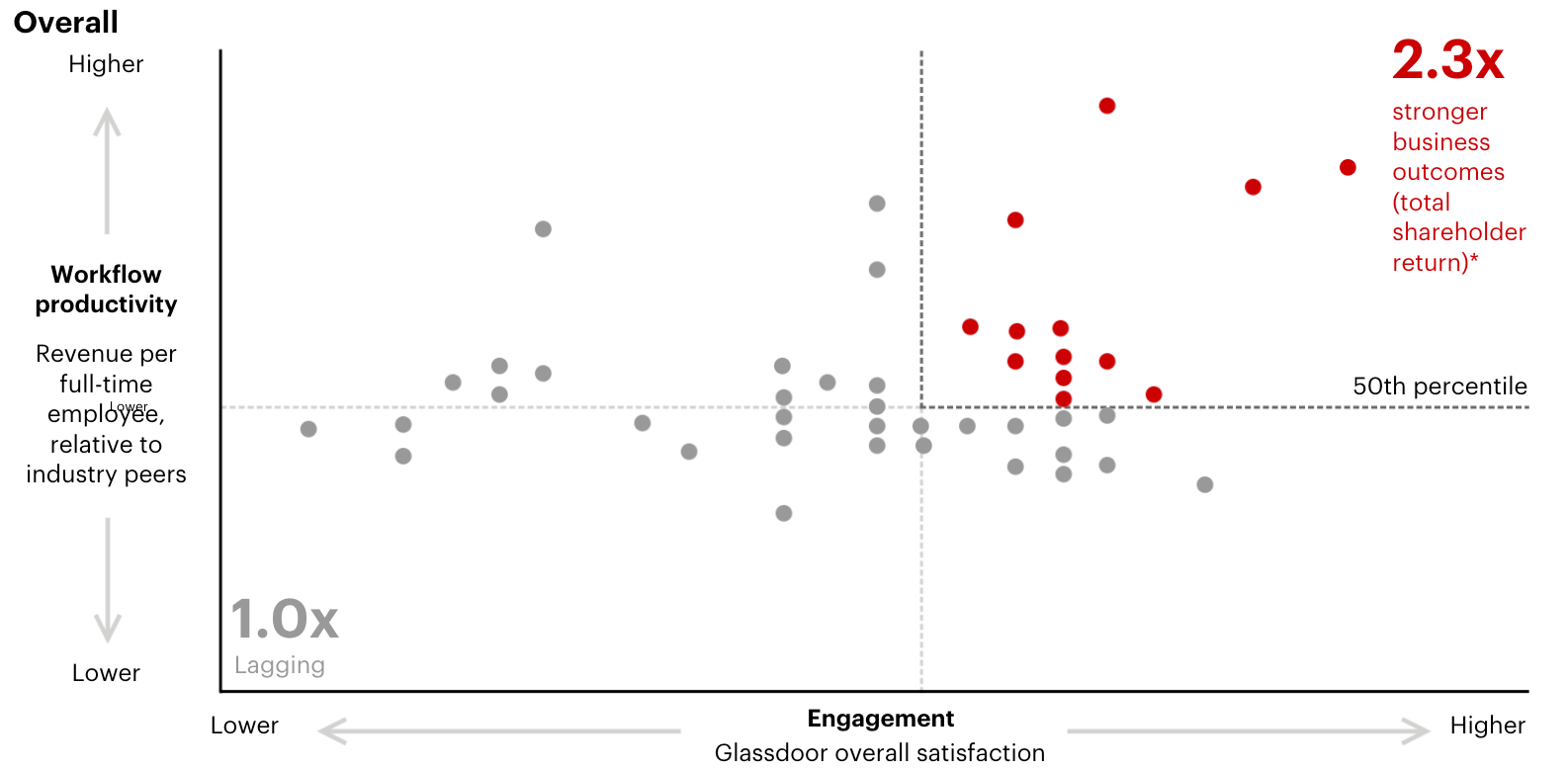
Human-centric AI firms deliver 2.3x the shareholder return of those without.
Mastercard put HR in charge of AI talent strategy and freed $21M in year one.
In the fall of 2025, a strange thing started happening in boardrooms. Companies that had done everything “right” with AI, buying the tools, training the staff, naming a CIO and a CHRO to lead the charge, were still coming up short. The pilots worked, but the expected productivity gains didn't show up on the balance sheet.
Keith Ferrazzi, who has advised dozens of executive teams on how they work together, watched this pattern repeat. Enterprises kept pairing the CIO with the CHRO and calling it their AI leadership team. It made sense on paper: one owns the technology, the other owns the people. But the results kept stalling. Ferrazzi came to a blunt conclusion: that two-person team, while necessary, was nowhere near enough. Real change demanded a wider alliance that would expand to include the CFO, the COO, and the board itself.
"The original CIO-CHRO AI power team was necessary but not sufficient."
—Keith Ferrazzi, Founder and Chair, Ferrazzi Greenlight
The problem was the AI org chart. Most companies add AI to their tools and leave their leadership structure untouched, assuming the old boxes can hold the new work. They cannot. AI reassigns accountability faster than most companies redraw their reporting lines. Mandates change while titles stay the same, and value leaks through the space between.
The companies figuring this out are treating the AI org chart as something to redesign, not inherit. They are rewriting what their top leaders own before they spend another dollar on a platform.
Why the AI Org Chart Became a Bottleneck
The evidence that structure drives AI returns is hard to ignore. Bain studied Fortune 1000 companies and found that those taking a human-centric approach to AI, redesigning workflows and the workforce together, led to higher workforce engagement and productivity and delivered 2.3 times the total shareholder return of companies that did not. The same firms saw productivity lifts of 10 to 15 percent that translated into meaningful EBITDA gains as the programs grew.
Compare that with the wider field. BCG's 2025 study of more than 1,250 global companies found that only 5 percent were seeing real value from AI, while 60 percent saw little to no benefit despite serious spending. The difference is rarely the model or the vendor. It is who owns the work, how decisions get made, and whether the operating structure lets AI produce results the business can bank. Those 5 percent are not smarter; they are further along in changing their operating system to fit the technology.
That is why the roles at the top are shifting. Companies like Mastercard and analysts at BCG, EY, and the World Economic Forum are all describing the same work: figuring out how AI creates value, which means rebuilding the operating system one seat at a time. What follows are five executive roles being redrawn right now, each one a signal of how the enterprise operating system is being rebuilt around AI.
#1: The CHRO Moves from Cleanup Crew to Strategy Co-Owner
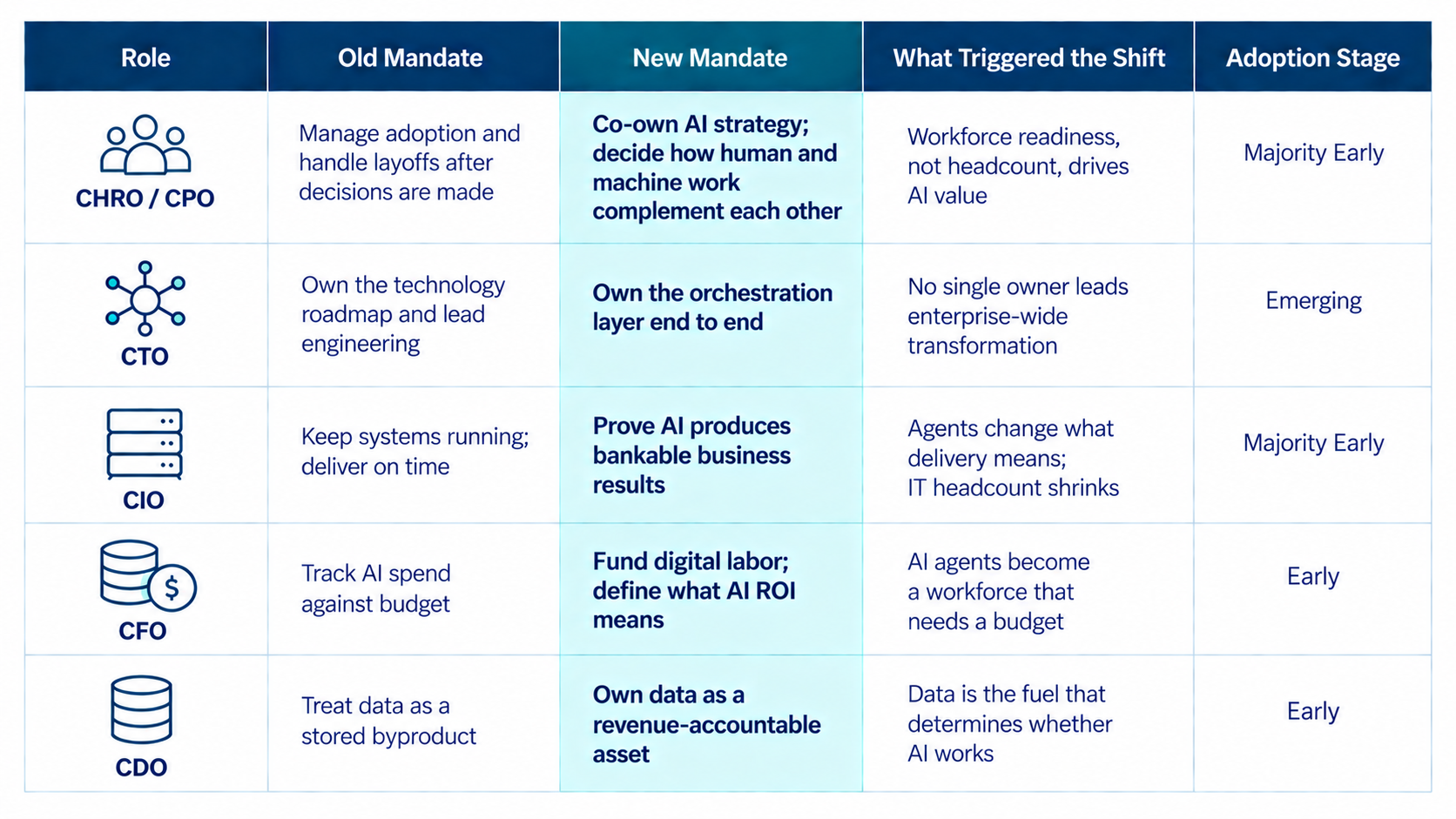
For two years, AI was sold as the thing that would replace workers. That framing pushed HR into a defensive crouch. The CHRO became the person who managed the anxiety, handled the layoffs, and ran training after the crucial decisions had already been made elsewhere. HR was the cleanup crew.
That order has it backward, and the best companies now know it. Whether AI pays off depends less on the technology and more on whether the workforce is ready to use it. Readiness is the real barrier, and HR owns it. So the workforce owner has to be in the strategy room from the start, not called in afterward to smooth things over. When the CHRO helps design the AI strategy, the plan reflects what the workforce can actually absorb.
Mastercard shows what this looks like in practice. Its internal talent platform, called Unlocked, uses AI to match employees to projects, mentors, open roles, and learning paths based on the skills they have and the skills they want to build. This is HR running an AI system as a core strategy, not as a side project. And the numbers back it up. Roughly 90 percent of Mastercard's workforce is on the platform, and the company logged more than $21 million in productivity in the first year alone. A third of active users have made an internal career move.
"We're helping employees be future ready by focusing on skills over titles or degrees."
—Lucrecia Borgonovo, Chief Talent and Organizational Officer, Mastercard
The person leading that work carries a telling title: Chief Talent and Organizational Officer. HR is treated as a source of business strategy, not a support desk.
#2: A New Seat Appears at the Orchestration Layer
Three years ago, responsibility for AI transformation was scattered. The CIO owned some of it, the CHRO owned another piece, and business unit leaders ran their own experiments. Nobody owned the whole operating system.
That ownership gap is creating a new kind of role, sometimes assigned to the Chief Transformation Officer. This person owns the orchestration layer, the connective work of aligning technology, people, and process toward a business outcome. BCG describes the AI-first Chief Transformation Officer as the bridge between AI activity and business impact, a role built to drive change rather than advise on it.
Three-time founding chief of staff Elliott Fisher has noticed a related shift and given it a sharp name: the rise of the executive operator. Fisher argues that a new role is emerging with its own title, pay band, and mandate, distinct from the chief of staff.
"At the end of the day, the chief of staff's job is to support a person, while the executive operator's job is to support the system at large."
—Elliott Fisher, 3x founding Chief of Staff
The difference is telling. The chief of staff supports a person. The executive operator supports the system at large, owning the operating rhythms and cross-functional alignment that hold a company together. That is precisely what AI transformation demands: a single accountable owner who drives it.
#3: The CIO Gets Judged on Business Results, Not Uptime
For decades, the CIO had a clear job: keep the systems running. Success meant uptime, security, and on-schedule delivery. The scorecard measured whether the technology worked.
AI changes what CIOs are measured on. The new question is not whether the systems run; it is whether AI produces results the business can count in dollars. EY frames this as the CIO needing an execution playbook for agentic AI, one focused on outcomes rather than deployment. When AI agents can handle work that used to require whole teams, the CIO's value becomes the business impact the technology creates.
Here is the twist that makes the role harder: the CIO's own department is shrinking. IT leaders expect a reduction in IT workforces as AI takes over routine technical work. So the CIO is being asked to deliver more business value with a smaller team, while proving that value in terms a CFO would recognize. The role is becoming smaller and more strategic at the same time. The CIO who still measures success by uptime alone is behind the curve.
#4: The CFO Starts Funding a Workforce of Machines
The CFO used to have a simple job with AI: track what it cost. Watch the spend, check it against the budget, report the number. AI ends that simplification.
When AI agents do work that people used to do, the CFO faces a new question: How do you fund a workforce that is part human and part machine? Budgeting for digital labor is not the same as approving a software license. It means putting a real definition on AI ROI and deciding how much capital to move toward machine work versus human headcount. The World Economic Forum's playbook for financial services gives the CFO ownership of that business case across the company, not passive watch over a line item. The CFO becomes the person who decides what digital labor is worth and how to pay for it.
#5: The CDO Turns Data from Exhaust Into an Asset
For years, data was a byproduct. It was the exhaust a company gave off while doing business, stored somewhere and mostly ignored. AI changes that overnight, because data is the fuel that decides whether any AI works at all. Bad data equals bad results, but owned and organized data creates results the business can use.
That change creates a much bigger area of responsibility for the Chief Data Officer. Data stops being a back-office cleanup task and becomes a strategic asset with a stake in revenue. IBM's study of the role describes the CDO carrying real revenue accountability, with responsibility for turning data into measurable business results. The CDO now owns one of the most valuable assets the company has.
What to Do Before You Buy Another Tool
Ferrazzi was right. The CIO-CHRO team wasn’t a bad start; it was just incomplete. The companies getting more from AI did not do it by buying a better model. They fixed it by redrawing who owns what, then letting the technology do its work inside a structure built to capture the value.
That is the move available to every leadership team right now. At your next AI steering meeting, ask the hard question: which of these mandates is sitting with the wrong owner? Find the answer, redraw the box, and you will get more from the AI you already have.
.avif)
Frequent Asked Questions
What is a Chief Transformation Officer?
It is an emerging executive role that owns AI transformation end to end. Rather than advising on change, this operator runs the day-to-day orchestration across technology, people, and process. The role exists because no traditional executive previously held enterprise-wide AI ownership, leaving transformation scattered and stalled.
Why do most enterprise AI initiatives fail to show returns?
BCG found only 5 percent of companies generate real value from AI, while 60 percent see little benefit despite heavy spending. The cause is rarely the technology. It is structural: unclear ownership, slow decisions, and an operating model that prevents AI from producing results the business can measure.
How is AI changing the CHRO role?
The CHRO is moving from managing adoption to co-owning AI strategy. Because workforce readiness drives whether AI pays off, the person who owns the workforce belongs in the strategy room. At Mastercard, HR runs an AI talent platform that freed more than $21 million in productivity in its first year.
Who should own AI strategy in a company?
No single executive owns it alone. The strongest structures pair the CIO and CHRO with the CFO, COO, and board. Many companies now assign the Chief Transformation Officer to own the orchestration layer: the cross-functional work that connects technology, people, and process to a business outcome.
What is an AI org chart?
It describes how AI reshapes ownership across the executive team. As AI takes over routine work, mandates for the CHRO, CIO, CFO, and data leaders change, and a new transformation role often appears. The reporting lines may look the same, but the accountability behind each title shifts.


.svg)


_0000_Layer-2.png)

