
Inside How Starbucks and Kaiser Keep AI Customer Experience Human
AI slop is costing brands trust and sales. See how Starbucks, Kaiser Permanente, and Aerie put AI behind the scenes, kept people in front, and turned that strategy into growth.
Suspected AI content is rated 48% less trustworthy and cuts purchase intent by 14%.
Starbucks grew global comps 7.9% with AI behind the counter and people in front.
The strongest AI customer experience strategies keep AI out of the customer’s view.
The top of the hour arrives the same way it always has on an iHeartMedia station. The host wraps a segment, and the FCC-required legal ID rolls out: call letters, city of license. Then come two words that may be one of the boldest AI customer experience bets in American media: “Guaranteed Human.”
Since late 2025, iHeart DJs have been expected to work the phrase into their hourly on-air disclosures. The company even filed a trademark on it. Tom Poleman, iHeart’s chief programming officer, explained the move to staff in a memo that read more like a declaration: “Sometimes you have to pick a side — we’re on the side of humans.”
iHeart’s strategy is a fresh approach to integrating AI without sacrificing quality. It still uses AI for back-end work. At CES (Consumer Electronics Show) 2026 in Las Vegas, its advice to advertisers fit in a single line: automate the pipes but never the personality. The country’s largest radio company sells humanity on the air and runs algorithms under the floorboards.
Critics call that a contradiction, but more and more companies call it a strategy.
Is AI Slop Costing Brands?
In December 2025, Merriam-Webster named “slop” its word of the year, a nod to the flood of cheap, inaccurate, or low-quality content that generative AI makes easy to produce. Customers noticed.
According to Raptive, a digital ad management and creator monetization platform, when people suspect content was made by AI, they rate it 48% less trustworthy, and purchase consideration for brands advertised alongside it drops 14%. That implied penalty holds true even when the content was actually written by a person. Suspicion alone does the damage.
In a separate study, 36% of Americans say they would engage less with content they know is AI-generated, while only 14% say they would engage more. In publishing, more than 70% of US readers say they’re less likely to engage with a fully AI-generated book. Bain argues human-made content can become a selling point, much like “fair trade” did on food packaging.
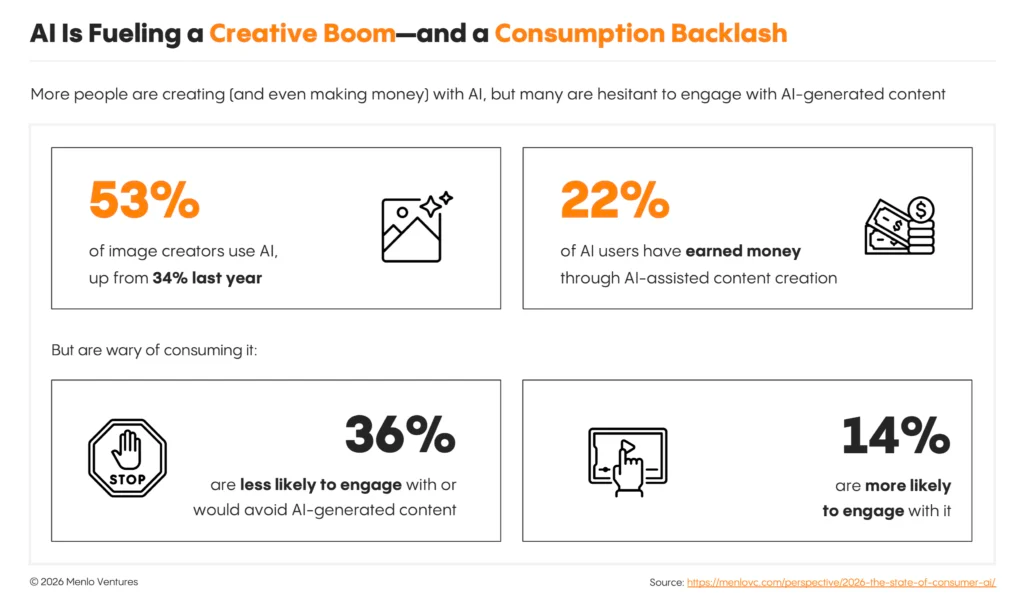
The tempting response is to pull back on AI. But Starbucks, Kaiser Permanente, and Aerie did something smarter. Each drew a hard line through its operations. AI runs the work customers never see, and people own the moments customers do see. Each company faced a different threat, and each built an AI customer experience that feels more human as a result.
The lesson for leaders planning the next AI budget is simple to say and hard to do: automate the supportive structure, protect brand personality, and know exactly where the line sits.
How a Bad AI Strategy Can Erode Customer Experience
The backlash against a poorly designed AI customer experience shows up in three distinct places: how a company serves customers, how its people do their work, and how its brand presents itself.
1. Lack of Human Customer Experience: The front line is where customers decide how they feel about a company. Klarna learned that the hard way. The fintech once said its AI chatbot was doing the work of 700 customer service reps, then reversed course and said customers should always be able to reach a human.
2. Workplace slop: AI output that goes out unchecked damages credibility and the quality of the work itself. Researchers at BetterUp Labs and the Stanford Social Media Lab call it workslop. 40% of US desk workers said they received it in the past month. Each incident took nearly two hours to clean up, and about half of recipients saw the sender as less capable and reliable.
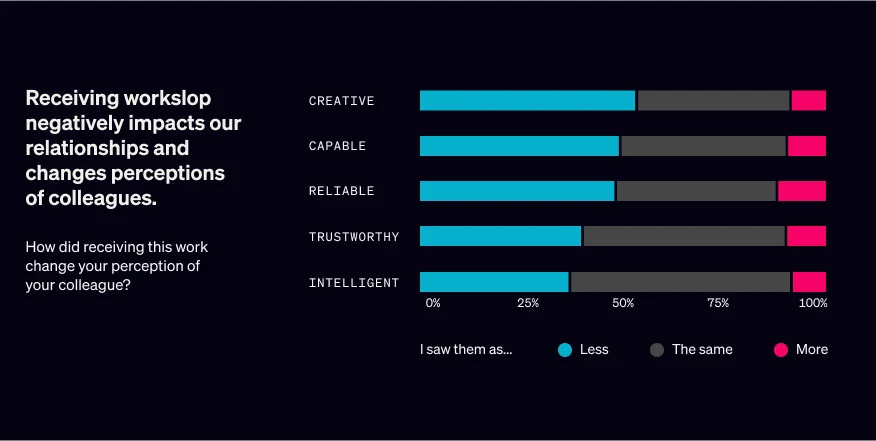
Even the perception of AI use hurts. In one experiment, reviewers rated engineers 9% less competent for identical code they believed was AI-assisted.
When AI slop is public-facing, the damage can quickly affect an organization’s reputation and bottom line. Deloitte Australia agreed to repay part of an A$440,000 government contract after reviewers found fabricated references and a misquoted court ruling in its report. One Australian senator said the firm had a “human intelligence problem.”
3: Synthetic brand content: How a company represents itself is paramount when it comes to customer service. When AI-generated people and ads stand in for a brand, audiences notice fast and react loudly.
McDonald’s Netherlands pulled its AI-generated holiday ad just three days after posting it to YouTube, after viewers mocked it as slop. A brand’s face is its promise. When the face is fake, customers start to wonder what else is. For AI customer experience leaders, the brand’s face is the last place to cut corners.
Starbucks Fixes a Hollowed-Out Front Line, One Cup at a Time
When Brian Niccol became CEO in September 2024, Starbucks had a front-line problem. The company had gone seven quarters without comparable sales growth before its “Back to Starbucks” turnaround reversed the slide. Mobile orders were jamming stores, and the app’s wait times were often wrong. Baristas were stretched across the café, the drive-thru, and the mobile queue at once.
Niccol could have automated the entire counter experience. Instead, he put AI behind it. Green Dot Assist, launched in June 2025, lets baristas ask questions on in-store iPads and get instant answers about recipes or a stubborn espresso machine. A system called Smart Queue sequences orders across channels. Niccol said the old first-in, first-out approach had created a bottleneck.
“We’re on our way to becoming the world’s greatest customer service company.”
—Brian Niccol, Chairman and Chief Executive Officer, Starbucks
At the same time, Starbucks moved the other direction on its people strategy. It rolled out Green Apron Service, a standard built around warmer and more personal coffeehouse moments and the human touch customers had been missing, backed by bigger rosters and a push to hire thousands of assistant managers.
The numbers followed. In the third quarter of fiscal 2026, global comparable sales rose 7.9%, and operating margin expanded 430 basis points to 14.4%. North American comps climbed more than 8%, the best in nearly three years, and customers got their orders faster. Connection did not cost speed.
Starbucks cut more than $2 billion across its P&L by streamlining its support structure. The savings behind the scenes helped pay for the people in front: AI customer experience built in the right order.
Kaiser Permanente Keeps Workplace Slop Out of the Exam Room
For doctors, paperwork is the enemy of eye contact. Every minute spent typing notes is a minute facing a screen instead of a patient, and much of it spills into what physicians call “pajama time” at home.
Kaiser Permanente’s answer was an ambient AI scribe. With a patient’s consent, it listens to the visit and drafts the clinical note. The keyword is “draft.” The tool makes no decisions or recommendations about care, and physicians review each note before it enters the record.
Kaiser treated quality as the whole game. Before the systemwide rollout, it ran a 10-week pilot and built a QA team that included physicians, informaticists, safety officers, and quality risk leaders. That feedback loop is what keeps a time-saving tool from becoming a source of workslop in a medical record.
“The ultimate goal of health care IT was always: Make me a better doctor.”
—Dr. Brian Hoberman, Executive Vice President of IT and Chief Information Officer, The Permanente Federation
The results speak in hours and in human terms. Over one year, AI scribes saved Permanente physicians more than 15,700 hours of documentation, equal to 1,794 working days. Patients felt the difference. 47% said their doctor spent less time looking at the computer, and 39% said the doctor spoke to them more directly. Hoberman noted that when doctors edited the AI notes, the tool had often captured more detail than they remembered.
The rollout has not been frictionless. Kaiser mental health professionals have raised concerns that recording sensitive visits needs stronger safeguards. That pushback reminds us that review processes must cover consent and context, not just accuracy. In the exam room, the human touch depends on it.
Aerie Swears Off Synthetic Brand Content and Puts AI in the Stockroom
Aerie has made authenticity its brand since 2014, when it stopped retouching its models. In October 2025, the American Eagle Outfitters brand went further. It pledged never to use AI-generated bodies or people in its marketing.
Customers responded immediately. The pledge became Aerie’s most popular Instagram post in a year, drawing more than 40,000 likes. In March 2026, the brand doubled down with a Pamela Anderson campaign that showed AI failing to produce real-looking models.
“In an industry where everything is generated, realness becomes special.”
—Stacey McCormick, Chief Marketing Officer, Aerie
Behind the scenes, the parent company uses AI where shoppers will never see it. AEO engineers built tools that give store associates a live view of inventory so they can close a sale on the spot, and they use AI to decide where to move stock to protect margins. The brand’s face stays human; the stockroom runs on algorithms.
The business results are strong. In the fourth quarter of fiscal 2025, Aerie comparable sales jumped 23%, while American Eagle grew 2%. On the earnings call, executives said new Aerie customers grew 14%, and brand awareness climbed 12% year over year.
The pledge alone did not produce those numbers. Management also credited new product collections and fresh campaigns. Still, Aerie shows that a public stand against synthetic brand content can sit comfortably beside aggressive AI use in operations. Shoppers get human-made content up front and better-stocked stores behind it.
Where Should Your AI Customer Experience Draw the Line?
Every hour, iHeart DJs still say “Guaranteed Human” on the air. Whether those two words build loyalty or invite skepticism will depend on what the company does off the air. The same is true for any enterprise building an AI customer experience.
Before your next AI budget review, run every workflow through a simple thought exercise:
- Does the customer see it, hear it, or feel it directly?
- Does trust depend on a person being accountable for it?
- Would a skilled human doing it change the outcome?
If the answer to all three is no, AI automation is probably the answer. If any answer is yes, use AI to clear the way for people to do what they do best.
The companies pulling ahead have settled one question early: where should the customer never notice AI at all?

Frequent Asked Questions
How can leaders decide which customer touchpoints to automate?
Leaders can run each workflow through a thought exercise. Ask whether customers see it directly, whether their trust depends on a person being accountable, and whether a skilled human would change the outcome. If every answer is no, automate it. If any answer is yes, use AI to support people and keep them in front.
How did Kaiser Permanente keep AI scribes from producing workslop?
Kaiser Permanente built quality controls into the rollout. The AI scribe only drafts notes with patient consent, makes no care decisions, and physicians review every note. A QA team of physicians, safety officers, and quality leaders vetted the tool first. Over one year, the scribes saved physicians more than 15,700 hours of documentation.
How does Starbucks use AI without replacing baristas?
Starbucks uses AI to support baristas behind the counter. Green Dot Assist answers recipe and equipment questions on in-store iPads, and Smart Queue sequences orders across channels. The company paired those tools with bigger rosters and its Green Apron Service standard. Global comparable sales rose 7.9% in the third quarter of fiscal 2026.
Why do customers distrust AI-generated content?
Customers associate AI-generated content with low effort and low accuracy. Raptive found that people rate content they suspect is AI-made 48% less trustworthy, even when a person wrote it. Purchase consideration for brands advertised next to that content also drops 14%, so suspicion alone carries a real business cost.
What is AI customer experience?
AI customer experience is any customer interaction shaped by AI, whether customers see the AI or not. The strongest versions use AI for work customers never see, like order sequencing, inventory, and note-taking. People stay in charge of the moments customers do see, which protects trust while still capturing efficiency gains.


