
What Uber, UnitedHealth and CommBank Know About AI Cost Management
Enterprises price AI like a software license, then watch the bill scale with usage instead of headcount. Uber, UnitedHealth, and Commonwealth Bank show the five costs that arrive after deployment.
AI budgets built like software budgets are breaking. Gartner expects over 40% of agentic AI projects to be canceled by the end of 2027, with escalating cost among the causes.
AI cost management prices usage, not seats, because one employee can put 38 times more work through the same license as another.
AI budget planning needs five line items beyond the license: consumption, integration, evaluation, governance, and model migration.
Praveen Neppalli Naga, Uber's chief technology officer, spent two hours demonstrating Claude Code to colleagues in 2026. The session produced nothing shippable and reportedly cost $1,200 in tokens because Naga was using the tool exactly the way Uber had encouraged its 5,000 engineers to use it.
Uber rolled out Claude Code in late 2025 and encouraged adoption through an internal leaderboard that ranked engineers by usage. Adoption climbed from 32% in February to 84% by March. Today, around 95% of Uber engineers use AI tools each month, and CEO Dara Khosrowshahi says autonomous agents generate about 10% of the company's committed code.
The rollout was working by every measure Uber tracked, but AI cost management wasn't among them. Then, in April, Naga said in an interview that the entire annual Claude Code budget was gone, four months into the year.
"I'm back to the drawing board because the budget I thought I would need is blown away already."
—Praveen Neppalli Naga, Chief Technology Officer, Uber
Nothing had failed. Average monthly spending reached $150 to $250 per engineer, while heavy users approached $2,000. AI coding agents are priced by token usage, not by seat, so the harder they work, the bigger the bill.
The problem wasn't weak spending controls, and it wasn't a shortage of money. Uber spent $951 million on research and development in the first quarter of 2026 alone, up nearly 17% year over year. The budget broke because it was built on a number Uber controlled, headcount, while the bill was set by one it didn't: how much work each engineer handed to an agent.
By June, Uber had introduced monthly spending limits of $1,500 per employee for each agentic coding tool, along with usage dashboards and approval workflows. Even then, the harder question wasn't how much Uber was spending. It was what the spending was delivering.
"If you're not actually able to draw a direct line to how [many] useful features and functionality you're shipping to your users, that trade becomes harder to justify."
—Andrew Macdonald, President and Chief Operating Officer, Uber
That is the question every 2027 AI budget has to answer. What is AI cost management when the highest costs don't behave like software? AI cost management is the practice of budgeting for AI based on usage rather than headcount, and funding ongoing costs after deployment rather than ending at purchase.
In this article, we'll break down five AI cost categories that traditional software budgets often miss and how to account for each before they become budget surprises.
AI Cost Management Is a Forecasting Problem, Not a Spending Problem
Uber's overrun wasn't an anomaly. It was a preview of how AI cost management is changing.
Anthropic, the maker of Claude Code, has shifted from flat-fee pricing to usage-based billing, charging for the compute that AI agents consume rather than for the number of people using them. As more AI vendors follow that model, enterprise budgets become tied to usage instead of licenses.
That shift breaks the assumption most budgets rest on. A software license costs the same whether it is used once a month or all day. AI priced by token consumption does not. The bill grows as adoption spreads and agents take on more work.
The hard part isn't the size of the bill. It's forecasting it. That helps explain why more than 40% of agentic AI projects are expected to be canceled by the end of 2027, with escalating costs among the leading reasons.
Oversight hasn't kept pace either. McKinsey's 2026 AI Trust Maturity Survey of around 500 organizations scored responsible AI practices on a four-level scale. In data and technology, 55% reached level three or higher. Governance reached just 35%, and strategy and agentic AI controls each sat at 32%. The chart below shows the gap.
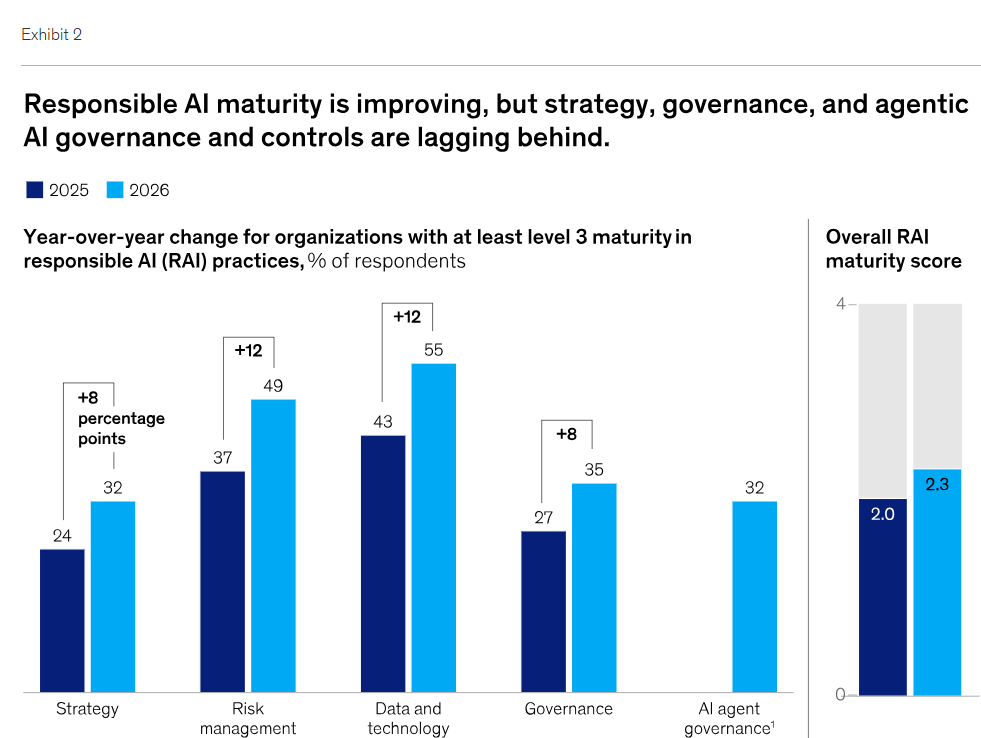
When spending grows with usage, but the planning behind it lags, an overrun stops being a surprise and becomes the default. That's why AI cost management looks different from software budgeting.
Next, we'll walk through the five AI cost categories a per-seat budget doesn't contain, and how
Which Five Line Items Does Software Budgeting Miss?
The bill that catches enterprises off guard is rarely the AI development cost. It's the one that arrives after deployment, when AI becomes part of everyday work.
Inference costs have fallen 280-fold over the past two years. Enterprise AI spending keeps rising anyway, because usage is growing faster than prices are falling. Some organizations now face monthly AI bills in the tens of millions of dollars, and agentic AI is a major reason. It runs continuously instead of responding to a single prompt.
Let's take a closer look at the five line items that make AI cost management different. A per-seat budget was built to price software licenses. These costs don't behave that way.
Line Item 1: Consumption-Based Usage
Consumption is where AI budgets break first. A per-seat budget prices access. Token billing prices the work itself, and the two diverge the moment anyone runs an agent.
Token costs have no natural ceiling. A basic chatbot user consumes around 9.4 million tokens a year. Someone running autonomous agents can reach 356 million, roughly 38 times more on the same license.
The gap widens as AI scales. At one large healthcare enterprise, token usage grew 8% to 10% a month, adding more than $6 million in annualized costs that were never in the original budget.
The same pattern appears across enterprises. Deloitte's survey of 515 U.S. enterprise leaders found that 30% of organizations already consume more than 10 billion tokens a month, rising to 61% by 2028.
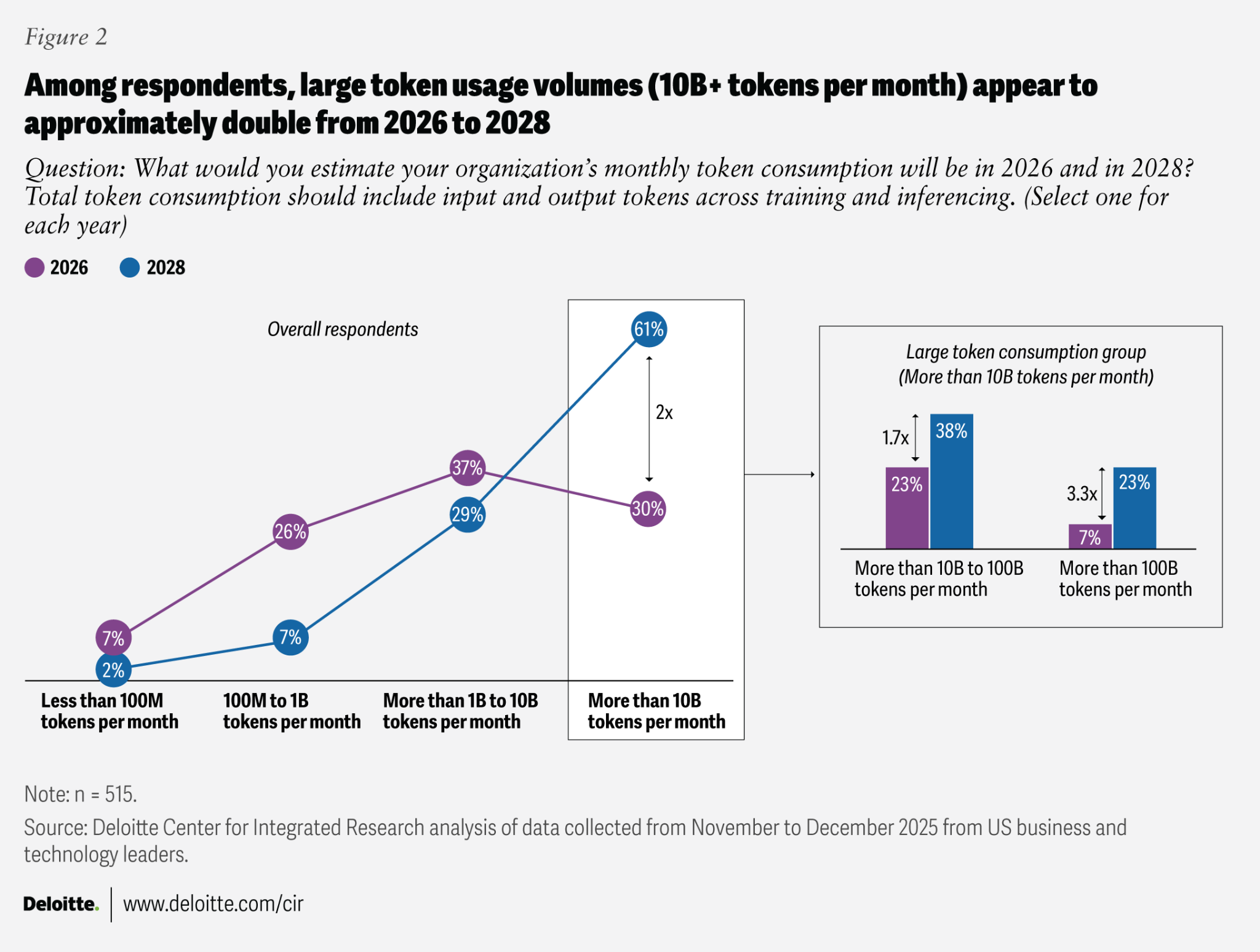
Falling prices don't change that. Inference on a one-trillion-parameter model is expected to cost providers more than 90% less by 2030. But providers won't pass all those savings through, and agentic systems consume 5 to 30 times more tokens per task than a standard chatbot. Volume grows faster than price falls.
AI cost estimation starts with forecasting adoption and expected token usage, then separating light users from agentic workflows instead of counting seats. Uber's rollout showed why. Adoption succeeded exactly as planned, but the budget failed because AI cost management priced licenses instead of managing consumption.
Consumption is only the first cost curve. The next appears when AI reaches the systems where work already happens.
Line Item 2: Integration Debt
Integration is where the second cost curve begins. In AI budget planning, integration debt is the cost of connecting AI to the ERP, CRM, and data platforms where work already happens.
The AI development cost is only the start. A pilot connects to one clean system. Production requires custom middleware, data mapping, and regression testing across every legacy system the workflow touches. Vendor demos run on modern, well-documented APIs. Most enterprise systems don't.
That's enough to stop deployments outright. Of organizations that evaluated custom or vendor-built AI tools, 60% completed an evaluation, 20% reached a pilot, and just 5% reached production, stalling on brittle workflows rather than model quality.
In Bain's Automation and AI Pathfinder Survey of 951 companies, data access and integration ranked as the biggest barrier to AI progress, cited by 41% of respondents, ahead of compliance, budget, and skills gaps. Even companies that met their AI cost-saving targets cited it more often than those that missed, 44% versus 40%, having deployed AI widely enough to hit it at full scale.
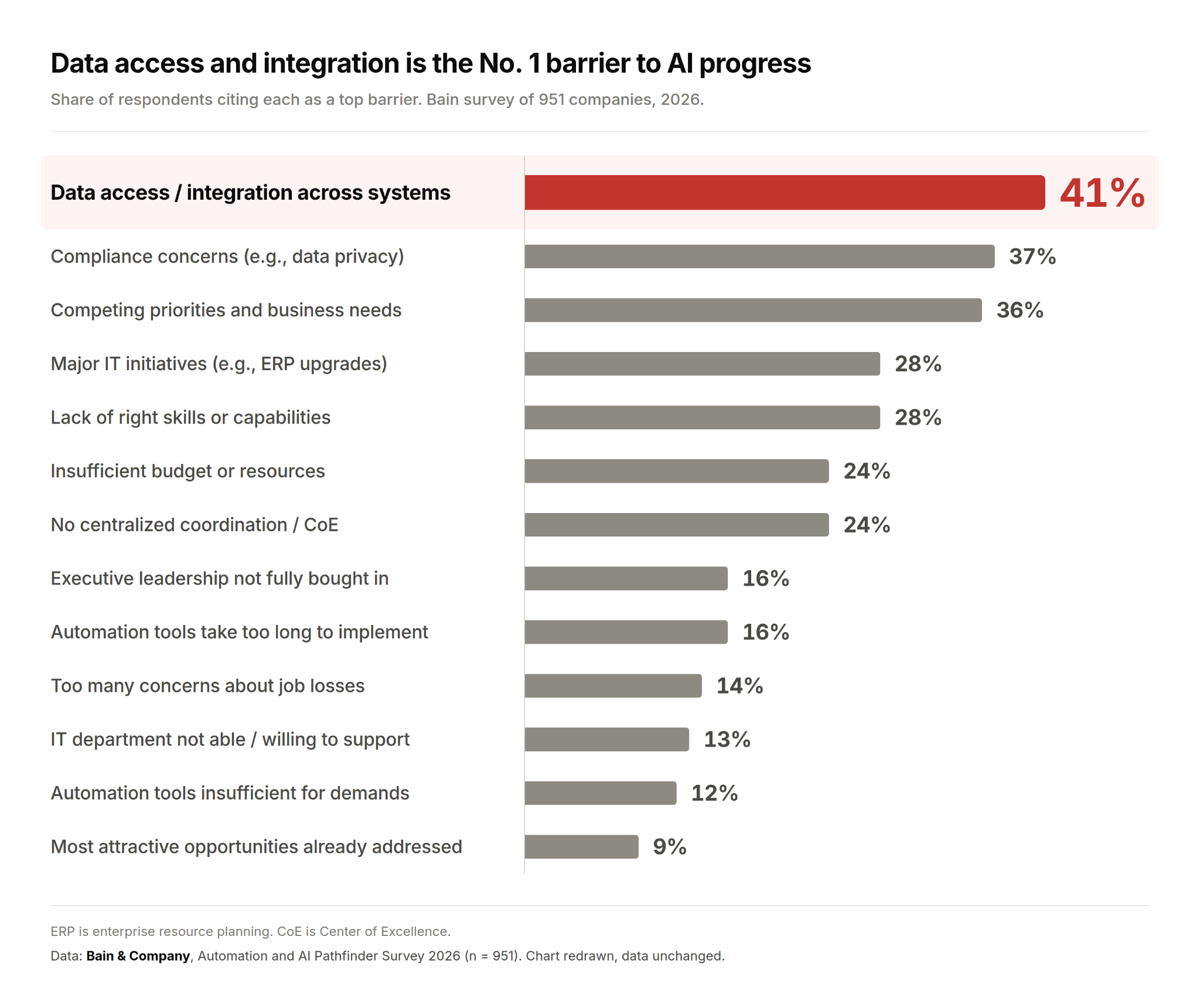
AI cost management means budgeting integration as its own line item, sized to the number and age of the systems involved rather than folded into the AI development cost. It also means fixing the workflow first, because AI locks in a broken process and runs it faster. Once AI is connected, the next cost comes from proving it keeps performing.
Line Item 3: Evaluation Infrastructure
A pilot is evaluated once and passes. Production never stops being evaluated, and that is the third cost curve.
Evaluation infrastructure is the ongoing cost of proving AI still works: testing outputs, monitoring for drift, detecting failures, and retraining models after deployment. Real-world data gradually drifts away from what the model was tested on, and the decline is invisible until it starts affecting decisions.
That is why evaluation is becoming a tooled infrastructure rather than a one-time check. By 2028, 40% of organizations deploying AI are expected to adopt dedicated observability tools to monitor model performance, bias, and outputs. AI decisions are hard to explain, and failures can lead to financial loss, reputational damage, and regulatory scrutiny.
Evaluation belongs in the AI total cost of ownership as an operating cost, not a launch expense. Drift detection, retraining, and incident response continue for the life of the system, so AI cost management should price them as an annual commitment.
Line Item 4: Governance Staffing
Evaluation tells you when AI fails. Governance decides who answers for it, and that is the fourth cost curve. It covers the people who oversee AI once it's running, including model risk reviewers, compliance teams, auditors, and the leaders who decide what autonomous systems are allowed to do.
Many organizations treat AI cost governance as a policy exercise, but production AI requires continuous oversight, audit trails, and clear accountability. During a pilot, those costs stay mostly hidden and become visible only after AI is deployed at scale and begins handling real transactions.
Organizations are already responding. Among large enterprises, 76% now have a Chief AI Officer, up from 26% a year earlier. The role sets AI priorities, standards, and funding decisions, while business leaders remain accountable for outcomes.
Governance belongs in AI strategic cost management as part of the headcount plan, sized to the number and risk of deployed AI systems rather than treated as a fixed compliance cost. When an AI system makes a consequential wrong decision, who is accountable, and is that role already funded?
Line Item 5: Model-Migration Churn
The model you budget for often isn't the model you'll be running, and that is the last cost curve. Model-migration churn is the cost of changing models or running several at once.
Models aren't a setting. They're embedded in application logic, data pipelines, and prompt structures, so replacing one means rebuilding connections and rerunning tests, repeating part of the AI development cost each time.
Cost is usually what forces the decision. Open-weight models from Chinese developers now run 60% to 90% cheaper than leading US frontier models, and that is changing how organizations route AI workloads.
The share of tokens US companies send to Chinese models through OpenRouter has remained above 30% every week since February 2026 and peaked at 46%, compared with an average of 11% over the previous 12 months. Instead of relying on one provider, organizations increasingly route each task to the lowest-cost model that meets their quality requirements.
Changing the model call is the easy part. AI cost management treats model choice as replaceable from the start, budgeting for the integration, evaluation, and engineering needed to route, monitor, and manage multiple providers instead of assuming one model stays in place.
Together, these five line items show what a per-seat budget misses. Next, we’ll look at how two leading enterprises planned for some of these costs before scaling AI and what happened as a result.
How Did UnitedHealth Group Turn AI Governance Into a Staffed Function?
UnitedHealth Group, the largest US healthcare company by revenue, runs more than 1,000 AI use cases in production and employs more than 2,000 AI engineers. At that scale, a model that gets a decision wrong doesn't stay a technical problem. It becomes a claims problem, a regulatory problem, and a headline.
That risk became real in 2023. A class-action lawsuit alleged that nH Predict, a claims tool used in Medicare Advantage decisions, operated with a 90% error rate. UnitedHealth disputes that characterization, maintaining the tool supports decisions rather than makes them. Meanwhile, the company faced separate scrutiny from the Department of Justice over its Medicare billing practices.
The response was structural rather than procedural. UnitedHealth built a Responsible AI Program around an AI Review Board that brings together leaders from clinical care, ethics, business, analytics, technology, legal, compliance, regulatory affairs, and privacy. The board reviews AI systems for reliability, fairness, accountability, transparency, and privacy before deployment. The company also hired Michael Pencina from Duke University as Chief AI Scientist in October 2025.
"Responsible AI is a collective responsibility."
—Rahul Bhotika, Chief AI Officer, UnitedHealth Group
That structure now applies to every new deployment. Avery, its member-facing AI companion, launched in March 2026 to roughly 6.5 million employer-sponsored members, with expansion to 20.5 million planned by year-end. It cleared the AI Review Board before launch under the same responsible use policy that governs every model for safety, effectiveness, and bias.
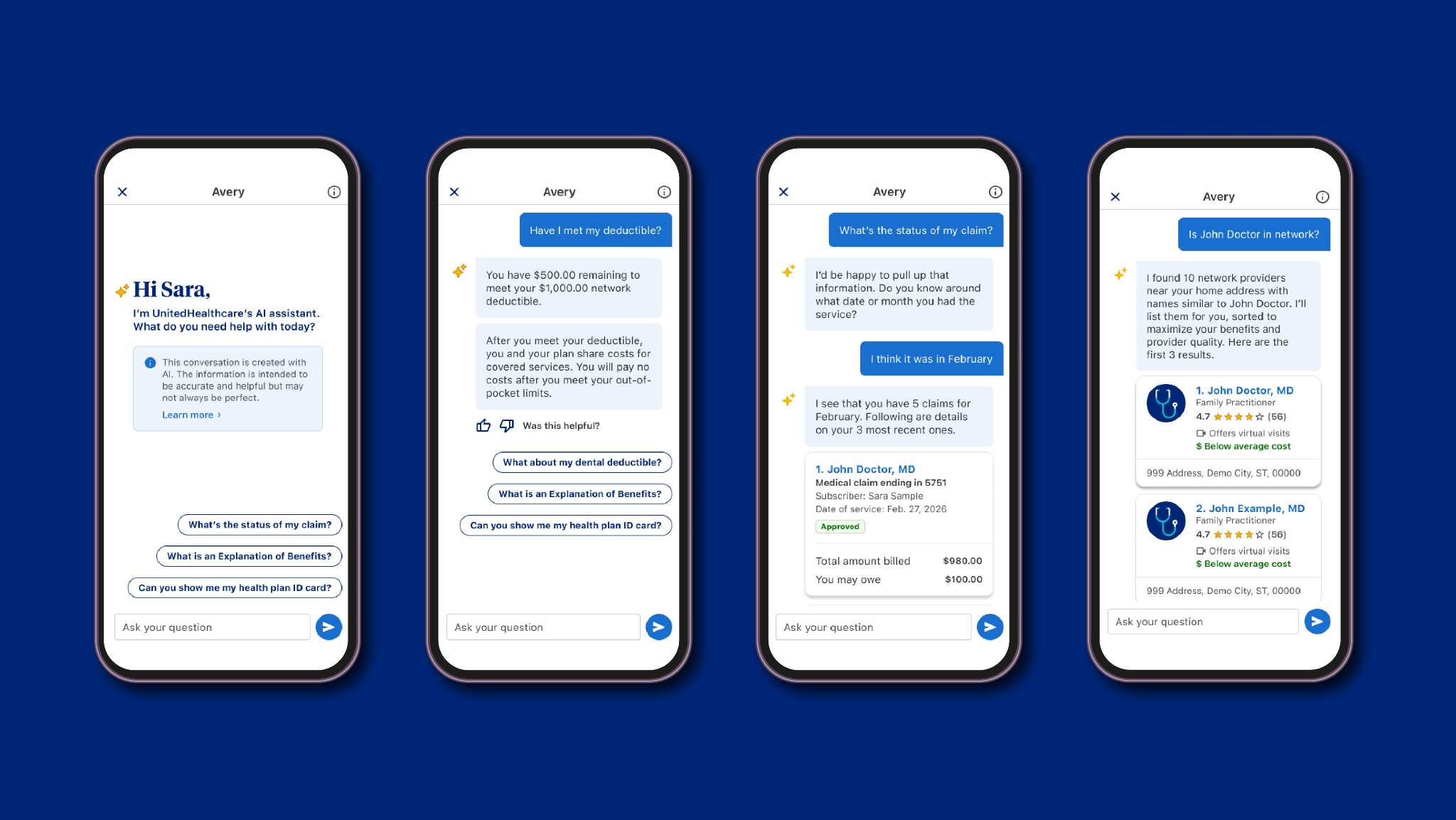
None of that oversight is free. Review boards, dedicated leadership, and ongoing review require people, making governance a recurring AI cost management expense. UnitedHealth added those costs as its AI program grew.
From 61,000 Data Pipelines to Enterprise AI at Commonwealth Bank
Commonwealth Bank of Australia, which serves more than 18 million customers and is among the largest corporate users of AI in the country, had that problem before it had an AI program. Its data sat across on-premises systems and legacy silos, limiting model development and real-time decision-making. The pattern is common across banking, where only 25% of global banks use AI strategically, and most stay stuck in siloed pilots.
That's why CBA fixed the foundation first. Between July 2024 and mid-2025, the bank migrated more than 61,000 data pipelines off on-premises systems with an external IT services partner, running in phases and validating every pipeline before declaring the platform ready.
"Having the right data foundations, built on advanced technology, enables CommBank to unleash its full potential with AI and agentic AI."
—Terri Sutherland, Lead for Data Platforms, Commonwealth Bank of Australia
That year of migration is what the AI program now runs on. CBA's data platform processes 157 billion data points each day, supports more than 2,000 AI models, and powers an automated engagement engine making roughly 55 million customer-level decisions daily.
Meanwhile, fraud models analyzing nearly 20 million transactions a day have contributed to a 30% reduction in fraud losses, and Project Coral, an agentic framework, scans codebases for technical debt and tests fixes across 7,800 engineers.
CBA didn't fold migration into its AI budget. It treated it as its own program, with dedicated funding, a separate timeline, vendor relationships, and success criteria before expanding AI. Integration belongs in the AI total cost of ownership from the start, which helps keep it from becoming a budget surprise later.
AI Cost Management Is Decided Before the Spending Starts
Uber's engineers didn't slow down, and the AI tool didn't break. AI cost management failed because the budget treated AI like a software license instead of a cost that scales with usage.
In a survey of 782 infrastructure and operations leaders, only 28% of AI use cases fully met ROI expectations, and 20% failed outright, with returns depending less on the model than on how well AI was integrated, managed, and aligned with the business.
So the question for any leadership team finalizing a 2027 budget isn't whether the model is good enough. It's about whether AI's total cost of ownership has been planned across consumption, integration, evaluation, governance, and model changes, or whether those costs are still buried in a budget built for software licenses.
.avif)
Frequent Asked Questions
Why do AI costs increase after deployment instead of leveling off?
Because everything that drives AI cost scales after launch. Agentic systems consume 5 to 30 times more tokens per task than a standard chatbot, and governance becomes recurring headcount, with 76% of large enterprises now employing a Chief AI Officer.
What is AI for cost estimating?
AI for cost estimating means using AI to forecast and monitor spend, including AI's own. At one large healthcare enterprise, token usage grew 8% to 10% a month and added more than $6 million in annualized costs before finance saw what was driving it.
What is the cost of AI development?
Building or fine-tuning a model is a one-time expense. Connecting it to the systems where work happens is not. Of organizations that evaluated AI tools, 60% completed an evaluation, 20% reached a pilot, and 5% reached production, stalling on brittle workflows rather than model quality.
How much does it cost to own an AI?
The purchase price is the smallest part. AI total cost of ownership is dominated by what it costs to run after launch: continuous inference, monitoring for drift, retraining, integration work, and the staff who govern it. Integration alone is the biggest barrier to AI progress, cited by 41% of companies.
What is the role of AI in budgeting?
Traditional budgets extrapolate license spend and treat cost as linear, while AI spend is usage-based. More than 40% of agentic AI projects are expected to be canceled by the end of 2027, with escalating costs among the causes. Sound AI budget planning prices each cost category as its own line, sized to usage rather than headcount.
What is cost management in artificial intelligence?
AI cost management is forecasting and controlling what AI costs to run, not just what it costs to license, because AI spend scales with usage rather than headcount. A basic chatbot user consumes around 9.4 million tokens a year, while someone running autonomous agents can reach 356 million on an identical license.


.svg)


_0000_Layer-2.png)

