
Red Teams: Inside the Framework That Helps CEOs Disrupt Their Own Companies
AI disruption is accelerating faster than corporate decision cycles. Learn how red teams help organizations drive business innovation by reinventing processes before competitors force change.
AI disruption is outpacing corporate planning cycles, and 77% of CEOs expect major changes within five years, yet many companies still prioritize the present.
Companies rarely fail from a lack of business innovation. They fail because internal systems block teams from challenging profitable business models while they still work
Red teams give organizations the authority and speed to spot disruption early, test new ideas quickly, and reinvent the core business before competitors force change.
A red team business strategy is a method of using critical and contrarian thinking to challenge an organization's plans and assumptions by simulating an adversary's perspective to uncover weaknesses. Put simply, a red team exists to ask the uncomfortable question: what would break our business if we don’t break it first?
It’s an uncomfortable question - but a necessary one. Some of the most durable companies in the world have survived by institutionalizing it early, long before the market forced their hand.
In 2006, Amazon was already a powerhouse. The company had crossed $10.7 billion in annual revenue, and much of that success still came from the business that started it all: books. It was profitable, familiar, and deeply tied to Amazon’s identity. For most leaders, this would have been the moment to protect what was working, not question it.
But Jeff Bezos was asking a more complex question - one many executives avoid when the numbers look good: what happens when the thing that made us successful becomes the thing that holds us back?
That question sits at the heart of business innovation. What is business innovation? It’s the ability to create new value, new products, services, or business models, before the market forces the change.
This is the same question modern leadership teams must confront today. And increasingly, they’re turning to red teams to do it. A red team is a small, cross-functional group empowered to challenge assumptions, pressure-test strategy, and expose blind spots - before competitors or disruption do it for you.
Bezos believed that books would eventually move into electronic formats - a shift he felt Amazon needed to lead rather than react to. To prepare for that future, the company quietly established Lab126 in 2004 in Palo Alto, a semi-autonomous skunkworks built to innovate free from the constraints of Amazon’s core business. Even the name, inspired by the first and twenty-sixth letters of the alphabet, was a nod to Amazon’s ambition to offer every book from A to Z.
To spearhead the effort, Bezos pulled Steve Kessel out of Amazon’s traditional media division and handed him a mandate that bordered on self-sabotage: build the device that could eventually disrupt Amazon’s own book business.
“Your job is to kill your own business. I want you to proceed as if your goal is to put everyone selling physical books out of a job.”
— Jeff Bezos
Inside Lab126, Kessel and a small team began working on Amazon’s first dedicated reading device - hardware that Amazon had never attempted before. The effort created immediate tension within the company.
Senior leaders, including Jeff Wilke and Diego Piacentini, pushed back, arguing that building devices was far outside Amazon’s core capabilities. Wilke, who had deep experience in manufacturing, cautioned that moving into hardware would bring inventory exposure, operational complexity, and the risk of costly missteps.
Bezos acknowledged the concerns but refused to slow down. As he told the team, “You are basically already late.”
When the Kindle debuted in 2007, it sold out within hours and redefined an industry.
Today, enterprises are facing their own Kindle moment. AI is shifting where value is created, and companies must be willing to challenge what still works. For example, Generative AI usage nearly doubled over just 10 months in 2024 - an adoption curve that’s moving far faster than most organizations can respond.
Red teams help leaders respond to this acceleration by challenging assumptions before AI disruption forces the change. These small, cross-functional groups are empowered to pressure-test strategy, expose blind spots, and rethink core business models while the company is still ahead - not after it has fallen behind.
In this article, we’ll show how red teams help leaders accelerate business innovation by challenging what still works today before AI disruption forces the change.
The Real Threat to Business Innovation: Protecting What Still Works
Amazon acted while its core business was thriving - but that was only possible because Amazon never believed its destiny was to be the world’s largest bookseller. Books were a means to an end, not the end itself. That mindset allowed Bezos to challenge the very business that was generating billions in revenue and pursue a future that didn’t yet make financial sense.
Most companies don’t operate this way. When results look good, leaders wait for certainty - and by the time it arrives, the window to act is gone. That hesitation persists even though 77% of CEOs expect AI to reshape their business within five years.
For instance, Google’s current strategy shows why companies can’t afford to wait. Google’s mission has never been “to run the world’s most profitable search engine” - it has been to organize the world’s information and make it universally accessible and useful. Search was simply the best vehicle for that mission for two decades.
But with the rise of Generative AI, the way people access information is changing. Google’s own AI Overviews have already reduced clicks to top-ranked pages by as much as 79%. Rather than protect the old model, Google is choosing to disrupt its core product because it understands a fundamental truth: if it doesn’t reinvent how people find information, someone else will.
This tension is not new. Kodak built the first digital camera prototype in 1975, yet decades later failed to pivot its business fast enough and ultimately filed for bankruptcy protection in 2012.
Blockbuster faced a similar fate. In 2000, the company declined an opportunity to acquire Netflix for about $50 million, believing streaming was too small to matter. Within a decade, Blockbuster was closing stores as digital distribution transformed the industry. These companies saw the future, but they couldn’t act on it while their existing business models still looked successful.
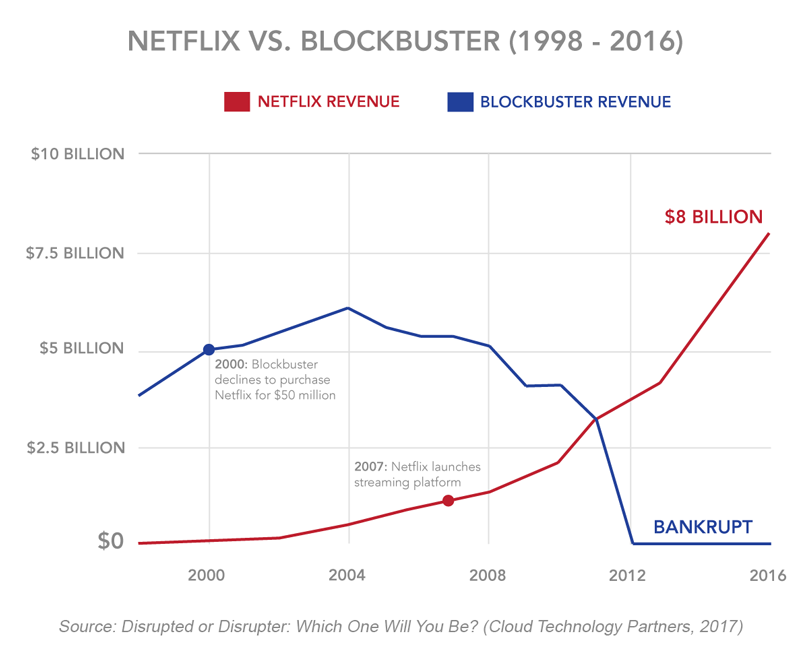
Today, that hesitation is far more dangerous because AI adoption is accelerating faster than most organizations can respond. In 2024, the use of generative AI nearly doubled over 10 months, and 68% of small businesses reported integrating AI into daily operations, with clear productivity gains. The market is moving whether companies are ready or not.
So the real question is no longer whether AI will disrupt your business, but whether you will lead that disruption or be forced to follow it. Technology isn’t the obstacle. Vision isn’t the obstacle. The real barrier is the willingness to challenge what still works to protect what comes next.
“If you don’t cannibalize yourself, someone else will.”
- Steve Jobs, Apple’s Co-founder
The companies that will survive AI disruption are the ones that act on this truth while they still have the advantage.
The Four Traps That Kill Disruptive Innovation
Organizations rarely fail because they lack innovation. They fail because the systems designed to protect current success often prevent necessary change. Clayton Christensen, the Harvard professor who introduced the concept of disruptive innovation, noted that effective managers are trained to optimize today’s business, prioritize top customers, and defend established margins.

These behaviors are rational and rewarded, yet they make self-disruption, and the exponential growth that can come with it, extremely difficult.
“The forces that make you successful are often the same ones that make you vulnerable.”
- Clayton Christensen
Here’s an overview of the four organizational barriers that consistently kill disruptive innovation:
- The ROI Trap: Disruptive ideas rarely deliver early returns, so they look irresponsible next to proven revenue streams. For instance, Blockbuster’s late fees generated $800 million annually, making streaming appear unprofitable. Its then-CEO reportedly dismissed the online threat, saying, “The dot-com hysteria is completely overblown.”
- The Customer Loyalty Trap: Your most valuable customers often oppose what threatens their own success. Kodak’s photo retailers earned their margins from film and processing. When asked what they wanted, they demanded “better film”, not the digital future that would eventually replace them.
- The Resource Allocation Trap: Most budgets overwhelmingly protect the core business. About 80% of funding goes to existing operations, around 5% to adjacent opportunities, and only a small fraction, if anything, to disruptive innovation. The future is structurally underfunded.
- The Career Risk Trap: Managers are penalized more for failed bets than for missed opportunities. As a result, 45% of employee time still goes to repetitive tasks that AI could automate, because redesigning work threatens roles, reporting lines, and established routines.
Together, these forces create a single reality: you can’t expect the people who built the castle to volunteer to burn it down.
How Red Teams Unlock the Future While the Present Still Works
Red teams help organizations innovate faster by giving people explicit permission to challenge the current business before the market does. Instead of waiting for disruption to appear in declining revenue, Red teams identify emerging threats early, test new models quickly, and recommend decisive action while the core is still performing.
Amazon’s Kindle is a clear example. A small, empowered team had the authority to explore a future that didn’t yet make financial sense, ultimately protecting and expanding Amazon’s business.
Next, let’s take a look at the four components that make the red team framework effective.
1. Organizational Design
A Red Team only works if it is structured intentionally. The team is intentionally small, typically 5 to 12 people, and reports directly to the CEO, so its work can’t be slowed or filtered through traditional approvals. Its mission is direct: make the current business obsolete before someone else does. This is the core of effective AI red teaming as a corporate innovation strategy.
An interesting example of this structure comes from Apple during the early 2000s. Even as the iPod dominated Apple’s revenue, executives recognized that mobile phones would eventually overtake standalone music players. Instead of protecting the iPod, Apple created a small, secret team known as Project Purple, operating completely outside the company’s normal processes.
Engineers later recalled that “nobody in the company knew we were working on a phone.” The group explored multiple competing prototypes and was explicitly tasked with building the device that might one day replace Apple’s most successful product. That protected autonomy - small team, isolation, and direct executive sponsorship - ultimately made the iPhone possible.
Red teams follow the same principle. They blend operators grounded in today’s business with forward-looking technologists who can spot the next wave of disruption: a Disruption Lead to drive direction, an AI or Technology Provocateur to track external risks, a Business Model Designer to rethink revenue streams, a Customer Anthropologist to uncover unmet needs, and a Financial Architect to map the cost and impact of disruption.
Also, red team members keep their core jobs but dedicate a meaningful share of their time to red team work. Companies like Google have long shown the value of this model - its well-known “20% time” created products like Gmail and AdSense by giving employees protected space to explore ideas beyond their day-to-day responsibilities. Red teams use a similar approach: enough separation to innovate boldly, enough connection to stay grounded in operational reality.
2. Budget and Authority
A red team can’t challenge the core business unless it has both resources and the authority to use them. That starts with protected funding. At least 2% of R&D should be allocated, with 3% to 5% recommended for companies serious about avoiding AI disruption.
Top innovators follow similar patterns. McKinsey’s 2023 research found that leading organizations reinvest 1.5 to 3 times more of their R&D budgets into long-term bets than average performers.
Innovation groups without decision rights rarely survive budget cycles; success depends on giving them the authority to test ideas that may disrupt existing revenue streams. That’s why clear thresholds matter: the red team decides on initiatives under $5M, the CEO approves those between $5M and $25M, and anything above $25M moves to the board.
3. Operating Rhythm
According to McKinsey, traditional budgeting, planning, and performance management cycles are too slow for AI-first workflows. The rise of agentic AI widens that gap: companies are moving from tools that assist tasks to fleets of agents that automate end-to-end workflows, collapsing work into faster, parallel execution. In other words, AI disruption now lands before it shows up in metrics - so red teams need shorter cycles to surface risks early and steer strategy ahead of the curve.
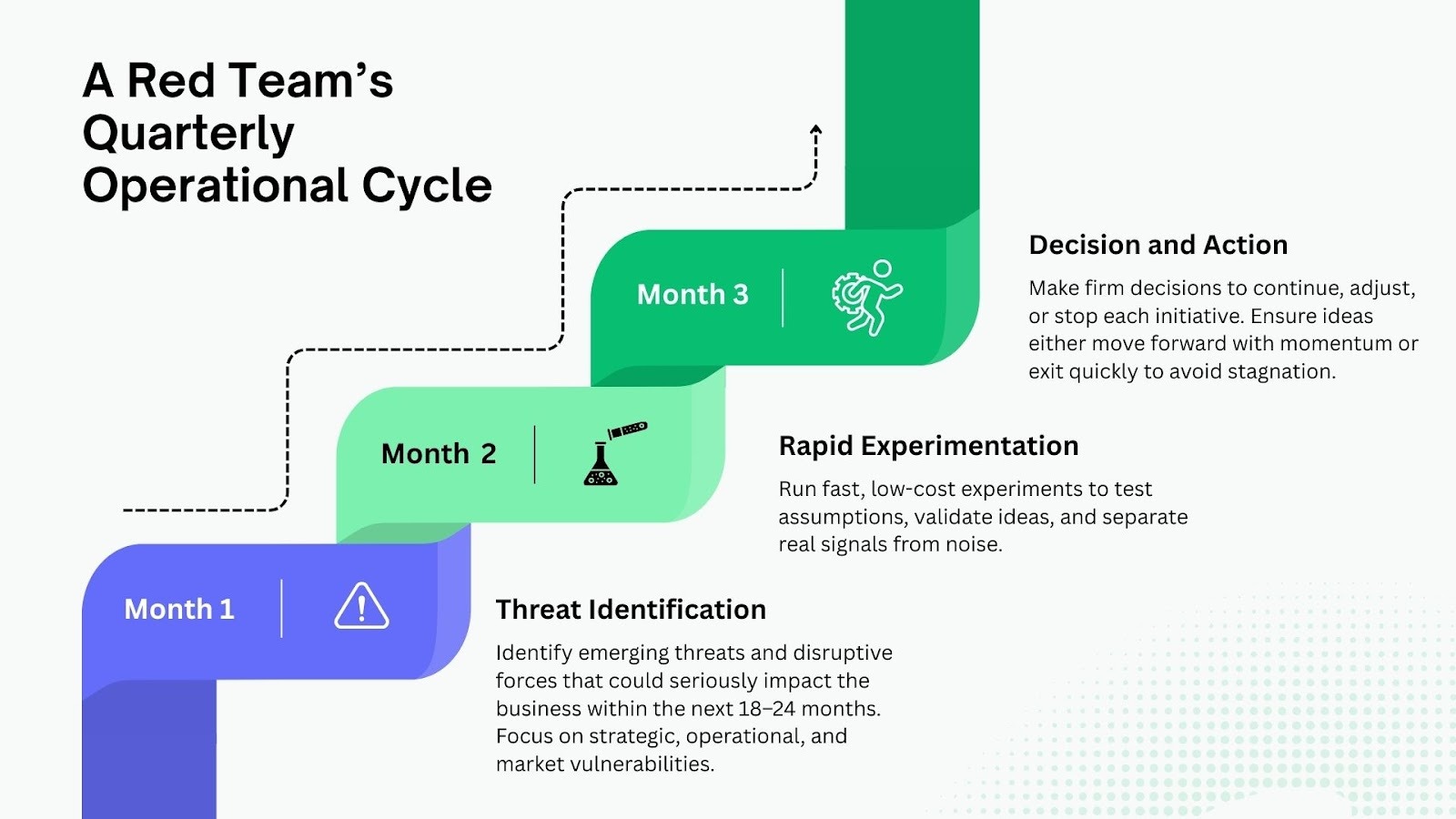
For example, if a red team operates on a quarterly cycle, it might look something like this:
- Month 1: Identify threats that could seriously impact the business within 18 to 24 months.
- Month 2: Run rapid experiments to test ideas and separate real signals from noise.
- Month 3: Make firm decisions, either continue, adjust, or stop each initiative, so ideas move forward or exit quickly instead of stalling.
To maintain alignment, leaders receive ongoing updates. Every month, the red team delivers an assassination brief outlining the most urgent threats, the evidence gathered, and recommended actions - giving executives early visibility into risks before they become financial problems.
Once a year, the team presents a board-level update such as “Five Ways We Almost Died - and What We Did About It.” The purpose is simple: reinforce accountability, urgency, and the need to address disruption while the company still holds a strong market position.
4. Governance
Governance ensures a red team’s work translates into real business change rather than becoming another business innovation exercise that never leaves the slide deck. When a disruptive threat becomes credible, leaders must decide how it will live inside the company - integrated into the core business, run in parallel as a separate unit, or spun out entirely.
Clear decision rights also prevent momentum from stalling: issues under $10 million are resolved by the CEO within a week. In contrast, larger decisions are referred to a board committee with a 30-day deadline.
Most importantly, every red team recommendation must trigger action: stop the initiative with rationale, continue with resources, or move directly into implementation. One principle guides every decision: when the present and the future conflict, choose the future.
Red Teams in Action: Stories of Kill or Scale Decisions
Red teams aren’t theoretical - they’ve been used in real companies to spot disruption early and build future growth engines alongside the core. Here are a couple of well-known examples showing how the red team framework works across industries:
- Netflix: Before streaming, Netflix operated as a DVD-by-mail rental service: customers chose titles on its website, Netflix shipped physical DVDs to their homes, and users mailed them back when they were done, with the next disc in their queue sent automatically. Even though this model was still profitable, Netflix launched streaming in 2007 as a side feature and then steadily shifted investment, talent, and customer habits toward it as broadband improved. That move intentionally cannibalized the DVD engine, but it allowed Netflix to lead the industry’s shift to digital distribution, and later add a second disruptive wave through original content, before competitors could force the transition.
- Adobe: Adobe’s core business was selling Creative Suite as boxed software with perpetual licenses, making money through large upgrade releases every 18–24 months. Creative Suite was Adobe’s all-in-one bundle of pro tools, like Photoshop, Illustrator, InDesign, and Premiere, sold as a one-time purchase that customers “owned” until they paid again for the next version. Even while this model was still highly profitable, Adobe launched Creative Cloud in 2012 and then ended new perpetual Creative Suite sales in 2013, shifting customers to a subscription bundle delivered through the cloud with continuous updates. The move intentionally cannibalized the old upgrade cycle and sparked short-term backlash, but it positioned Adobe for recurring revenue and always-current, cloud-based creative workflows before the market could force that transition.
Your Kindle Moment Is Here: Will You Act Before It’s Too Late?
Amazon’s Kindle story shows that the most successful companies don’t wait for disruption - they challenge themselves while the business is still strong. Amazon risked short-term revenue to secure long-term relevance, choosing to shape the future of reading rather than react to it.
The companies that fail in moments of transformation share a familiar pattern: they wait too long to question what is already working. They see the threat, they have the resources, but no one has permission to ask, “What if our best product becomes our biggest liability?”
Someone inside your organization already understands how AI disruption could weaken your core business. They see the risks and the opportunities - but they stay quiet because raising them feels like career risk. There is no budget to cannibalize profitable revenue. Leadership continues to reward the present instead of inventing what comes next.
Your Kindle moment is happening now across every industry AI touches. The question is no longer whether disruption will arrive. It already has. The real question is this: Who inside your company has permission to challenge the business that still looks successful today - before someone outside the company forces you to?
.avif)


.svg)


_0000_Layer-2.png)

