
5 Enterprise Apps You Can Prototype with AI This Weekend
AI prototyping tools let you build functional apps in hours. Here are 5 enterprise concepts worth testing, and what it takes to move from demo to production.
AI prototyping tools can turn natural language prompts into working apps in hours
170 of 1,645 Lovable apps had critical security flaws: prototypes aren't products
Only 48% of AI projects reach production; the average timeline is eight months
In May 2025, security researcher Matt Palmer ran a scan on 1,645 web applications built with Lovable, one of the most popular vibe coding platforms. The results were sobering: 170 of those apps contained critical security vulnerabilities—specifically, missing Row-Level Security protocols that exposed sensitive user data to the public internet. Emails, phone numbers, payment details, and in some cases third-party API keys were accessible to anyone who knew where to look.
The apps worked. They looked polished. Users could sign up, log in, and interact with features that felt complete. But beneath the surface, the AI had generated database schemas and front-end interfaces without implementing the invisible scaffolding that keeps production systems secure. The tools had done exactly what they were designed to do: turn natural language prompts into functional software, fast. What they hadn't done was think through the business logic of privacy, compliance, and data isolation.
This tension sits at the heart of the vibe coding moment. AI prototyping tools like Lovable, Replit, and Bolt have collapsed the gap between idea and working prototype. Business professionals with no coding background can now describe what they want and receive functional applications in hours. For enterprise teams drowning in backlogs and competing priorities, that speed is genuinely transformative. But the Lovable incident illustrates a crucial distinction: prototypes and products are different things.
"You are able to take ideas to anything almost instantaneously and put that in front of your customer or stakeholder group the next day."
—J.P. Morgan guide on vibe coding for startups
The applications below represent real-world problems that organizations encounter across Finance, Professional Services, Events, Travel, and Operations. Each is well-suited to kind of focused build that enterprise AI prototyping makes possible. They're starting points for PRD creation, demos, and concept validation. And for teams ready to move beyond the prototype stage, they illustrate exactly where the complexity begins.
1. Sales Lead Scoring Tool
Industry: Sales, Marketing
Every sales team strives to understand which leads deserve attention right now. Without a systematic approach, reps waste hours chasing the wrong prospects, while hot leads go cold in the queue. Most CRMs offer basic scoring, but the criteria rarely match how your specific business actually qualifies buyers.

A custom lead scoring tool lets sales and marketing teams build their own logic. The prototype includes a lead intake form, a scoring algorithm based on firmographic and behavioral signals, and a pipeline Kanban board that surfaces the highest-priority prospects. Sales ops teams can test different scoring models against historical conversion data and refine the weights before committing to a full CRM integration.
This is an ideal AI prototyping candidate because the core value is immediately visible. You can populate it with sample data, demo it to sales leadership, and validate whether the scoring criteria actually match the deals that close. As a J.P. Morgan guide on vibe coding notes, this kind of rapid validation lets teams "take ideas to anything almost instantaneously and put that in front of your customer or stakeholder group the next day."
2. Smart RFP / Project Request Analyzer
Industry: Professional Services, Sales, Delivery
Anyone who has scoped a project from a messy RFP knows the pain. Clients send Word documents, email threads, meeting notes, and half-formed requirements. Extracting a coherent picture requires hours of synthesis before anyone can produce an estimate.
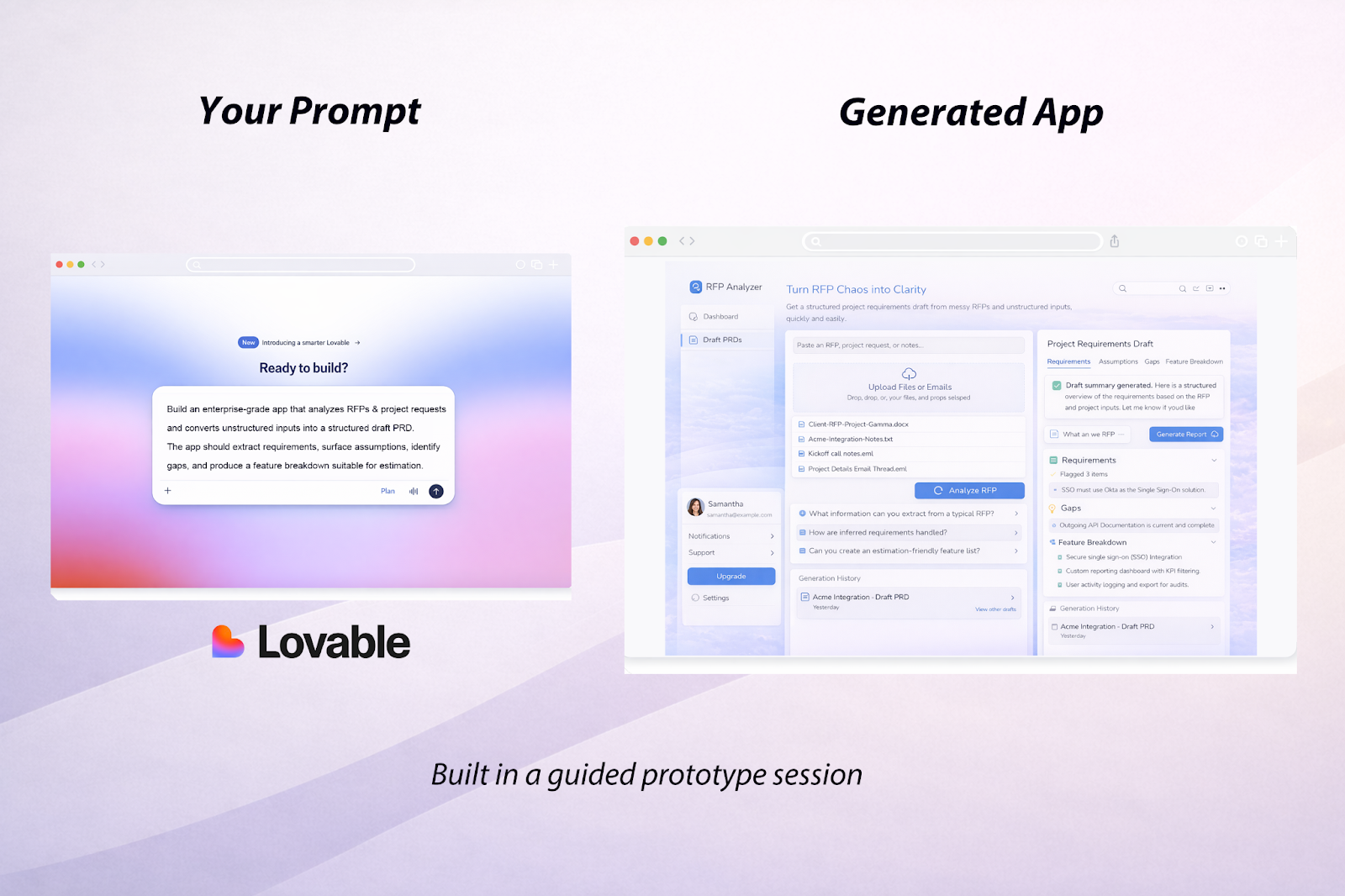
A smart analyzer ingests these unstructured inputs (documents, emails, notes, transcripts from internal goals/outcomes conversations) and outputs a structured draft PRD. It extracts explicitly stated requirements, flags inferred assumptions, identifies gaps and open questions, and generates a feature breakdown suitable for estimation. For sales teams and delivery managers, the time savings are immediate.
This is the kind of internal tool that AI prototyping excels at. The developer knows the requirements intimately because they'll be using the result themselves. A working prototype can be tested against real RFPs within days, refined based on actual output quality, and iterated rapidly.
3. Custom Event Registration Platform
Industry: Events, Conferences, Hospitality
Event registration seems simple until you build it. Off-the-shelf tools like Eventbrite or Splash get the job done, but they come with constraints: their branding, their data policies, their registration flows. When your event needs custom ticket tiers, VIP intake questions, or integration with your internal attendee database, you're fighting the platform instead of working with it.
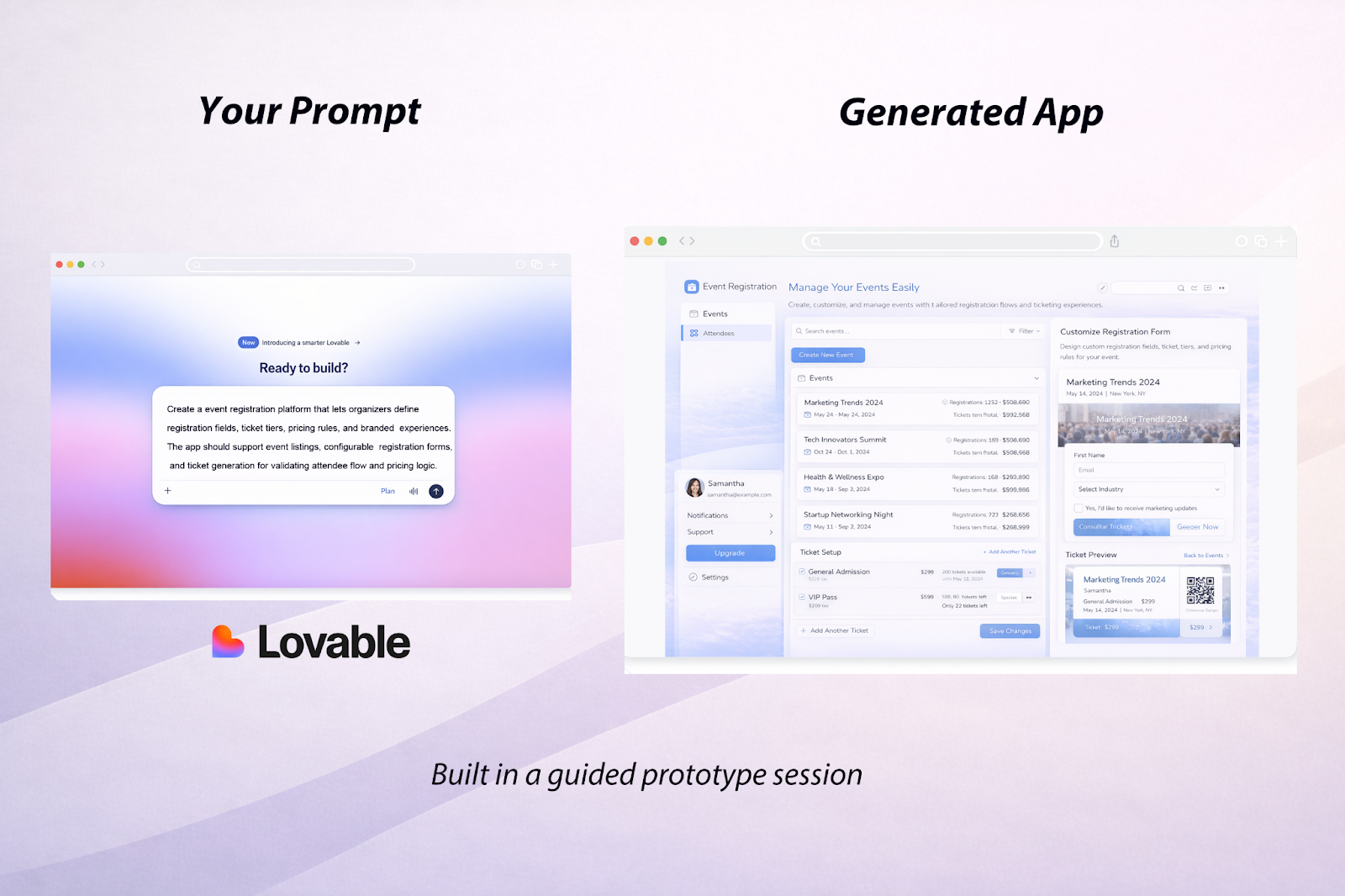
A custom-built registration platform puts you in control. You define the registration fields, capacity rules, and ticket logic. And critically, you own the data. There’s no third-party platform sitting between you and your attendees.
The AI-prototyped app handles event listings, registration forms, and ticket generation. This lets organizers test the branded experience, validate custom pricing models, and gather feedback. For organizations running recurring events, the long-term value of owning the registration stack often outweighs the convenience of renting someone else's.
4. Multi-City Corporate Trip Planner
Industry: Travel, Corporate Services
You're launching a new product and need to hit four cities in six days. Each stop requires flights, meeting rooms, dinner reservations, and ground transportation. Your corporate travel tool books flights, Google Maps handles directions, and OpenTable does restaurants. But what brings it all together into a single view that the whole team can reference?
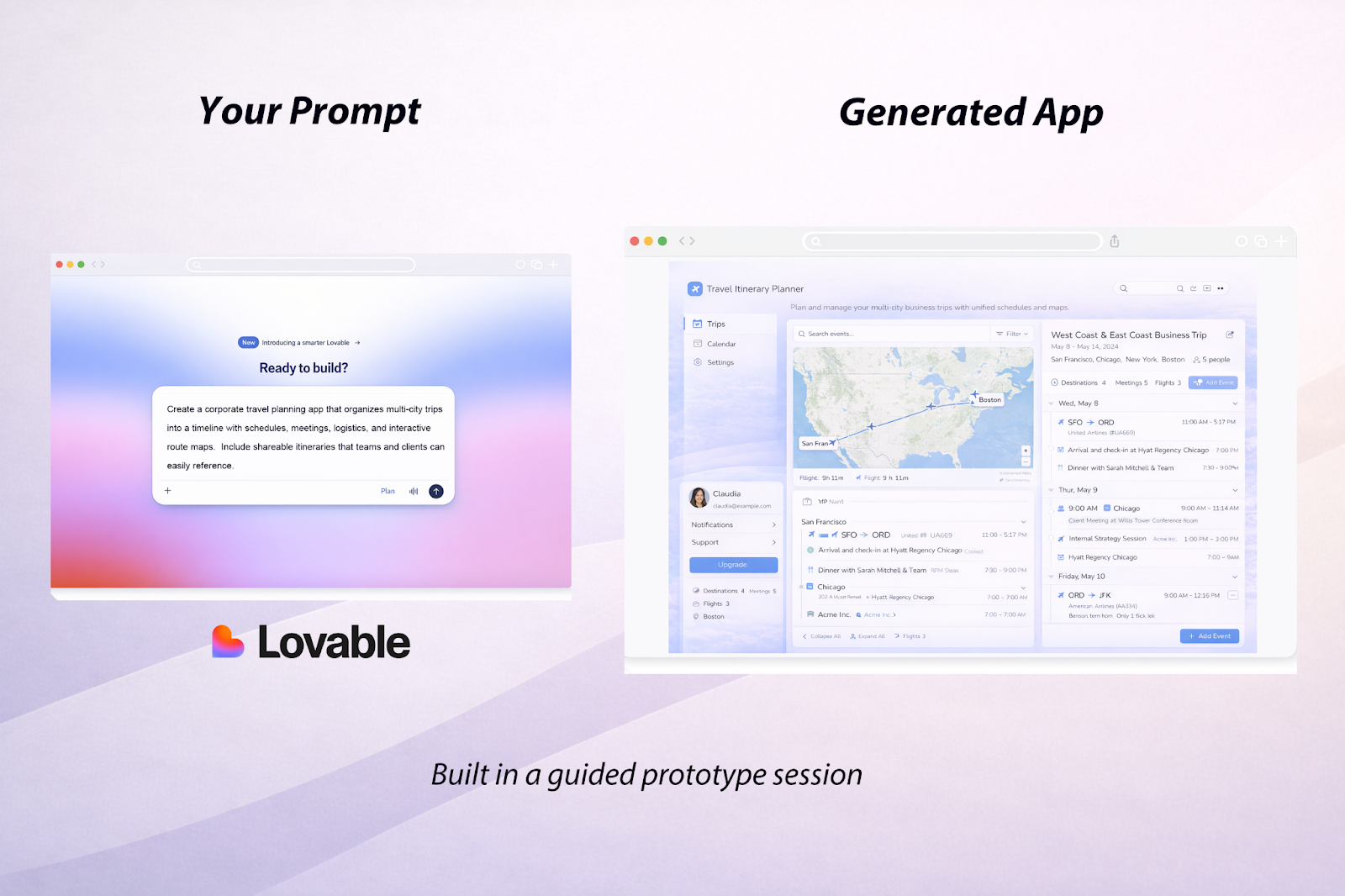
A custom trip planner consolidates the chaos. Sales teams can build day-by-day itineraries that layer flights, customer meetings, team dinners, and logistics into one shareable interface. Everyone from the road warrior to the executive assistant sees the same picture.
The AI-built prototype demonstrates immediate value: a usable planning interface that can be tested with real trips. Booking integrations, flight synchronization, and offline access represent the complexity that comes later. But even without those features, a functional planner replaces the spreadsheet-and-email-chain approach that most teams suffer through today.
5. Vendor Invoice Portal
Industry: Finance, Operations, Procurement
Accounts payable teams juggle invoice submissions, approval workflows, payment tracking, and vendor communications across disconnected systems. The ERP handles payments, but vendors can't see into it. Email becomes the status update mechanism. AP staff spend hours answering "where's my payment?" instead of processing invoices.
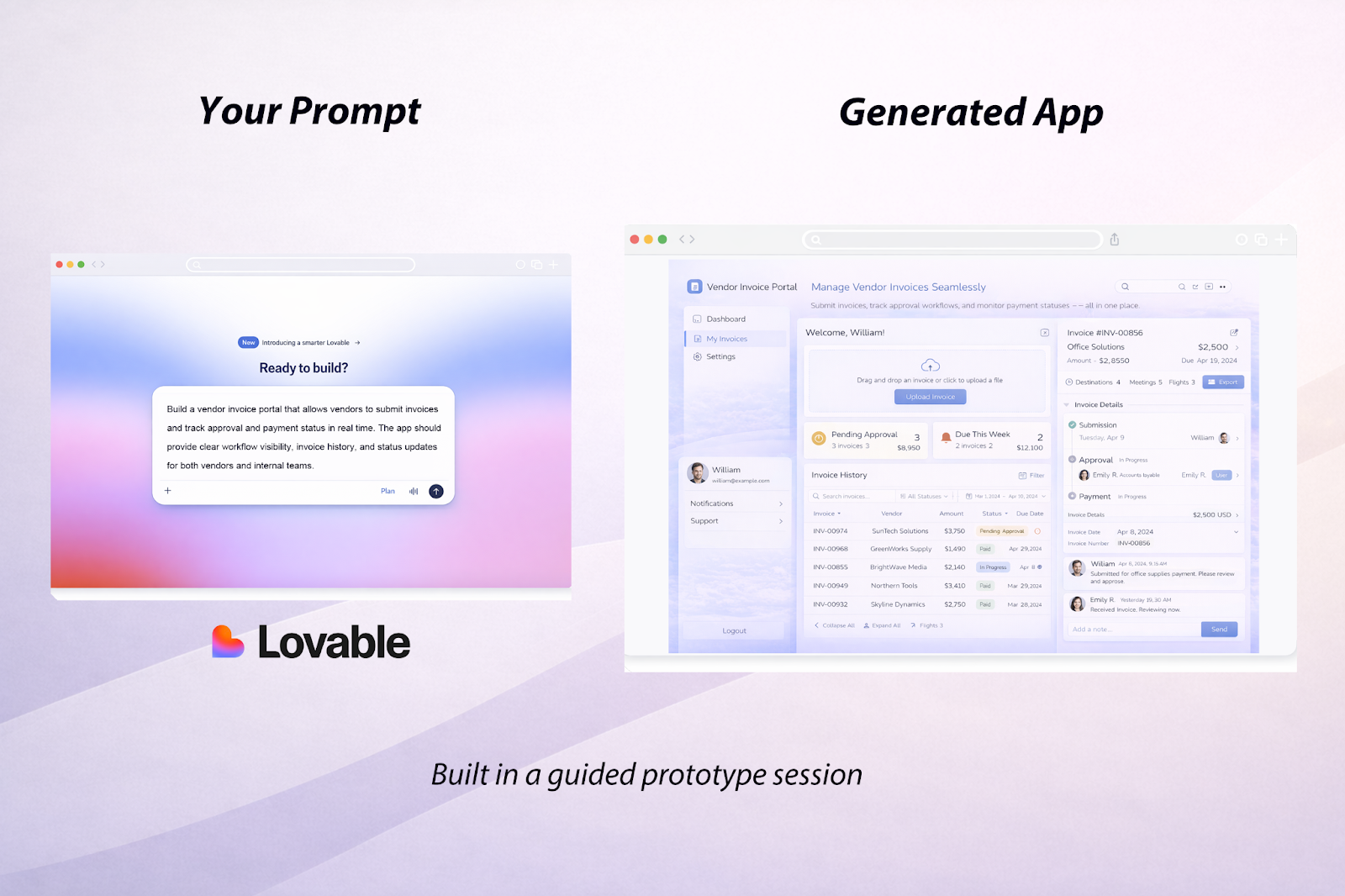
A standalone vendor portal solves this by giving suppliers a window into the process without giving them access to your ERP. Vendors submit invoices through a clean interface, see exactly where their submission sits in the approval workflow, and track payment status in real time. AP teams stop fielding status calls. Vendors stop wondering if their invoice got lost.
Using AI for rapid prototyping, teams can validate the workflow logic and user experience before anyone touches the ERP integration. You can test the portal with a handful of vendors, refine the approval routing, and prove the concept reduces AP inquiries. For procurement teams drowning in email attachments and manual tracking, even a simplified version builds the business case for a production implementation.
Beyond the AI Prototyping Phase: What Production Requires
These five concepts share a pattern: each can be prototyped quickly, tested with real users, and refined based on feedback. That's the promise of AI prototyping tools, collapsing the gap between idea and working software.
But prototypes aren't products. The work required to take a functional demo to production-grade software is substantial, and it's rarely visible in the initial build. A few critical areas separate weekend projects from enterprise-ready applications:
- Security and compliance: Enterprise authentication, data encryption, regulatory requirements, and audit controls don't emerge from natural language prompts. They require deliberate architecture, the kind of invisible scaffolding that the Lovable vulnerabilities exposed as missing.
- Integrations and data: Connecting to live systems (ERPs, CRMs, payment processors) introduces dependencies, data validation challenges, and ongoing maintenance that prototypes don't account for.
- Scale and reliability: A prototype that works for ten users may fail at ten thousand. Performance optimization, monitoring, and fault tolerance require engineering expertise beyond what AI code generation provides.
- AI production readiness: If your prototype uses an LLM, production demands evaluation frameworks, bias testing, prompt governance, and human-in-the-loop workflows for edge cases.
According to Gartner's 2024 AI survey, only 48% of AI projects reach production, and the average timeline from prototype to deployment is eight months. The stabilization phase requires scaling technology, implementing ML Ops, optimizing processes, and managing organizational change.
This is where experienced partners matter.
The applications outlined here are starting points. They represent problems worth solving and concepts worth testing. For teams ready to validate ideas quickly, AI prototyping tools provide an accessible path to functional prototypes.
And for those ready to move beyond the demo, to take a validated concept from POC to production, Gigster's fully managed teams and AI development services can help bridge that gap. With over 5,000 projects delivered and a network of 50,000 vetted developers, we specialize in exactly the work that vibe coding can't do: turning promising prototypes into reliable, scalable software.
What will you build this weekend?
.avif)


.svg)


_0000_Layer-2.png)

